



Typhlosynbranchus boueti Pellegrin, 1922
Liberian swamp eel
Envoyez vos Photos et vidéos
Images | Images Google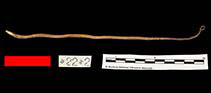 Typhlosynbranchus boueti
Photo de MNHN
Images | Images Google
Photo de MNHN
Classification / Noms Noms communs | Synonymes | Catalog of Fishes(Genre, Espèce) | ITIS | CoL | WoRMS | Cloffa
> Synbranchiformes (Spiny eels) > Synbranchidae (Swamp-eels)
Eponymy: Dr Georges Théodore Louis Bouët (1869–1957) was an army physician, ornithologist and colonial administrator, who served (1896–1900) in Sudan, Madagascar (1900–1904), Ivory Coast, Niger and Dahomey (Benin) (1906–1930). [...] (Ref. 128868), visit book page.
More on author: Pellegrin.
Eponymy: Dr Georges Théodore Louis Bouët (1869–1957) was an army physician, ornithologist and colonial administrator, who served (1896–1900) in Sudan, Madagascar (1900–1904), Ivory Coast, Niger and Dahomey (Benin) (1906–1930). [...] (Ref. 128868), visit book page.
More on author: Pellegrin.
Environnement : milieu / zone climatique / profondeur / gamme de distribution Écologie
; eau douce démersal. Tropical
Distribution Territoires | Zones FAO | Écosystèmes | Occurrences | Carte par point | Introductions | Faunafri
Africa: Sierra Leone and Monrovia, Liberia (Ref. 57291, 116049). Reported also from Côte d'Ivoire (Ref. 2828), but its identification is unclear as the specimen has clearly visible eyes (Ref. 116049).
Taille / Poids / Âge
Description synthétique Clés d'identification | Morphologie | Morphométrie
Diagnosis: body naked, slender, elongated and cylindrical, ending in a very tapering point; the caudal part of the body makes less than one third of the total length; no trace of paired or unpaired fins; eye atrophied, deep-set under skin, practically invisible from the outside; conical teeth on jaws and palate; gill opening minute, reduced to a median ovate pore, surrounded with longitudinal skin folds; 4 branchiostegal rays; 3 branchial arches without branchial lamellae; lateral line present; vertebral count: 140-144 abdominal and 39-45 caudal (Ref. 57291).
Colouration: uniformly dark (Ref. 57291).
Body shape (shape guide): eel-like.
Body shape (shape guide): eel-like.
Obligate air-breathing (Ref. 126274); Contrary to what is suggested by its morphology, this species is not cavernicolous; it burrows in mud, never very far from the sea (Ref. 57291). The male guards and builds nest or burrow (Ref. 205).
Cycle de vie et comportement reproducteur Maturité | Reproduction | Frai | Œufs | Fécondité | Larves
The male guards and builds nest or burrow (Ref. 205).
Référence principale
Téléchargez vos références | Références | Coordinateur : Fávorito, Sandra | Collaborateurs
Daget, J., 2003. Synbranchidae. p. 447-450 In C. Lévêque, D. Paugy and G.G. Teugels (eds.) Faune des poissons d'eaux douce et saumâtres de l'Afrique de l'Ouest, Tome 2. Coll. Faune et Flore tropicales 40. Musée Royal de l'Afrique Centrale, Tervuren, Belgique, Museum National d'Histoire Naturalle, Paris, France and Institut de Recherche pour le Développement, Paris, France. 815 p. (Ref. 57291)
Statut dans la liste rouge de l'IUCN (Ref. 130435: Version 2025-2 (Global))
Données manquantes (DD) ; Date assessed: 30 November 2019
CITES
Not Evaluated
Menace pour l'homme
Harmless
Utilisations par l'homme
FAO - Publication: search | FishSource |
Plus d'informations
Écologie trophique
Aliments (proies)
Composition du régime alimentaire
Consommation alimentaire
Rations alimentaires
Prédateurs
Aliments (proies)
Composition du régime alimentaire
Consommation alimentaire
Rations alimentaires
Prédateurs
Écologie
Écologie
Écologie
Dynamique des populations
Paramètres de croissance
Âges / tailles maximales
Longueur-poids rel.
Rel. longueur-longueur.
Fréquences de longueurs
Conversion de masse
Recrutement
Abondance
Paramètres de croissance
Âges / tailles maximales
Longueur-poids rel.
Rel. longueur-longueur.
Fréquences de longueurs
Conversion de masse
Recrutement
Abondance
Cycle de vie
Reproduction
Maturité
Maturité/épines rel.
Fécondité
Frai
Agrégats de frai
Œufs
Développement de l'œuf
Larves
Dynamique des populations larvaires
Reproduction
Maturité
Maturité/épines rel.
Fécondité
Frai
Agrégats de frai
Œufs
Développement de l'œuf
Larves
Dynamique des populations larvaires
Anatomie
Surface branchiale
Cerveau
Otolithe
Surface branchiale
Cerveau
Otolithe
Physiologie
Composition corporelle
Nutriments
Consommation d'oxygène
Type de natation
Vitesse de nage
Pigments visuels
Son de poisson
Maladies et parasites
Toxicité (CL50)
Composition corporelle
Nutriments
Consommation d'oxygène
Type de natation
Vitesse de nage
Pigments visuels
Son de poisson
Maladies et parasites
Toxicité (CL50)
Génétique
génôme
Génétique
Hétérozygotie
Héritabilité
Diversité génétique
génôme
Génétique
Hétérozygotie
Héritabilité
Diversité génétique
Liées à l'homme
Systèmes d'aquaculture
Profils d'aquaculture
Souches
Cas de ciguatera
Timbres, pièces de monnaie, divers
Systèmes d'aquaculture
Profils d'aquaculture
Souches
Cas de ciguatera
Timbres, pièces de monnaie, divers
Outils
E-book | Guide de terrain | Clés d'identification | Générateur de fréquences de longueur | Outil de dynamique de population | Carte par point |
Capture-MSY |
Articles particuliers
Télécharger en XML
Sources Internet
AFORO (otoliths) | Aquatic Commons | BHL | Cloffa | Websites from users | FishWatcher | CISTI | Catalog of Fishes: Genre, Espèce | DiscoverLife | ECOTOX | FAO - Publication: search | Faunafri | Fishipedia | Fishtrace | GloBI | Google Books | Google Scholar | Google | IGFA World Record | OneZoom | Open Tree of Life | Otolith Atlas of Taiwan Fishes | PubMed | Reef Life Survey | Socotra Atlas | TreeBase | Arbre de Vie | Wikipedia: aller à, chercher | World Records Freshwater Fishing | Zoobank | Zoological Record
Estimations basées sur des modèles
Indice de diversité phylogénétique (Réf. 82804): PD50 = 0.7500 [Uniqueness, from 0.5 = low to 2.0 = high].
Bayesian length-weight: a=0.00085 (0.00040 - 0.00182), b=3.09 (2.90 - 3.28), in cm total length, based on LWR estimates for this (Sub)family-body shape (Ref. 93245).
Niveau trophique (Réf. 69278): 3.2 ±0.3 se; based on size and trophs of closest relatives
Résilience (Réf. 120179): Milieu, temps minimum de doublement de population : 1,4 à 4,4 années (Preliminary K or Fecundity.).