



Pseudobarbus afer (Peters, 1864)
Eastern Cape redfin
Загрузить свой Фото и Видео
Изображение на Google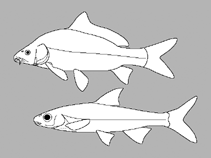 No image available for this species;
drawing shows typical species in Cyprinidae.
Изображение на Google
drawing shows typical species in Cyprinidae.
Классификация / Имена народные названия | синонимы | Catalog of Fishes(род, виды) | ITIS | CoL | WoRMS | Cloffa
> Cypriniformes (Carps) > Cyprinidae (Minnows or carps) > Smiliogastrinae
Etymology: Pseudobarbus: Greek, pseudes = false + Latin, barbus = barbel (Ref. 45335).
More on author: Peters.
Etymology: Pseudobarbus: Greek, pseudes = false + Latin, barbus = barbel (Ref. 45335).
More on author: Peters.
Окружающая среда: среда / климатическая зона / пределы глубины / диапазон распространения экология
; пресноводный демерсальный. Subtropical; 31°S - 35°S
распространение Территории | регионы FAO | Экосистемы | места находок | карта точек | интродукции | Faunafri
Africa: Sundays River, Swartkops River and Baakens River systems, which discharge into Algoa Bay, in South Africa (Ref. 114782).
Длина при первой зрелости / Размер / Вес / Возраст
половая зрелость: Lm 4.0, range 4 - 4 cm
Max length : 8.9 cm SL самец/пол неопределен; (Ref. 114782)
Max length : 8.9 cm SL самец/пол неопределен; (Ref. 114782)
Краткое описание определительные ключи | морфология | морфометрия
колючие лучи спинного плавника (общее число) : 0; членистые (мягкие) лучи спинного плавника (общее число) : 9 - 11; колючие лучи анального плавника: 0; членистые (мягкие) лучи анального плавника: 8 - 9; позвонки: 36 - 39. Diagnosis: Pseudobarbus afer differs from P. burchelli, P. burgi, P. skeltoni and P. verloreni by the possession of a single pair of oral barbels (Ref. 114782). The possession of fewer and larger scales separates P. afer, which has 29-35 scales along the lateral line, from P. quathlambae and P. asper, with respectively more than 60 and more than 35 scales along the lateral line (Ref. 114782). Lack of a mid-dorsal stripe and a relatively deeper head and body profile separates P. afer from the more slender bodied P. tenuis, head depth being 66.5-78.2% of head length vs. 61.1-71.2% and body depth being 22.5-31.6% of standard length vs. 18.8-26.8% (Ref. 114782). Lack of prominent black spots and patches on the body distinguishes P. afer from P. phlegethon (Ref. 114782). Pseudobarbus afer most closely resembles P. senticeps, P. swartzi and P. asper; barbel length and the number of scale rows along the lateral line separates P. afer from these three species; short barbels which do not reach the vertical through the posterior margin of the eye and a higher number of lateral line scales, 29-35, distinguishes P. afer from P. senticeps whose barbels reach or surpass the vertical through posterior edge of eye and has fewer and larger scales along lateral line, 25-30, and around caudal peduncle, 10-12; it further differs from P. senticeps by lack of a blotch of pigment at the base of the caudal fin, while the lateral stripe in P. senticeps terminates in a triangular blotch at the base of the caudal fin (Ref. 114782). Pseudobarbus afer differs from P. swartzi by possession of fewer scale rows along the lateral line, 29-35 vs. 34-37, and fewer scales around the caudal peduncle, 12-16 vs. 13-17; it has a distinct mesh-like pigmentation pattern below the lateral line which further separates this species from P. swartzi which lacks discernible pigmentation pattern on the latero-ventral scales (Ref. 114782). Pseudobarbus afer is separated from P. asper by the possession of fewer and larger scales, lateral line scale series 29-35 vs. 35-45 and caudal peduncle scale rows 12-16 vs. 16-22 (Ref. 114782).
Body shape (shape guide): fusiform / normal; Cross section: compressed.
Body shape (shape guide): fusiform / normal; Cross section: compressed.
This species refers clear rocky pools; fry and juveniles occur in large schoals, adults in small groups (Ref. 7248). Once common and widely distributed, but Pseudobarbus afer suffered severe decline in distribution and abundance, mainly due to the invasion by alien predators and competitors, deterioration of water quality and loss of critical habitat (Ref. 114782). Omnivorous, feeding mainly from the bottom on algae and small invertebrates (Ref. 7248). Breeds in summer, spawning in riffles above pools (Ref. 7248).
Жизненный цикл и брачное поведение половая зрелость | размножение | нерест | икра | Плодовитость | личинки
Основная ссылка
Загрузите свои рекомендации | ссылки | координатор | соавторы
Chakona, A. and P.H. Skelton, 2017. A review of the Pseudobarbus afer (Peters, 1864) species complex (Teleostei, Cyprinidae) in the eastern Cape Fold Ecoregion of South Africa. ZooKeys 657:109-140. (Ref. 114782)
Статус Красного Списка МСОП (Ref. 130435: Version 2025-2 (Global))
Под угрозой исчезновения (EN) (B1ab(ii,iii,v)+2ab(ii,iii,v)); Date assessed: 01 December 2016
CITES
Not Evaluated
Угроза для людей
Harmless
Использование человеком
аквариум: коммерческий
FAO - Publication: search | FishSource |
дополнительная информация
Трофическая экология
Пищевые предметы (добыча)
состав пищи
потребление пищи
Продовольственные пайки
хищники
Пищевые предметы (добыча)
состав пищи
потребление пищи
Продовольственные пайки
хищники
Динамика численности населения
Параметры роста
Макс. возраст / размер
Отношение длины к весу.
Отношение длины к длине.
Размерный состав
Преобразование массы
пополнение
численность
Параметры роста
Макс. возраст / размер
Отношение длины к весу.
Отношение длины к длине.
Размерный состав
Преобразование массы
пополнение
численность
Жизненный цикл
размножение
половая зрелость
Зрелость/Жиры относительно.
Плодовитость
нерест
Нерестовые скопления
икра
Развитие икры
личинки
динамика численности личинок
размножение
половая зрелость
Зрелость/Жиры относительно.
Плодовитость
нерест
Нерестовые скопления
икра
Развитие икры
личинки
динамика численности личинок
Анатомия
жаберная область
Мозг
Отолит
жаберная область
Мозг
Отолит
Физиология
Состав тела
Питательные вещества
Потребление кислорода
Тип плавания
Скорость плавания
Зрительные пигменты
Звук рыбы
Болезни и паразиты
Токсичность (LC50s)
Состав тела
Питательные вещества
Потребление кислорода
Тип плавания
Скорость плавания
Зрительные пигменты
Звук рыбы
Болезни и паразиты
Токсичность (LC50s)
Связанные с человеком
Системы аквакультуры
особенности рыбоводства
степень растяжения
Случаи заболевания сигуатерой
Марки, монеты и прочее.
Системы аквакультуры
особенности рыбоводства
степень растяжения
Случаи заболевания сигуатерой
Марки, монеты и прочее.
инструменты
Электронная книга | полевой определитель | определительные ключи | Длина-Частота | онтогенез | карта точек |
Catch-MSY |
Специальные отчеты
Проверить содержание в аквариумах | Проверить опубликованные видовые данные | Проверить опубликованные данные по аквакультуре
Скачать в формате XML
ресурсы в Интернет
AFORO (otoliths) | Aquatic Commons | BHL | Cloffa | Websites from users | Проверить FishWatcher | CISTI | Catalog of Fishes: род, виды | DiscoverLife | ECOTOX | FAO - Publication: search | Faunafri | Fishipedia | Fishtrace | GloBI | Google Books | Google Scholar | Google | IGFA World Record | OneZoom | Open Tree of Life | Otolith Atlas of Taiwan Fishes | PubMed | Reef Life Survey | Socotra Atlas | TreeBase | Tree of Life | Wikipedia: Вперёд, поиск | World Records Freshwater Fishing | Зоологическая летопись
Оценки, основанные на моделях
Индекс филогенетического разнообразия (ссылка 82804): PD50 = 0.5001 [Uniqueness, from 0.5 = low to 2.0 = high].
Bayesian length-weight: a=0.00603 (0.00282 - 0.01286), b=3.06 (2.87 - 3.25), in cm total length, based on LWR estimates for this (Sub)family-body shape (Ref. 93245).
Трофический уровень (ссылка 69278): 2.7 ±0.24 se; based on food items.
Generation time: 6.4 ( na - na) years. Estimated as median ln(3)/K based on 1 growth studies.
устойчивость к внешним воздействиям (ссылка 120179): средний (среднего размера), минимальное время удвоения популяции 1.4-4.4 года (K=0.17; tm=2; tmax=6).