



Squalius carolitertii (Doadrio, 1988)
Bordallo
Envoyez vos Photos et vidéos
Images | Images Google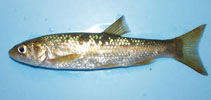 Squalius carolitertii
Photo de Ribeiro, F.
Images | Images Google
Photo de Ribeiro, F.
Classification / Noms Noms communs | Synonymes | Catalog of Fishes(Genre, Espèce) | ITIS | CoL | WoRMS | Cloffa
> Cypriniformes (Carps) > Leuciscidae (Minnows) > Leuciscinae
Eponymy: Carlos III (1716–1788) was King of Spain (1759–1788). The binomial is a Latinized version of ‘Carlos the third’. He founded the Museo Nacional de Ciencias Naturales, Madrid (1777) where the holotype of this species is housed. (Ref. 128868), visit book page.
Eponymy: Carlos III (1716–1788) was King of Spain (1759–1788). The binomial is a Latinized version of ‘Carlos the third’. He founded the Museo Nacional de Ciencias Naturales, Madrid (1777) where the holotype of this species is housed. (Ref. 128868), visit book page.
Environnement : milieu / zone climatique / profondeur / gamme de distribution Écologie
; eau douce benthopélagique; potamodrome (Ref. 138297). Subtropical; 44°N - 36°N
Distribution Territoires | Zones FAO | Écosystèmes | Occurrences | Carte par point | Introductions | Faunafri
Europe: Iberian Peninsula in Douro, Mondego, Umia, Limia, Tagus, Miño and Lérez drainages (Ref. 59043). Listed in the Spanish Red Data Book (Ref. 35754).
Taille / Poids / Âge
Maturité: Lm ? range ? - ? cm
Max length : 25.0 cm TL mâle / non sexé; (Ref. 35754); common length : 13.6 cm SL mâle / non sexé; (Ref. 28035)
Max length : 25.0 cm TL mâle / non sexé; (Ref. 35754); common length : 13.6 cm SL mâle / non sexé; (Ref. 28035)
Description synthétique Clés d'identification | Morphologie | Morphométrie
Épines dorsales (Total) : 3; Rayons mous dorsaux (Total) : 7 - 9; Épines anales: 3; Rayons mous anaux: 6 - 9; Vertèbres: 39 - 41. Mouth subterminal, snout rounded; head length about equal to maximum body depth; infraorbitals 4 and 5 expanded; communication preopercular-mandibular and infraorbital canals present; supraethmoid narrow and short (Ref. 28035). Diagnosed from its congeners in Iberian Peninsula by the following characters: scales on lateral line 39-44 + 2-3; 3-4½ scale rows between lateral line and pelvic fin origin; infraorbital bones narrow, width of infraorbitals 2 and 5 about 2 times width of sensory canal on same bones; snout rounded, mouth subterminal; and head length about equal to body depth (Ref. 59043).
Body shape (shape guide): fusiform / normal.
Body shape (shape guide): fusiform / normal.
Adults inhabit hill streams to middle stretches of rivers (Ref. 59043). They occur in rivers on the low plains and at high attitudes. Can withstand low levels of oxygen during summer. Juveniles are omnivorous whereas adults feed on arthropods and other animals (Ref. 35754). Reported to feed on fry of other fish species. Involved in the Iberocypris alburnoides hybrid complex (Ref. 59043). Threatened due to habitat destruction, pollution and the introduction of other species (Ref. 26100).
Cycle de vie et comportement reproducteur Maturité | Reproduction | Frai | Œufs | Fécondité | Larves
Interspecific hybridization occurs between males of L. carolitertii and females of L. alburnoides.
Référence principale
Téléchargez vos références | Références | Coordinateur | Collaborateurs
Carmona, J.A. and I. Doadrio, 2000. Threatened fishes of the world: Leuciscus carolitertii Doadrio, 1988 (Cyprinidae). Environ. Biol. Fishes 57(1):96. (Ref. 35754)
Statut dans la liste rouge de l'IUCN (Ref. 130435: Version 2025-2 (Global))
Quasi-menacé (NT) (A2ace); Date assessed: 09 December 2023
CITES
Not Evaluated
Menace pour l'homme
Harmless
Utilisations par l'homme
Pêcheries: sans intérêt
FAO - Publication: search | FishSource |
Plus d'informations
Écologie trophique
Aliments (proies)
Composition du régime alimentaire
Consommation alimentaire
Rations alimentaires
Prédateurs
Aliments (proies)
Composition du régime alimentaire
Consommation alimentaire
Rations alimentaires
Prédateurs
Dynamique des populations
Paramètres de croissance
Âges / tailles maximales
Longueur-poids rel.
Rel. longueur-longueur.
Fréquences de longueurs
Conversion de masse
Recrutement
Abondance
Paramètres de croissance
Âges / tailles maximales
Longueur-poids rel.
Rel. longueur-longueur.
Fréquences de longueurs
Conversion de masse
Recrutement
Abondance
Cycle de vie
Reproduction
Maturité
Maturité/épines rel.
Fécondité
Frai
Agrégats de frai
Œufs
Développement de l'œuf
Larves
Dynamique des populations larvaires
Reproduction
Maturité
Maturité/épines rel.
Fécondité
Frai
Agrégats de frai
Œufs
Développement de l'œuf
Larves
Dynamique des populations larvaires
Anatomie
Surface branchiale
Cerveau
Otolithe
Surface branchiale
Cerveau
Otolithe
Physiologie
Composition corporelle
Nutriments
Consommation d'oxygène
Type de natation
Vitesse de nage
Pigments visuels
Son de poisson
Maladies et parasites
Toxicité (CL50)
Composition corporelle
Nutriments
Consommation d'oxygène
Type de natation
Vitesse de nage
Pigments visuels
Son de poisson
Maladies et parasites
Toxicité (CL50)
Génétique
génôme
Génétique
Hétérozygotie
Héritabilité
Diversité génétique
génôme
Génétique
Hétérozygotie
Héritabilité
Diversité génétique
Liées à l'homme
Systèmes d'aquaculture
Profils d'aquaculture
Souches
Cas de ciguatera
Timbres, pièces de monnaie, divers
Systèmes d'aquaculture
Profils d'aquaculture
Souches
Cas de ciguatera
Timbres, pièces de monnaie, divers
Outils
E-book | Guide de terrain | Générateur de fréquences de longueur | Outil de dynamique de population | Carte par point |
Capture-MSY |
Articles particuliers
Télécharger en XML
Sources Internet
AFORO (otoliths) | Aquatic Commons | BHL | Cloffa | Websites from users | FishWatcher | CISTI | Catalog of Fishes: Genre, Espèce | DiscoverLife | ECOTOX | FAO - Publication: search | Faunafri | Fishipedia | Fishtrace | GloBI | Google Books | Google Scholar | Google | IGFA World Record | Bases de données nationales | OneZoom | Open Tree of Life | Otolith Atlas of Taiwan Fishes | PubMed | Reef Life Survey | Socotra Atlas | TreeBase | Arbre de Vie | Wikipedia: aller à, chercher | World Records Freshwater Fishing | Zoological Record
Estimations basées sur des modèles
Indice de diversité phylogénétique (Réf. 82804): PD50 = 0.5000 [Uniqueness, from 0.5 = low to 2.0 = high].
Bayesian length-weight: a=0.00776 (0.00505 - 0.01193), b=3.11 (2.98 - 3.24), in cm total length, based on LWR estimates for this species & Genus-body shape (Ref. 93245).
Niveau trophique (Réf. 69278): 3.4 ±0.38 se; based on food items.
Generation time: 12.2 ( na - na) years. Estimated as median ln(3)/K based on 1 growth studies.
Résilience (Réf. 120179): Très faible, temps minimum de doublement de population supérieur à 14 ans (Preliminary K or Fecundity.).