



Carregue seu(sua) Fotos e vídeos
Fotos | Imagem do Google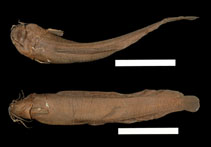 Tanganikallabes mortiauxi
Foto de RMCA / Mark Hanssens
Fotos | Imagem do Google
Foto de RMCA / Mark Hanssens
Classificação / Nomes Nomes comuns | Sinônimos | Catalog of Fishes(Gênero, Espécies) | ITIS | CoL | WoRMS | Cloffa
> Siluriformes (Catfishes) > Clariidae (Airbreathing catfishes)
Etymology: Tanganikallabes: Composed from lake Tanganyka + Greek, allabes, -etos = a fish of the Nile, a kind of lamprey (Ref. 45335).
Eponymy: T Mortiaux, a health worker in Albertville, Belgian Congo (Kalemie, Democratic Republic of the Congo), on the western shore of Lake Tanganyika, collected the holotype. (Ref. 128868), visit book page.
More on author: Poll.
Etymology: Tanganikallabes: Composed from lake Tanganyka + Greek, allabes, -etos = a fish of the Nile, a kind of lamprey (Ref. 45335).
Eponymy: T Mortiaux, a health worker in Albertville, Belgian Congo (Kalemie, Democratic Republic of the Congo), on the western shore of Lake Tanganyika, collected the holotype. (Ref. 128868), visit book page.
More on author: Poll.
Meio ambiente: milieu / Zona climática / intervalo de profundidade / faixa de distribuição Ecologia
; Água doce demersal. Tropical; 3°S - 9°S
Distribuição Territórios | Áreas da FAO | Ecossistemas | Ocorrências | Mapa de pontos | Introduções | Faunafri
Africa: Lake Tanganyika (Ref. 90118).
Tamanho / Peso / Idade
Descrição suscinta Chaves de identificação | Morfologia | Morfometria
Espinhos dorsais (total) : 0; Raios dorsais (total) : 72 - 83; Espinhos anais: 0; Raios anais : 58 - 65. Diagnosis: Tanganikallabes mortiauxi is distinguished from its congeners by the morphology of the vomerine toothpad, which, at its widest point anteroposteriorly, is thicker than the premaxillary toothpad, vs. a uniformly thin, broad crescent in other Tanganikallabes species; the presence of a complete lateral line, vs. incomplete lateral line; free lower orbital margin, vs. no free margin; well-defined, thick basal membranes on the barbels, vs. thin membranes; and a larger eye, 1.8-3.0% of standard length vs. 0.8-1.6% in Tanganikallabes alboperca or 1.0-1.9% in T. stewarti (Ref. 90118). The cranial osteology of T. mortiauxi further separates this species from all congeners: in T. mortiauxi, io-iv consists of a single element, vs. two separate elements in T. alboperca and T. stewarti; similarly, the suprapreopercle of T. mortiauxi is composed of a single element, whereas that of T. alboperca and T. stewarti is composed of two, or sometimes three, elements; furthermore, the extensions of the lateral ethmoid nearly overlie io-ii when viewed from above, but are well separated in T. alboperca and T. stewarti (Ref. 90118). Tanganikallabes mortiauxi can also be distinguished from T. alboperca by having longer pelvic fins, 7.4-9.3% of standard length vs. 6.0-7.7%, that reach beyond the origin of the anal fin when adpressed; longer pectoral fin spines, 5.6-8.8% of standard length vs. 3.6-5.3; a higher number of dorsal fin rays, 72-81 vs. 65-74; and the lack of a depigmented opercular margin (Ref. 90118). Tanganikallabes mortiauxi is further separated from T. stewarti by its proportionally longer prepelvic length, 39.7-44.4% of standard length vs. 35.7-39.2%; its proportionally longer preanal length, 47.1-51.7% of standard length vs. 42.4-44.8%; and shorter anal fin, anal fin base 47.6-54.2% of standard length vs. 54.1-58.9% (Ref. 90118).
Body shape (shape guide): elongated.
Body shape (shape guide): elongated.
Found in littoral to benthic zones over rocky bottoms; this species may inhabit rocky bottoms over a wide range of depths (Ref. 78218, 90118). It appears to be an opportunistic, generalist predator feeding on eggs of fish species, platythelphusid crabs, atyid shrimps and insect larvae (Ref. 90118).
Ciclo de vida ou comportamento de acasalamento Maturidade | Reprodução | Desova | Ovos | Fecundidade | Larvas
Referência principal
Carregar suas referências | Referências | Coordenador | Colaboradores
Wright, J.J. and R.M. Bailey, 2012. Systematic revision of the formerly monotypic genus Tanganikallabes (Siluriformes: Clariidae). Zool. J. Linn. Soc. 165:121-142. (Ref. 90118)
Status na Lista Vermelha da UICN (Ref. 130435: Version 2025-2 (Global))
Segura ou pouco preocupante (LC) ; Date assessed: 19 February 2025
CITES
Not Evaluated
Ameaça para os humanos
Harmless
Uso pelos humanos
FAO - Publication: search | FishSource |
Mais informação
Ecologia Trófica
Itens alimentares (presas)
Composição da dieta
Consumo alimentar
Rações alimentares
Predadores
Itens alimentares (presas)
Composição da dieta
Consumo alimentar
Rações alimentares
Predadores
Dinâmica populacional
Parâmetros de crescimento
Idade máxima / tamanhos
Relação comprimento-peso.
Relação comprimento-comprimento.
Frequências de comprimento
Conversão de massa
Recrutamento
Abundância
Parâmetros de crescimento
Idade máxima / tamanhos
Relação comprimento-peso.
Relação comprimento-comprimento.
Frequências de comprimento
Conversão de massa
Recrutamento
Abundância
Ciclo de vida
Reprodução
Maturidade
Maturidade/Rel. das guelras
Fecundidade
Desova
Agregações de desova
Ovos
Desenvolvimento dos ovos
Larvas
Dinâmica larval
Reprodução
Maturidade
Maturidade/Rel. das guelras
Fecundidade
Desova
Agregações de desova
Ovos
Desenvolvimento dos ovos
Larvas
Dinâmica larval
Anatomia
Área branquial
Cérebro
Otólito
Área branquial
Cérebro
Otólito
Fisiologia
Composição corporal
Nutrientes
Consumo de oxigênio
Tipo de natação
Velocidade de natação
Pigmentos visuais
Som de peixe
Doenças e Parasitas
Toxicidade (LC50s)
Composição corporal
Nutrientes
Consumo de oxigênio
Tipo de natação
Velocidade de natação
Pigmentos visuais
Som de peixe
Doenças e Parasitas
Toxicidade (LC50s)
Genética
genoma
Genética
Heterozigosidade
Hereditariedade
Diversidade genética
genoma
Genética
Heterozigosidade
Hereditariedade
Diversidade genética
Relacionado a humanos
Sistemas de aquicultura
Perfis para aquacultura
Estirpes
Casos de Ciguatera
Selos, moedas, diversos.
Sistemas de aquicultura
Perfis para aquacultura
Estirpes
Casos de Ciguatera
Selos, moedas, diversos.
Ferramentas
Livro eletrônico | Guia de campo | Ferramenta auxiliar de frequências de comprimento | Ferramenta sobre a história de vida | Mapa de pontos |
Catch-MSY |
Relatórios especiais
Checar Manutenção em Aquário | Checar Planilhas de Fatos sobre as Espécies | Checar Planilhas de Fatos sobre Aquicultura
Baixar XML
Fontes da internet
AFORO (otoliths) | Aquatic Commons | BHL | Cloffa | Websites from users | Checar Observador de Peixes (FishWatcher) | CISTI | Catalog of Fishes: Gênero, Espécies | DiscoverLife | ECOTOX | FAO - Publication: search | Faunafri | Fishipedia | Fishtrace | GloBI | Google Books | Google Scholar | Google | IGFA World Record | OneZoom | Open Tree of Life | Otolith Atlas of Taiwan Fishes | PubMed | Reef Life Survey | Socotra Atlas | TreeBase | Árvore da vida | Wikipedia: Ir para, procura | World Records Freshwater Fishing | Zoobank | Registro zoológico
Estimativas baseadas em modelos
Índice de diversidade filogenética (Ref. 82804): PD50 = 0.6250 [Uniqueness, from 0.5 = low to 2.0 = high].
Bayesian length-weight: a=0.00741 (0.00344 - 0.01597), b=2.97 (2.79 - 3.15), in cm total length, based on LWR estimates for this (Sub)family-body shape (Ref. 93245).
Nível Trófico (Ref. 69278): 3.4 ±0.6 se; based on size and trophs of closest relatives
Resiliência (Ref. 120179): Elevada, tempo mínimo de duplicação da população menor que 15 meses (Preliminary K or Fecundity.).