This website uses cookies to enhance your browsing experience and ensure the functionality of our site. For more detailed information about the types of cookies we use and how we protect your privacy, please visit our Privacy Information page.
×
Cookie Settings
This website uses different types of cookies to enhance your experience. Please select your preferences below:
Northwest to West Central Atlantic: from Massachusetts and Bermuda to Trinidad and Tobago, including the Gulf of Mexico and the islands of the Caribbean.
Länge bei der ersten Reifung / Größe / Gewicht / Alter
Geschlechtsreife: Lm15.5, range 9 - ? cm Max length : 38.1 cm SL Männchen/unbestimmt; (Ref. 9761); common length : 25.0 cm TL Männchen/unbestimmt; (Ref. 3142); max. veröff. Alter: 31 Jahre (Ref. 52229)
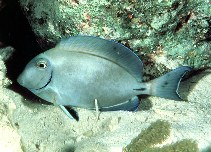
Rückenflossenstacheln (insgesamt) : 9; Rückenflossenweichstrahlen (insgesamt) : 23 - 26; Afterflossenstacheln: 3; Afterflossenweichstrahlen: 21 - 23. This species is distinguished by the following set of characters: D IX, 23-26; A III, 21-23; pectoral rays 15-17; gill rakers 18-24; covered with very small ctenoid scales; spatulate teeth have denticulate edges, upper jaw with 14, lower jaw 16; body depth about 2.0 in standard length; caudal fin lunate, concavity of caudal fin 5.0-12.0 in SL, more concave in adults; length of caudal spine 3.0-3.5 in SL; eye diameter 3.0-3.5 in head length; colour of body yellowish to grayish brown, without dark vertical bars; yellow lines radiating from the posterior margin of eye; translucent pectoral fin with yellow tints; white or pale spot at the base of caudal fin; posterior margin of caudal, anal and dorsal fins have light blue or white margin (Ref. 87362).. Body shape (shape guide): short and / or deep; Cross section: compressed.
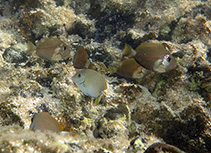
Inhabits shallow bottoms with coral or rocky formations (Ref. 13628); also found around inshore rocky areas with patches of sand, feeding primarily on benthic algae and occasionally grazing on seagrass beds (Ref. 87362). Usually occurs in groups of five or more individuals. Mainly diurnal species. The spine on both sides of the caudal peduncle may inflict painful wounds (Ref. 5217). Marketed fresh. Minimum depth reported from Ref. 27115. Previously reported longevity of 31 years from Ref. 52229 refers to Acanthurus bahianus, a case of misidentification.
Bernal, M.A. and L.A. Rocha, 2011. Acanthurus tractus Poey, 1860, a valid western Atlantic species of surgeonfish (Teleostei, Acanthuridae), distinct from Acanthurus bahianus Castelnau, 1855. Zootaxa 2905:63-68. (Ref. 87362)
IUCN Rote Liste Status (Ref. 130435: Version 2025-2 (Global))
Bevorzugte Temperatur (Ref. 123201): 22.9 - 28, mean 26.6 °C (based on 426 cells).
Phylogenetischer Diversitätsindex (Ref. 82804): PD50 = 0.5000 [Uniqueness, from 0.5 = low to 2.0 = high].
Bayesian length-weight: a=0.01905 (0.01220 - 0.02976), b=2.92 (2.79 - 3.05), in cm total length, based on LWR estimates for this species & Genus-body shape (Ref. 93245).
Trophische Ebene (Ref. 69278): 2.0 ±0.0 se; based on diet studies.
Generation time: 2.9 ( na - na) years. Estimated as median ln(3)/K based on 1 growth studies.
Widerstandsfähigkeit (Ref. 120179): sehr niedrig, Verdopplung der Population dauert mehr als 14 Jahre. (K=0.3-1.5; tmax=31).
Anfälligkeit der Fischerei (Ref. 59153): Low to moderate vulnerability (32 of 100). 🛈