



Envoyez vos Photos et vidéos
Images | Images Google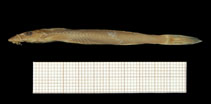 Leptoglanis xenognathus
Photo de RMCA / Mark Hanssens
Images | Images Google
Photo de RMCA / Mark Hanssens
Classification / Noms Noms communs | Synonymes | Catalog of Fishes(Genre, Espèce) | ITIS | CoL | WoRMS | Cloffa
> Siluriformes (Catfishes) > Amphiliidae (Loach catfishes) > Leptoglaninae
Etymology: Leptoglanis: Greek,leptos = thin + Greek, glanis = a fish that can eat the bait without touching the hook; a cat fish (Ref. 45335).
More on author: Boulenger.
Etymology: Leptoglanis: Greek,leptos = thin + Greek, glanis = a fish that can eat the bait without touching the hook; a cat fish (Ref. 45335).
More on author: Boulenger.
Environnement : milieu / zone climatique / profondeur / gamme de distribution Écologie
; eau douce démersal. Tropical
Distribution Territoires | Zones FAO | Écosystèmes | Occurrences | Carte par point | Introductions | Faunafri
Africa: Pool Malebo (= Stanley Pool)(Ref. 51287), middle Congo River main course (Ref. 106245), Aruwimi River (Ref. 51287, 106290) and Wagenia Falls (Ref. 51287, 106245) in Democratic Republic of the Congo, as well as the Ubangi in Democratic Republic of the Congo and Central African Republic (Ref. 51287).
Taille / Poids / Âge
Description synthétique Clés d'identification | Morphologie | Morphométrie
Vertèbres: 38 - 41. Anterior margin of mouth with a single large medial fleshy lobe and several lateral fleshy lobes of variable size (Ref. 51287). Premaxillary with toothless anterior portion, posterior portion with slender conical teeth (Ref. 51287). Lower jaw toothless and exceptionally elongate (Ref. 51287). Coronomeckelian bone exceptionally large and well defined (Ref. 51287). Hyomandibular and quadrate joined by a complex joint consisting of a cartilaginous ball partially enclosed by bony sockets (Ref. 51287). An exceptionally short braincase (Ref. 51287). Pharynx and gill arches with numerous soft fleshy fingerlike or digitiform structures (Ref. 51287). Pectoral and pelvic fins excessively branched (Ref. 51287). Number of principal caudal fin rays: 7+8 (Ref. 51287). In life this species has a milk-white body, with fine, faint melanophores concentrated just above and below lateral line canal and in dorsal portions of myoseptal troughs (Ref. 51287). Two broad oblique bands on the dorsal fin, two broad vertical bands on the caudal fin and a single broad band in the middle of the pectoral fin, all composed of brownish melanophores (Ref. 51287); anal fin with a few fine melanophores on some rays, otherwise colorless (Ref. 51287); adipose and pelvic fins without notable color features (Ref. 51287).
Body shape (shape guide): elongated.
Body shape (shape guide): elongated.
Cycle de vie et comportement reproducteur Maturité | Reproduction | Frai | Œufs | Fécondité | Larves
Référence principale
Téléchargez vos références | Références | Coordinateur | Collaborateurs
Roberts, T.R., 2003. Systematics and osteology of Leptoglaninae a new subfamily of the African catfish family Amphiliidae, with descriptions of three new genera and six new species. Proc. Calif. Acad. Sci. 54(5):81-132. (Ref. 51287)
Statut dans la liste rouge de l'IUCN (Ref. 130435: Version 2025-2 (Global))
Préoccupation mineure (LC) ; Date assessed: 16 February 2009
CITES
Not Evaluated
Menace pour l'homme
Harmless
Utilisations par l'homme
FAO - Publication: search | FishSource |
Plus d'informations
Écologie trophique
Aliments (proies)
Composition du régime alimentaire
Consommation alimentaire
Rations alimentaires
Prédateurs
Aliments (proies)
Composition du régime alimentaire
Consommation alimentaire
Rations alimentaires
Prédateurs
Écologie
Écologie
Écologie
Dynamique des populations
Paramètres de croissance
Âges / tailles maximales
Longueur-poids rel.
Rel. longueur-longueur.
Fréquences de longueurs
Conversion de masse
Recrutement
Abondance
Paramètres de croissance
Âges / tailles maximales
Longueur-poids rel.
Rel. longueur-longueur.
Fréquences de longueurs
Conversion de masse
Recrutement
Abondance
Cycle de vie
Reproduction
Maturité
Maturité/épines rel.
Fécondité
Frai
Agrégats de frai
Œufs
Développement de l'œuf
Larves
Dynamique des populations larvaires
Reproduction
Maturité
Maturité/épines rel.
Fécondité
Frai
Agrégats de frai
Œufs
Développement de l'œuf
Larves
Dynamique des populations larvaires
Anatomie
Surface branchiale
Cerveau
Otolithe
Surface branchiale
Cerveau
Otolithe
Physiologie
Composition corporelle
Nutriments
Consommation d'oxygène
Type de natation
Vitesse de nage
Pigments visuels
Son de poisson
Maladies et parasites
Toxicité (CL50)
Composition corporelle
Nutriments
Consommation d'oxygène
Type de natation
Vitesse de nage
Pigments visuels
Son de poisson
Maladies et parasites
Toxicité (CL50)
Génétique
génôme
Génétique
Hétérozygotie
Héritabilité
Diversité génétique
génôme
Génétique
Hétérozygotie
Héritabilité
Diversité génétique
Liées à l'homme
Systèmes d'aquaculture
Profils d'aquaculture
Souches
Cas de ciguatera
Timbres, pièces de monnaie, divers
Systèmes d'aquaculture
Profils d'aquaculture
Souches
Cas de ciguatera
Timbres, pièces de monnaie, divers
Outils
E-book | Guide de terrain | Générateur de fréquences de longueur | Outil de dynamique de population | Carte par point |
Capture-MSY |
Articles particuliers
Télécharger en XML
Sources Internet
AFORO (otoliths) | Aquatic Commons | BHL | Cloffa | Websites from users | FishWatcher | CISTI | Catalog of Fishes: Genre, Espèce | DiscoverLife | ECOTOX | FAO - Publication: search | Faunafri | Fishipedia | Fishtrace | GloBI | Google Books | Google Scholar | Google | IGFA World Record | OneZoom | Open Tree of Life | Otolith Atlas of Taiwan Fishes | PubMed | Reef Life Survey | Socotra Atlas | TreeBase | Arbre de Vie | Wikipedia: aller à, chercher | World Records Freshwater Fishing | Zoobank | Zoological Record
Estimations basées sur des modèles
Indice de diversité phylogénétique (Réf. 82804): PD50 = 0.7500 [Uniqueness, from 0.5 = low to 2.0 = high].
Bayesian length-weight: a=0.00389 (0.00180 - 0.00842), b=3.12 (2.94 - 3.30), in cm total length, based on all LWR estimates for this body shape (Ref. 93245).
Niveau trophique (Réf. 69278): 3.1 ±0.4 se; based on size and trophs of closest relatives
Résilience (Réf. 120179): Haut, temps minimum de doublement de population inférieur à 15 mois (Preliminary K or Fecundity.).