



Uploaden van uw Foto's en video's
Afbeeldingen | Postzegels, munten, diversen. | Google afbeelding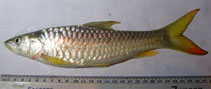 Tor putitora
Afbeelding van Bakalial, B.
Afbeeldingen | Postzegels, munten, diversen. | Google afbeelding
Afbeelding van Bakalial, B.
Classificatie / Namen Lokale namen | Synoniemen | Catalog of Fishes(Genus, Soort(en)) | ITIS | CoL | WoRMS | Cloffa
Taxonomic Remarks
Junior synonym Tor mosal is considered valid by Pinder et al., 2019 (Ref. 123468:428).
Milieu: milieu / Klimaatzone / Diepte / verspreidingsgebied Ecologie
; zoet water benthopelagisch; pH range: 7.4 - 8.0; potamodroom (Ref. 51243); diepte 0 - ? m (Ref. 56197), usually 0 - 1 m (Ref. 56197). Subtropical; 13°C - 30°C (Ref. 40948); 34°N - 20°N
Verspreiding Gebieden | FAO regio's | Ecosystemen | Voorkomen | Verspreidingskaart | Introducties | Faunafri
Asia: Afghanistan, Pakistan, India, Nepal, Bangladesh (Ref. 4832), Bhutan (Ref. 9418) and Mynmar (Ref. 57739).
Lengte bij maturiteit / Grootte / Gewicht / Leeftijd
Maturiteit: Lm ?, range 33 - ? cm
Max length : 275 cm TL mannelijk / geslacht onbekend; (Ref. 6695); common length : 183 cm TL mannelijk / geslacht onbekend; (Ref. 6694); max. gepubliceerd gewicht: 54.0 kg (Ref. 1479)
Max length : 275 cm TL mannelijk / geslacht onbekend; (Ref. 6695); common length : 183 cm TL mannelijk / geslacht onbekend; (Ref. 6694); max. gepubliceerd gewicht: 54.0 kg (Ref. 1479)
Korte beschrijving Determinatiesleutels | Morfologie | Morfometrie
Dorsale stekels (totaal) : 4; Dorsale zachte stralen (totaal) : 8; Anale stekels: 2; Anale zachte stralen: 5.
Body shape (shape guide): fusiform / normal; Cross section: compressed.
Body shape (shape guide): fusiform / normal; Cross section: compressed.
Inhabit streams, riverine pools and lakes. Found in rapid streams with rocky bottom (Ref. 41236). Omnivorous, feeding on fish, zooplankton, dipteran larvae and plant matter (Ref. 40948). Juveniles subsist on plankton while fingerlings feed mainly on algae (Ref. 40948). Ascend streams to breed over gravel and stones and returns to perennial ponds after breeding. The most common Himalayan mahseer and a very attractive sport fish, with excellent food value. Specimens over 30 cm and 5 kg in weight are rarely caught in recent times (Ref. 41236). Threatened due to over harvesting and habitat loss (Ref. 58490).
Levenscyclus en paargedrag Maturiteit | Voortplanting | Paaien | Eieren | Fecunditeit | Larven
Migrate from the lower to the middle reaches of streams or rivers to spawn (Ref. 40949). Spawning takes place during low phase of flood (Ref. 56197). Fry are found among stones in marginal areas of the stream (Ref. 56197).
Hoofdreferentie
Upload uw referenties | Referenties | Coördinator | Medewerkers
Talwar, P.K. and A.G. Jhingran, 1991. Inland fishes of India and adjacent countries. vol 1. A.A. Balkema, Rotterdam. i-liv + 1-541, 1 map (Ref. 4832)
Status op de Rode Lijst van het IUCN (Ref. 130435: Version 2025-2 (Global))
Bedreigd (EN) (A2abcd); Date assessed: 05 August 2018
CITES
Not Evaluated
Gevaar voor de mens
Harmless
Gebruik door de mens
Visserij: commercieel; Aquacultuur: commercieel; sportvis: ja; Aquarium: Publieke aquaria
FAO - Publication: search | FishSource |
Meer informatie
Trofische ecologie
Voedsel (prooien)
Dieetsamenstelling
Voedselconsumptie
Voedselrantsoenen
Predatoren
Voedsel (prooien)
Dieetsamenstelling
Voedselconsumptie
Voedselrantsoenen
Predatoren
Populatiedynamica
Groeiparameters
Max. leeftijden / maten
Lengte-gewicht rel.
Lengte-lengte rel.
Lengtefrequenties
Massaconversie
Rekrutering
Abundantie
Groeiparameters
Max. leeftijden / maten
Lengte-gewicht rel.
Lengte-lengte rel.
Lengtefrequenties
Massaconversie
Rekrutering
Abundantie
Levenscyclus
Voortplanting
Maturiteit
Rijpheid/kieuwen rel.
Fecunditeit
Paaien
Paaibestanden
Eieren
Ontwikkeling van de eieren
Larven
Larvale populatiedynamiek
Voortplanting
Maturiteit
Rijpheid/kieuwen rel.
Fecunditeit
Paaien
Paaibestanden
Eieren
Ontwikkeling van de eieren
Larven
Larvale populatiedynamiek
Anatomie
Kieuwoppervlak
Hersenen
Otoliet
Kieuwoppervlak
Hersenen
Otoliet
Fysiologie
Lichaamssamenstelling
Voedingsstoffen
Zuurstofverbruik
Type zwemmen
Zwemsnelheid
Visuele pigmenten
Vis geluid
Ziekten en parasieten
Toxiciteit (LC50)
Lichaamssamenstelling
Voedingsstoffen
Zuurstofverbruik
Type zwemmen
Zwemsnelheid
Visuele pigmenten
Vis geluid
Ziekten en parasieten
Toxiciteit (LC50)
Menselijk gerelateerd
Aquacultuursystemen
Aquacultuurprofielen
Kweeklijnen
Ciguatera gevallen
Postzegels, munten, diversen.
Aquacultuursystemen
Aquacultuurprofielen
Kweeklijnen
Ciguatera gevallen
Postzegels, munten, diversen.
Tools
E-boek | Veldgids | Determinatiesleutels | Lengtefrequentie Tool | Levenscyclus tool | Verspreidingskaart |
Vangst-MSY |
Speciale rapporten
Bekijk gegevens voor het houden in een aquarium | Bekijk Fact Sheets voor de soort | Bekijk Aquacultuur Fact Sheets
Download XML
Internetbronnen
AFORO (otoliths) | Exoten/Invasieve soorten database | Aquatic Commons | BHL | Cloffa | Websites from users | Bekijk FishWatcher | CISTI | Catalog of Fishes: Genus, Soort(en) | DiscoverLife | ECOTOX | FAO - Publication: search | Faunafri | Fishipedia | Fishtrace | GloBI | Google Books | Google Scholar | Google | IGFA World Record | OneZoom | Open Tree of Life | Otolith Atlas of Taiwan Fishes | Publieke aquaria | PubMed | Reef Life Survey | Socotra Atlas | TreeBase | Tree of Life | Wikipedia: ga naar, zoek | World Records Freshwater Fishing | Zoological Record
Schattingen op basis van modellen
Fylogenetische diversiteitsindex (Ref. 82804): PD50 = 0.5000 [Uniqueness, from 0.5 = low to 2.0 = high].
Bayesian length-weight: a=0.00933 (0.00767 - 0.01136), b=3.00 (2.94 - 3.06), in cm total length, based on LWR estimates for this species (Ref. 93245).
Trofisch niveau (Ref. 69278): 2.9 ±0.38 se; based on food items.
Generation time: 15.7 ( na - na) years. Estimated as median ln(3)/K based on 1 growth studies.
Weerstandsvermogen (Ref. 120179): laag, minimale populatieverdubbelingstijd 4,5-14 jaar (tm=1.5; K=0.07; Fec=26,998).
Voedingsstoffen (Ref. 124155): Calcium = 69.7 [16.3, 159.7] mg/100g; Iron = 1 [0, 3] mg/100g; Protein = 17.8 [15.9, 19.9] %; Omega3 = 0.514 [0.223, 1.171] g/100g; Selenium = 55.5 [22.8, 134.3] μg/100g; VitaminA = 14.4 [5.2, 40.4] μg/100g; Zinc = 1.17 [0.53, 1.99] mg/100g (wet weight); based on nutrient studies.