



個人による観察記録の追加 Fish Watcher
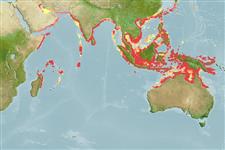
| Native range | All suitable habitat | Point map | Year 2050 |
|
| This map was computer-generated and has not yet been reviewed. |
| Eusphyra blochii AquaMaps Data sources: GBIF OBIS |
分類 / 名前 共通名の | 類義語 | Catalog of Fishes(部類, 種) | ITIS | CoL | WoRMS | Cloffa
板鰓亜鋼(サメとエイ類) (sharks and rays) > Carcharhiniformes (Ground sharks) > Sphyrnidae (Hammerhead, bonnethead, or scoophead sharks)
Etymology: Eusphyra: eu- (Gr.), good, well or very; sphyra (Gr.), hammer, referring to immense hammer-shaped head (See ETYFish); blochii: In honor of physician-naturalist Marcus Elieser Bloch (1723-1799), who described and illustrated this shark in 1785, which he identified as Squalus zygaena (See ETYFish).
Eponymy: Marcus Élieser Bloch (1723–1799) was a German physician and naturalist specialising in ichthyology. [...] (Ref. 128868), visit book page.
More on author: Cuvier.
Etymology: Eusphyra: eu- (Gr.), good, well or very; sphyra (Gr.), hammer, referring to immense hammer-shaped head (See ETYFish); blochii: In honor of physician-naturalist Marcus Elieser Bloch (1723-1799), who described and illustrated this shark in 1785, which he identified as Squalus zygaena (See ETYFish).
Eponymy: Marcus Élieser Bloch (1723–1799) was a German physician and naturalist specialising in ichthyology. [...] (Ref. 128868), visit book page.
More on author: Cuvier.
Taxonomic Remarks
Eusphyra laticeps (Cantor, 1837) is a valid species after Fernando et al 2019 (Ref. 120444).
環境:環境 / 気候帯 / 深さの範囲 / 分布範囲 生態学
海; 汽水性の 底生の漂泳性; 両側回遊性 (Ref. 87829). Tropical; 31°N - 20°S, 47°E - 154°E
分布 領土 | 国連食糧農業機関の区域 | エコシステム | 事件 | 目的のマップ | 導入 | Faunafri
Indo-West Pacific: Persian Gulf to the Philippines, north to China, south to Australia.
初回成熟時の長さ / サイズ / 重さ / 年齢
簡単な記述 検索表 | 形態学 | 形態計測学
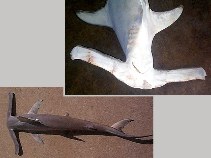
背面の脊椎 (合計) : 0; 肛門の骨: 0. Grey or grey-brown above, paler below. Expanded lateral blades of head very narrow and wing-like, with a series of small bumps along edges in front of nostrils; width across head 40 or 50% of total length. Nostrils enormously expanded, each nearly 2 times the mouth head (Ref 13562).
Body shape (shape guide): elongated.
Body shape (shape guide): elongated.
Found in shallow water on continental and insular shelves (Ref. 244). Enters estuaries (Ref. 4832). Feeds mainly on small teleost fishes but also takes crustaceans and cephalopods (Ref. 13562). Viviparous (Ref. 50449), with 6 to 25 pups in a litter (Ref. 6871). Has a remarkable wing-shaped head which is nearly or quite half of its body length, the function of which is uncertain, maybe for maneuvering or for increasing the surface area of some of the sense organs (Ref. 244). Probably harmless to people (Ref. 13562). Caught commonly, but in low numbers, by inshore gillnet fisheries. Particularly common in catches off Kalimantan (Ref.58048). Probably a common fisheries species where it occurs (Ref. 13562). Meat utilized for human consumption; liver is a source of vitamin oil (Ref. 244). Offal probably utilized for fishmeal (Ref. 13562). Reported to reach 300 cm TL (Ref. 58784).
ライフサイクルと交尾行動 成熟 | 繁殖 | 放精 | 卵 | 生産力 | 幼生
Viviparous, placental (Ref. 50449), with 6 to 25 in a litter after a gestation period of 8 (Ref.58048) -11 months (Ref. 6871). Size at birth between 32 and 45 cm TL (Ref. 13562).
主な参考文献
参考文献のアップロード | 参考文献 | コーディネーター : Compagno, Leonard J.V. | 協力者
Compagno, L.J.V., 1984. FAO Species Catalogue. Vol. 4. Sharks of the world. An annotated and illustrated catalogue of shark species known to date. Part 2 - Carcharhiniformes. FAO Fish. Synop. 125(4/2):251-655. Rome: FAO. (Ref. 244)
IUCNのレッドリストの状況は (Ref. 130435: Version 2025-2 (Global))
絶滅寸前の危機的状況 (CR) (A2cd); Date assessed: 30 July 2024
人間に対する脅威
Harmless (Ref. 13562)
人間の用途
水産業: 商業
FAO - Publication: search | FishSource |
より多くの情報
解剖学
カマ
脳
オトリス
カマ
脳
オトリス
用具
特記事項
XMLをダウンロードして下さい
インターネットの情報源
AFORO (otoliths) | Aquatic Commons | BHL | Cloffa | Websites from users | Check FishWatcher | CISTI | Catalog of Fishes: 部類, 種 | DiscoverLife | ECOTOX | FAO - Publication: search | Faunafri | Fishipedia | Fishtrace | GloBI | Google Books | Google Scholar | Google | IGFA World Record | 国のデーターベース | OneZoom | Open Tree of Life | Otolith Atlas of Taiwan Fishes | PubMed | Reef Life Survey | Socotra Atlas | TreeBase | 生命の木 | Wikipedia: 行く, 検索する | World Records Freshwater Fishing | 動物に関する記録
モデルに基づく推定値
好ましい温度 (参照 123201): 25.2 - 29.1, mean 28.3 °C (based on 970 cells).
系統多様性指数 (参照 82804): PD50 = 0.7501 [Uniqueness, from 0.5 = low to 2.0 = high].
Bayesian length-weight: a=0.00513 (0.00276 - 0.00952), b=3.25 (3.08 - 3.42), in cm total length, based on LWR estimates for this species & (Sub)family-body (Ref. 93245).
栄養段階 (参照 69278): 4.2 ±0.6 se; based on diet studies.
回復力 (参照 120179): 非常に低い, 14年以上の倍増期間の最小個体群 (Fec=6).
栄養素 (Ref. 124155): Calcium = 16.6 [2.7, 88.0] mg/100g; Iron = 0.526 [0.132, 1.586] mg/100g; Protein = 18.9 [16.9, 21.1] %; Omega3 = 0.129 [0.056, 0.295] g/100g; Selenium = 76.7 [22.3, 229.5] μg/100g; VitaminA = 19 [8, 48] μg/100g; Zinc = 0.721 [0.349, 1.352] mg/100g (wet weight);