This website uses cookies to enhance your browsing experience and ensure the functionality of our site. For more detailed information about the types of cookies we use and how we protect your privacy, please visit our Privacy Information page.
×
Cookie Settings
This website uses different types of cookies to enhance your experience. Please select your preferences below:
Elasmobranchii (Haie und Rochen) (sharks and rays) > Carcharhiniformes (Ground sharks) > Galeocerdonidae (Tiger sharks)
Etymology: Galeocerdo:galeos, a small shark or dogfish according to Aristotle and others (but perhaps used here as a generic term for shark); kerdo, Greek for fox, allusion not explained, perhaps referring to a cunning ability to steal bait from the line (see Alopias, Alopiidae) (See ETYFish); cuvier:Patronym not identified but almost certainly in honor of French naturalist Georges Cuvier (1769-1832), then most famous for his Le Règne Animal (1816), a survey of the animal kingdom based on comparative anatomy [presumably a noun in apposition, without the patronymic “i”] (See ETYFish). Eponymy: Georges Léopold Chrétien Frédéric Dagobert Baron Cuvier (1769–1832), better known by his pen name Georges Cuvier, was a French naturalist and one of the scientific giants of his age. [...] (Ref. 128868), visit book page. More on authors: Péron & Lesueur.
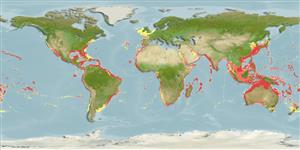
Circumglobal in tropical and temperate seas. Western Atlantic: Massachusetts, USA to Uruguay, including Gulf of Mexico and the Caribbean. Eastern Atlantic: Iceland to Angola. Indo-Pacific: Persian Gulf (Ref. 68964), Red Sea and East Africa to Hawaii and Tahiti, north to southern Japan, south to New Zealand. Eastern Pacific: southern California, USA to Peru, including the Revillagigedo, Cocos, and Galapagos islands. Highly migratory species.
Länge bei der ersten Reifung / Größe / Gewicht / Alter
Geschlechtsreife: Lm300.0, range 210 - 350 cm Max length : 750 cm TL Männchen/unbestimmt; (Ref. 58784); common length : 500 cm TL Männchen/unbestimmt; (Ref. 2683); max. veröff. Gewicht: 807.4 kg (Ref. 4699); max. veröff. Alter: 50 Jahre (Ref. 4827)
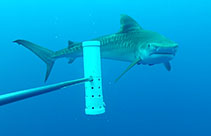
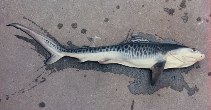
Rückenflossenstacheln (insgesamt) : 0; Afterflossenstacheln: 0. This species is a huge, vertical tiger-striped shark with a very short or broad, bluntly rounded snout (its length much less than width of mouth), long upper labial furrows (about as long as snout, reaching front of eyes), a big mouth with large, saw-edged, cockscomb-shaped teeth (coarsely serrated with outer edges deeply notched and tips directed obliquely outward); spiracles small, slit-like, but easily visible, caudal keels low. Colour of back dark grey or greyish brown with vertical dark grey to black bars and rectangular spots often forming bars on sides and fins, but fading with growth (Ref. 5578, 9997). Body shape (shape guide): fusiform / normal; Cross section: angular.
Usually found near surface to depths of 140 m (Ref. 26938); in Tahiti from 0-350 m (Ref. 89972). Occurs on or adjacent to continental and insular shelves, frequenting river estuaries, off wharves and jetties in harbors, and in coral atolls and lagoons (Ref. 244). Bottom-associated, sometimes pelagic (Ref. 58302). Also off oceanic islands far from other islands and continental land masses (Ref. 244). Makes excursions in the open ocean, but is not a truly oceanic species (Ref. 244). Nocturnal feeder on other sharks, rays, bony fishes, marine mammals, tortoises, seabirds, sea snakes, squids, gastropods, crustaceans, detritus (Ref. 9997), also including toxic or armored fish species such as Lactoria cornuta or Diodon hystrix, porpoises, whales, sea turtles, cephalopods, domestic animals and humans (Ref. 37816). It also feeds on carrion and garbage, including cans, pieces of metal and burlap bags (Ref. 26938). Second only to Carcharodon carcharias in recorded attacks on humans with at least 27 documented attacks sourced to it . One specimen, reportedly taken off Indo-China, weighed 3,110 kg and measured 740 cm (Ref. 9987). May be kept in an aquaria, but does not last for more than a few months (Ref. 244). Ovoviviparous (Ref. 50449). Up to 80 young of 51 to 104 cm are born per litter (Ref. 1602). Valued for its meat, fins, hide and liver oil (Ref. 9997) and also for its jaws and cartilage (Ref. 58048). Often used for fishmeal (Ref. 9997). Utilized fresh, dried-salted, smoked and frozen (Ref. 9987). Species from the Persian Gulf and Oman Sea has a max size of 750 cm TL (Ref. 47613).
Ovoviviparous (Ref. 4805, 6871) with 10-82 in a litter (Ref. 26346). Mating takes place even before gravid females have given birth (Ref. 244). Distinct pairing with embrace (Ref. 205). Gestation period: 13-16 months. Size at birth between 51 (Ref. 244) and 104 (Ref. 9997) cm TL; born at about 51-76 cm TL (Ref. 58048).
Compagno, L.J.V., 1984. FAO Species Catalogue. Vol. 4. Sharks of the world. An annotated and illustrated catalogue of shark species known to date. Part 2 - Carcharhiniformes. FAO Fish. Synop. 125(4/2):251-655. Rome: FAO. (Ref. 244)
IUCN Rote Liste Status (Ref. 130435: Version 2025-2 (Global))
Bevorzugte Temperatur (Ref. 123201): 15.8 - 28.9, mean 26.4 °C (based on 6872 cells).
Phylogenetischer Diversitätsindex (Ref. 82804): PD50 = 1.5000 [Uniqueness, from 0.5 = low to 2.0 = high].
Bayesian length-weight: a=0.00724 (0.00282 - 0.01861), b=3.09 (2.87 - 3.31), in cm total length, based on LWR estimates for this (Sub)family-body shape (Ref. 93245).
Trophische Ebene (Ref. 69278): 4.5 ±0.0 se; based on diet studies.
Generation time: 10.3 ( na - na) years. Estimated as median ln(3)/K based on 2 growth studies.
Widerstandsfähigkeit (Ref. 120179): niedrig, Verdopplung der Population dauert 4,5 - 14 Jahre. (tm=4-11; tmax=50; K=0.18-0.6; Fec=10).
Prior r = 0.27, 95% CL = 0.18 - 0.41, Based on 1 data-limited stock assessment.
Anfälligkeit der Fischerei (Ref. 59153): High vulnerability (64 of 100). 🛈
Klimaanfälligkeit (Ref. 125649): High vulnerability (57 of 100). 🛈