



Eretmodus cyanostictus Boulenger, 1898
Tanganyika Clown
Hochladen Photos und videos
Bilder | Google Bild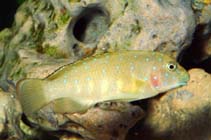 Eretmodus cyanostictus
Photo von Hippocampus-Bildarchiv
Bilder | Google Bild
Photo von Hippocampus-Bildarchiv
Klassifizierung / Names Namen | Synonyme | Catalog of Fishes(Gattung, Arten) | ITIS | CoL | WoRMS | Cloffa
> Cichliformes (Cichlids, convict blennies) > Cichlidae (Cichlids) > Pseudocrenilabrinae
Etymology: Eretmodus: Greek, eretmos, -ou = with oars + Greek, odous = teeth (Ref. 45335).
More on author: Boulenger.
Etymology: Eretmodus: Greek, eretmos, -ou = with oars + Greek, odous = teeth (Ref. 45335).
More on author: Boulenger.
Umwelt: Milieu / Klimazone / Tiefenbereich / Verbreitungsgebiet Ökologie
; süßwasser benthopelagisch; pH range: 8.0 - 9.0; dH range: 9 - 19. Tropical; 24°C - 26°C (Ref. 1672); 3°S - 9°S
Verbreitung Territorien | FAO Gebiete | Ökosysteme | Vorkommen | Punkt Karte | Einführungen | Faunafri
Africa: endemic to Lake Tanganyika, occurs in the southern part of the Lake, from Kipili (Tanzania) to Moliro (Democratic Republic of the Congo) (Ref. 46829).
Größe / Gewicht / Alter
Kurzbeschreibung Bestimmungsschlüssel | Morphologie | Morphometrie
Rückenflossenstacheln (insgesamt) : 23 - 24; Rückenflossenweichstrahlen (insgesamt) : 4 - 5; Afterflossenstacheln: 3; Afterflossenweichstrahlen: 6 - 7. Diagnosis: Eretmodus cyanostictus is characterized by a terminal mouth and a number of bright blue spots on the head and upper half of the body (Ref. 92306). About 5 light bars are present on the side of the body but evident only on the lower half of the body and none crossing the posterior en of the body or caudal peduncle (Ref. 92306).
Body shape (shape guide): short and / or deep.
Body shape (shape guide): short and / or deep.
Occurs in rocky areas (Ref. 53528). Adults occur in the turbulent, highly oxygenated shallow waters of the surf zone; found in the shallows of a gradually sloping rocky coast where some sand is found between the rocks; solitary and to some extent, territorial; heavy body and small swim bladder result in negative buoyancy (Ref. 6770). Feeds on algae which are scraped from the rocks (Ref. 6770, 46829). Both parents brood their young in the mouth (Ref. 52921, 86760).
Lebenszyklus und Paarungsverhalten Geschlechtsreife | Fortpflanzung | Ablaichen | Eier | Fruchtbarkeit | Larven
Eggs from the cleavage phase and larvae of up to 1.09 cm TL are mouthbrooded by male and female parents ranging from 4.7 to 6.2 cm SL (Ref. 86760).
Hauptreferenz
Laden Sie Ihre Referenzen hoch | Referenzen | Koordinator : Kullander, Sven O. | Partner
Konings, A., 1998. Tanganyika cichlids in their natural habitat. Cichlid Press. 272 p. (Ref. 46829)
IUCN Rote Liste Status (Ref. 130435: Version 2025-2 (Global))
nicht bedroht (LC) ; Date assessed: 25 February 2025
CITES
Not Evaluated
Bedrohung für Menschen
Harmless
Nutzung durch Menschen
Aquarium: Kommerziell
FAO - Publication: search | FishSource |
Mehr Information
Trophische Ökologie
Lebensmittel (Beutetiere)
Nahrungszusammensetzung
Nahrungsaufnahme
Lebensmittelrationen
Räuber
Lebensmittel (Beutetiere)
Nahrungszusammensetzung
Nahrungsaufnahme
Lebensmittelrationen
Räuber
Populationsdynamik
Wachstumsparameter
Max. Alter/Größen
Länge-Gewicht-Rel.
Länge-Länge-Verhältnis.
Längenhäufigkeiten
Massenkonvertierung
Rekrutierung
Dichte
Wachstumsparameter
Max. Alter/Größen
Länge-Gewicht-Rel.
Länge-Länge-Verhältnis.
Längenhäufigkeiten
Massenkonvertierung
Rekrutierung
Dichte
Lebenszyklus
Fortpflanzung
Geschlechtsreife
Reifung/Kiemen rel.
Fruchtbarkeit
Ablaichen
Laichaggregationen
Eier
Eientwicklung
Larven
Larven Pop.Dyn.
Fortpflanzung
Geschlechtsreife
Reifung/Kiemen rel.
Fruchtbarkeit
Ablaichen
Laichaggregationen
Eier
Eientwicklung
Larven
Larven Pop.Dyn.
Physiologie
Körperliche Zusammensetzung
Nährstoffe
Sauerstoffverbrauch
Schwimmart
Schwimmgeschwindigkeit
Visuelle Pigmente
Fischgeräusche
Krankheiten und Parasiten
Toxizität (LC50s)
Körperliche Zusammensetzung
Nährstoffe
Sauerstoffverbrauch
Schwimmart
Schwimmgeschwindigkeit
Visuelle Pigmente
Fischgeräusche
Krankheiten und Parasiten
Toxizität (LC50s)
Genetik
Genom
Genetik
Heterozygotie
Vererbbarkeit
Genetische Vielfalt
Genom
Genetik
Heterozygotie
Vererbbarkeit
Genetische Vielfalt
Menschenbezogen
Aquakultur-Systeme
Aquakultur Profile
Zuchtlinien
Ciguatera-Fälle
Briefmarken, Münzen, Verschiedenes.
Aquakultur-Systeme
Aquakultur Profile
Zuchtlinien
Ciguatera-Fälle
Briefmarken, Münzen, Verschiedenes.
Tools
Bio-Quiz | E-Book | Feldführer | Längenhäufigkeits Tool | Lebensdaten Tool | Punkt Karte |
Catch-MSY |
Zusatzinformationen
Download XML
Zusammenfassung | Punktdaten | Namen | Photos
Internet Quellen
AFORO (otoliths) | Aquatic Commons | BHL | Cloffa | Websites from users | FishWatcher Einträge suchen | CISTI | Catalog of Fishes: Gattung, Arten | DiscoverLife | ECOTOX | FAO - Publication: search | Faunafri | Fishipedia | Fishtrace | GloBI | Google Books | Google Scholar | Google | IGFA World Record | OneZoom | Open Tree of Life | Otolith Atlas of Taiwan Fishes | PubMed | Reef Life Survey | Socotra Atlas | TreeBase | Tree of Life | Wikipedia: Gehe zu, Suchen | World Records Freshwater Fishing | Zoobank | Zoologischer Rekord
Schätzungen auf der Grundlage von Modellen
Phylogenetischer Diversitätsindex (Ref. 82804): PD50 = 0.7500 [Uniqueness, from 0.5 = low to 2.0 = high].
Bayesian length-weight: a=0.01905 (0.00846 - 0.04293), b=3.01 (2.82 - 3.20), in cm total length, based on LWR estimates for this (Sub)family-body shape (Ref. 93245).
Trophische Ebene (Ref. 69278): 2.1 ±0.1 se; based on diet studies.
Widerstandsfähigkeit (Ref. 120179): niedrig, Verdopplung der Population dauert 4,5 - 14 Jahre. (tm<1 (?); Fec=20-25 (aquarium observation)).