



Envoyez vos Photos et vidéos
Images | Timbres, pièces de monnaie, divers | Images Google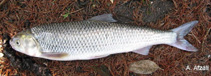 Rutilus frisii
Male Photo de Afzali, A.
Images | Timbres, pièces de monnaie, divers | Images Google
Male Photo de Afzali, A.
Classification / Noms Noms communs | Synonymes | Catalog of Fishes(Genre, Espèce) | ITIS | CoL | WoRMS | Cloffa
> Cypriniformes (Carps) > Leuciscidae (Minnows) > Leuciscinae
Etymology: Rutilus: Latin, rutilus = reddish (Ref. 45335).
Eponymy: Dr Bengt Fredrik Fries (1799–1839) was a Swedish biologist, entomologist and ichthyologist. [...] (Ref. 128868), visit book page.
Etymology: Rutilus: Latin, rutilus = reddish (Ref. 45335).
Eponymy: Dr Bengt Fredrik Fries (1799–1839) was a Swedish biologist, entomologist and ichthyologist. [...] (Ref. 128868), visit book page.
Environnement : milieu / zone climatique / profondeur / gamme de distribution Écologie
; eau douce; saumâtre benthopélagique; profondeur 50 - ? m. Temperate; 56°N - 36°N, 22°E - 54°E
Distribution Territoires | Zones FAO | Écosystèmes | Occurrences | Carte par point | Introductions | Faunafri
Eurasia: Black and Azov Sea basins, absent from Danube and Kuban drainages; landloacked populations in Don, resulting from dam construction; Caspian basin from Terek to Atrek drainages, very rarely in northern Caspian basin (Volga [earlier up to Perm], Ural); Lake Iznik in Sea of Marmara basin in Anatolia.
Longueur à la première maturité / Taille / Poids / Âge
Maturité: Lm 46.5, range 43 - 50 cm
Max length : 70.0 cm TL mâle / non sexé; (Ref. 556); common length : 60.0 cm TL mâle / non sexé; (Ref. 6111); poids max. publié: 8.0 kg (Ref. 59043); âge max. reporté: 12 années (Ref. 6111)
Max length : 70.0 cm TL mâle / non sexé; (Ref. 556); common length : 60.0 cm TL mâle / non sexé; (Ref. 6111); poids max. publié: 8.0 kg (Ref. 59043); âge max. reporté: 12 années (Ref. 6111)
Description synthétique Clés d'identification | Morphologie | Morphométrie
Rayons mous dorsaux (Total) : 11 - 12; Rayons mous anaux: 12 - 14. Can be diagnosed from its congeners in Black and Caspian Sea basins by having the following characters: body almost cylindrical, depth 19-26% SL; 53-64 + 3 scales on lateral line; abdomen posterior to pelvic rounded; snout rounded, stout; mouth subterminal; dorsal fin with 9-10½ branched rays; iris and fins grey or slightly yellowish; breeding males with large, scattered tubercles on top and side of head (Ref. 59043).
Body shape (shape guide): fusiform / normal; Cross section: circular.
Body shape (shape guide): fusiform / normal; Cross section: circular.
A semi-anadromous species which occurs in large brackish estuaries and their large, freshened plume waters, coastal lakes connected to rivers and lowland stretches of large rivers. Can tolerate salinities up to 7-12 ppt. Landlocked populations live in lakes or reservoirs. Larvae and early juveniles take zooplankton, algae and insect larvae as food while adults feed on molluscs, Rhithropanopeus crabs and other benthic invertebrates. Feeding ceases while migrating, spawning and overwintering. Breeds in small rivers or streams with heavy current on gravel bottom. Begins migration to rivers in second half of October (Black Sea, rarely in Caspian Sea). When rivers are covered with ice, spawning migration stops and continues when ice breaks up or even under ice in February-April. Spawns in April-May. Adults migrate back to estuaries to forage immediately after spawning. Juveniles move to estuaries during first summer in August. Landlocked populations undertake migration in springs from lakes or reservoirs or middle stretches of rivers to tributaries or upper reaches (Ref. 59043).
Cycle de vie et comportement reproducteur Maturité | Reproduction | Frai | Œufs | Fécondité | Larves
Lays eggs which adhere to rocks and gravel, rarely on submerged plants. Eggs hatch in 10-16 days at 12-19°C (Ref. 59043).
Référence principale
Téléchargez vos références | Références | Coordinateur | Collaborateurs
Kottelat, M. and J. Freyhof, 2007. Handbook of European freshwater fishes. Publications Kottelat, Cornol and Freyhof, Berlin. 646 pp. (Ref. 59043)
Statut dans la liste rouge de l'IUCN (Ref. 130435: Version 2025-2 (Global))
Préoccupation mineure (LC) ; Date assessed: 07 June 2022
CITES
Not Evaluated
Menace pour l'homme
Harmless
Utilisations par l'homme
Pêcheries: commercial; Aquaculture: commercial
FAO - pêcheries: débarquements; Publication: search | FishSource |
Plus d'informations
Écologie trophique
Aliments (proies)
Composition du régime alimentaire
Consommation alimentaire
Rations alimentaires
Prédateurs
Aliments (proies)
Composition du régime alimentaire
Consommation alimentaire
Rations alimentaires
Prédateurs
Dynamique des populations
Paramètres de croissance
Âges / tailles maximales
Longueur-poids rel.
Rel. longueur-longueur.
Fréquences de longueurs
Conversion de masse
Recrutement
Abondance
Paramètres de croissance
Âges / tailles maximales
Longueur-poids rel.
Rel. longueur-longueur.
Fréquences de longueurs
Conversion de masse
Recrutement
Abondance
Cycle de vie
Reproduction
Maturité
Maturité/épines rel.
Fécondité
Frai
Agrégats de frai
Œufs
Développement de l'œuf
Larves
Dynamique des populations larvaires
Reproduction
Maturité
Maturité/épines rel.
Fécondité
Frai
Agrégats de frai
Œufs
Développement de l'œuf
Larves
Dynamique des populations larvaires
Anatomie
Surface branchiale
Cerveau
Otolithe
Surface branchiale
Cerveau
Otolithe
Physiologie
Composition corporelle
Nutriments
Consommation d'oxygène
Type de natation
Vitesse de nage
Pigments visuels
Son de poisson
Maladies et parasites
Toxicité (CL50)
Composition corporelle
Nutriments
Consommation d'oxygène
Type de natation
Vitesse de nage
Pigments visuels
Son de poisson
Maladies et parasites
Toxicité (CL50)
Liées à l'homme
Systèmes d'aquaculture
Profils d'aquaculture
Souches
Cas de ciguatera
Timbres, pièces de monnaie, divers
Systèmes d'aquaculture
Profils d'aquaculture
Souches
Cas de ciguatera
Timbres, pièces de monnaie, divers
Outils
E-book | Guide de terrain | Générateur de fréquences de longueur | Outil de dynamique de population | Carte par point |
Capture-MSY |
Articles particuliers
Télécharger en XML
Sources Internet
AFORO (otoliths) | Alien/Invasive Species database | Aquatic Commons | BHL | Cloffa | Websites from users | FishWatcher | CISTI | Catalog of Fishes: Genre, Espèce | DiscoverLife | ECOTOX | FAO - pêcheries: débarquements; Publication: search | Faunafri | Fishipedia | Fishtrace | GloBI | Google Books | Google Scholar | Google | IGFA World Record | Bases de données nationales | OneZoom | Open Tree of Life | Otolith Atlas of Taiwan Fishes | PubMed | Reef Life Survey | Socotra Atlas | TreeBase | Arbre de Vie | Wikipedia: aller à, chercher | World Records Freshwater Fishing | Zoological Record
Estimations basées sur des modèles
Indice de diversité phylogénétique (Réf. 82804): PD50 = 0.5020 [Uniqueness, from 0.5 = low to 2.0 = high].
Bayesian length-weight: a=0.00832 (0.00525 - 0.01318), b=3.09 (2.96 - 3.22), in cm total length, based on LWR estimates for this species & (Sub)family-body (Ref. 93245).
Niveau trophique (Réf. 69278): 3.6 ±0.0 se; based on diet studies.
Generation time: 2.7 ( na - na) years. Estimated as median ln(3)/K based on 1 growth studies.
Résilience (Réf. 120179): Faible, temps minimum de doublement de population : 4,5 à 14 années (tmax=12; tm=3-5).
Nutriments (Ref. 124155): Calcium = 8.15 [5.12, 17.31] mg/100g; Iron = 0.0971 [, ] mg/100g; Protein = 19.1 [16.7, 21.3] %; Omega3 = 0.709 [0.367, 1.396] g/100g; Selenium = 2.5 [0.9, 7.1] μg/100g; VitaminA = 17.2 [6.3, 50.1] μg/100g; Zinc = 0.246 [0.163, 0.435] mg/100g (wet weight); based on nutrient studies.