



Adicionar o seu Fotografias e vídeos
Fotografias | Imagem do Google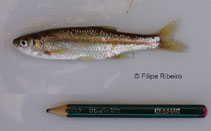 Squalius alburnoides
Fotografia de Ribeiro, F.
Fotografias | Imagem do Google
Fotografia de Ribeiro, F.
Classificação / Nomes Nomes comuns | Sinónimos | Catalog of Fishes(Género, Espécies) | ITIS | CoL | WoRMS | Cloffa
Ambiente: milieu / zona climática / intervalo de profundidade / gama de distribuição Ecologia
; Água doce bentopelágico; potamódromo (Ref. 138297). Subtropical; 42°N - 36°N, 9°W - 1°W
Distribuição Territórios | Áreas FAO | Ecossistemas | Ocorrências | Mapa dos pontos | Introduções | Faunafri
Europe: Iberian Peninsula in Douro, Tagus, Sado, Guadiana, Odiel, Guadalquivir and Quarteira drainages. Introduced in Júca drainage.
Tamanho / Peso / Idade
Maturidade: Lm ? range ? - ? cm
Max length : 25.0 cm TL macho/indeterminado; (Ref. 556); common length : 15.0 cm TL macho/indeterminado; (Ref. 556)
Max length : 25.0 cm TL macho/indeterminado; (Ref. 556); common length : 15.0 cm TL macho/indeterminado; (Ref. 556)
Descrição breve Chaves de identificação | Morfologia | Morfometria
Raios dorsais moles (total) : 7; Raios anais moles: 7 - 9. Diagnosed from other Cyprinidae in Iberian Peninsula by the following characters: barbels absent; dark midlateral stripe from snout to caudal base; body slender, depth 3.8-4.4 times in SL; 37-42 + 2-3 scales on lateral line; mouth opening upward; and anal fin with usually 8½ branched rays (Ref. 59043).
Body shape (shape guide): fusiform / normal; Cross section: oval.
Body shape (shape guide): fusiform / normal; Cross section: oval.
Adults live in schools in lowland rivers and lakes. They feed on invertebrates, chiefly small crustaceans and insect larvae. They breed in April-May among aquatic plants and on stony bottoms in shallow water. Threatened due to pollution, habitat destruction and the introduction of other species (Ref. 26100). The species is unique as it represents a stable all-male lineage nested within an almost all-female hybrid lineage (Ref. 49905).
Ciclo de vida e comportamento de acasalamento Maturidade | Reprodução | Desova | Ovos | Fecundidade | Larvas
This species originated as a hybrid that is now recognized as a species and consists only of diploid males. The males mate with triploid females that are current hybrids. These females produce haploid eggs with chromosomes that are identical to those of the males. These matings apparently produce only males.
Referência principal
Carregar as suas referências | Referências | Coordenador | Colaboradores
Collares-Pereira, M.J. and M.M. Coelho, 2010. Reconfirming the hybrid origin and generic status of the Iberian cyprinid complex Squalius alburnoides. J. Fish Biol. 76(3):707-115. (Ref. 106132)
Categoria na Lista Vermelha da IUCN (Ref. 130435: Version 2025-2 (Global))
Preocupação menor (LC) ; Date assessed: 08 December 2023
CITES
Not Evaluated
Ameaça para o homem
Harmless
Utilização humana
Pescarias: sem interesse
FAO - Publication: search | FishSource |
Mais informação
Ecologia Trófica
Produtos alimentares (presas)
Composição da dieta
Consumo alimentar
Rações alimentares
Predadores
Produtos alimentares (presas)
Composição da dieta
Consumo alimentar
Rações alimentares
Predadores
Dinâmica das populações
Parâmetros de crescimento
Idades / tamanhos máximos
Comprimento-peso rel.
Comprimento-comprimento rel.
Frequência de comprimento
Conversão de massa
Recrutamento
Abundância
Parâmetros de crescimento
Idades / tamanhos máximos
Comprimento-peso rel.
Comprimento-comprimento rel.
Frequência de comprimento
Conversão de massa
Recrutamento
Abundância
Ciclo de vida
Reprodução
Maturidade
Maturidade/Rel. das guelras
Fecundidade
Desova
Agregações de desova
Ovos
Desenvolvimento dos ovos
Larvas
Dinâmica larvar
Reprodução
Maturidade
Maturidade/Rel. das guelras
Fecundidade
Desova
Agregações de desova
Ovos
Desenvolvimento dos ovos
Larvas
Dinâmica larvar
Anatomia
Área branquial
Cérebro
Otólitos
Área branquial
Cérebro
Otólitos
Fisiologia
Composição corporal
Nutrientes
Consumo de oxigénio
Tipo de natação
Velocidade de natação
Pigmentos visuais
Som de peixe
Doenças e Parasitas
Toxicidade (LC50s)
Composição corporal
Nutrientes
Consumo de oxigénio
Tipo de natação
Velocidade de natação
Pigmentos visuais
Som de peixe
Doenças e Parasitas
Toxicidade (LC50s)
Relacionado com o ser humano
Sistemas de aquacultura
Perfis para aquacultura
Estirpes
Casos de Ciguatera
Selos, moedas, diversos.
Sistemas de aquacultura
Perfis para aquacultura
Estirpes
Casos de Ciguatera
Selos, moedas, diversos.
Ferramentas
E-book | Guia de campo | Ferramenta auxiliar de frequências de comprimento | Ferramenta sobre a história de vida | Mapa dos pontos |
Captura-MSY |
Relatórios especiais
Descarregue XML
Fontes da internet
AFORO (otoliths) | Aquatic Commons | BHL | Cloffa | Websites from users | Consultar FishWatcher | CISTI | Catalog of Fishes: Género, Espécies | DiscoverLife | ECOTOX | FAO - Publication: search | Faunafri | Fishipedia | Fishtrace | GloBI | Google Books | Google Scholar | Google | IGFA World Record | Bases de dados nacionais | OneZoom | Open Tree of Life | Otolith Atlas of Taiwan Fishes | PubMed | Reef Life Survey | Socotra Atlas | TreeBase | Árvore da vida | Wikipedia: ir para, procurar | World Records Freshwater Fishing | Registo zoológico
Estimativas baseadas em modelos
Índice de diversidade filogenética (Ref. 82804): PD50 = 0.5000 [Uniqueness, from 0.5 = low to 2.0 = high].
Bayesian length-weight: a=0.00794 (0.00402 - 0.01570), b=3.13 (2.97 - 3.29), in cm total length, based on LWR estimates for this Genus-body shape (Ref. 93245).
Nível Trófico (Ref. 69278): 3.1 ±0.40 se; based on food items.
Resiliência (Ref. 120179): Médio, tempo mínimo de duplicação da população 1,4 - 4,4 anos (Preliminary K or Fecundity.).