



Lacustricola katangae (Boulenger, 1912)
Striped topminnow
Envoyez vos Photos et vidéos
Images | Images Google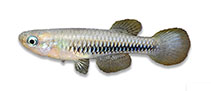 Lacustricola katangae
Photo de Nagy, B. et al., 2025
Images | Images Google
Photo de Nagy, B. et al., 2025
Classification / Noms Noms communs | Synonymes | Catalog of Fishes(Genre, Espèce) | ITIS | CoL | WoRMS | Cloffa
> Cyprinodontiformes (Rivulines, killifishes and live bearers) > Procatopodidae (African lampeyes) > Procatopodinae
Eponymy: This is a toponym; the holoypes of these fishes were collected in Katanga Province (formerly part of the Belgian Congo, now the Democratic Republic of Congo). (Ref. 128868), visit book page.
More on author: Boulenger.
Eponymy: This is a toponym; the holoypes of these fishes were collected in Katanga Province (formerly part of the Belgian Congo, now the Democratic Republic of Congo). (Ref. 128868), visit book page.
More on author: Boulenger.
Taxonomic Remarks
In Micropanchax in CofF (v, April 2020) following Skelton (2019: Ref. 120641). However no evidence is presented in the latter publication. More work is needed.
Environnement : milieu / zone climatique / profondeur / gamme de distribution Écologie
; eau douce benthopélagique; pH range: 6.5 - 7.2; non migrateur. Tropical; 20°C - 28°C (Ref. 2060); 11°S - 28°S
Distribution Territoires | Zones FAO | Écosystèmes | Occurrences | Carte par point | Introductions | Faunafri
Africa: widely distributed in southern Africa (Ref. 47311). Found in rivers and lakes of the southern Democratic Republic of Congo, Angola, Botswana, Zambia, Zimbabwe, Malawi, Mozambique, South Africa and Namibia (Ref. 3788, 47311).
Taille / Poids / Âge
Description synthétique Clés d'identification | Morphologie | Morphométrie
Épines dorsales (Total) : 0; Rayons mous dorsaux (Total) : 8 - 10; Épines anales: 0; Rayons mous anaux: 14 - 15.
It is found in schools mainly in the shallow and vegetated part of small rivers, brooks and swamps, and in the shallow parts of lakes (Ref. 47311). Uncommon in floodplains (Ref. 52193). It feeds on insect larvae, daphnia and other small invertebrates (Ref. 52193). Typical serial spawner, laying eggs on vegetation (Ref. 52193). Useful as a mosquito control agent (Ref. 7248). Not a seasonal killifish. Is difficult to maintain in aquarium (Ref. 27139).
Cycle de vie et comportement reproducteur Maturité | Reproduction | Frai | Œufs | Fécondité | Larves
Référence principale
Téléchargez vos références | Références | Coordinateur | Collaborateurs
Wildekamp, R.H., 1995. A world of killies. Atlas of the oviparous cyprinodontiform fishes of the world. Volume II. The genera Aplocheilichthys, Aplocheilus, Austrofundulus, Campellolebias, Crenichthys, Cualac, Cubanichthys. Cynolebias, Cynopoecilus and Cyprinodon. The American Killifish Association, Inc. 384 p. (Ref. 47311)
Statut dans la liste rouge de l'IUCN (Ref. 130435: Version 2025-2 (Global))
Préoccupation mineure (LC) ; Date assessed: 05 December 2017
CITES
Not Evaluated
Menace pour l'homme
Harmless
Utilisations par l'homme
Aquarium: Commercial
FAO - Publication: search | FishSource |
Plus d'informations
Écologie trophique
Aliments (proies)
Composition du régime alimentaire
Consommation alimentaire
Rations alimentaires
Prédateurs
Aliments (proies)
Composition du régime alimentaire
Consommation alimentaire
Rations alimentaires
Prédateurs
Dynamique des populations
Paramètres de croissance
Âges / tailles maximales
Longueur-poids rel.
Rel. longueur-longueur.
Fréquences de longueurs
Conversion de masse
Recrutement
Abondance
Paramètres de croissance
Âges / tailles maximales
Longueur-poids rel.
Rel. longueur-longueur.
Fréquences de longueurs
Conversion de masse
Recrutement
Abondance
Cycle de vie
Reproduction
Maturité
Maturité/épines rel.
Fécondité
Frai
Agrégats de frai
Œufs
Développement de l'œuf
Larves
Dynamique des populations larvaires
Reproduction
Maturité
Maturité/épines rel.
Fécondité
Frai
Agrégats de frai
Œufs
Développement de l'œuf
Larves
Dynamique des populations larvaires
Anatomie
Surface branchiale
Cerveau
Otolithe
Surface branchiale
Cerveau
Otolithe
Physiologie
Composition corporelle
Nutriments
Consommation d'oxygène
Type de natation
Vitesse de nage
Pigments visuels
Son de poisson
Maladies et parasites
Toxicité (CL50)
Composition corporelle
Nutriments
Consommation d'oxygène
Type de natation
Vitesse de nage
Pigments visuels
Son de poisson
Maladies et parasites
Toxicité (CL50)
Liées à l'homme
Systèmes d'aquaculture
Profils d'aquaculture
Souches
Cas de ciguatera
Timbres, pièces de monnaie, divers
Systèmes d'aquaculture
Profils d'aquaculture
Souches
Cas de ciguatera
Timbres, pièces de monnaie, divers
Outils
E-book | Guide de terrain | Clés d'identification | Générateur de fréquences de longueur | Outil de dynamique de population | Carte par point |
Capture-MSY |
Articles particuliers
Télécharger en XML
Sources Internet
AFORO (otoliths) | Aquatic Commons | BHL | Cloffa | Websites from users | FishWatcher | CISTI | Catalog of Fishes: Genre, Espèce | DiscoverLife | ECOTOX | FAO - Publication: search | Faunafri | Fishipedia | Fishtrace | GloBI | Google Books | Google Scholar | Google | IGFA World Record | OneZoom | Open Tree of Life | Otolith Atlas of Taiwan Fishes | PubMed | Reef Life Survey | Socotra Atlas | TreeBase | Arbre de Vie | Wikipedia: aller à, chercher | World Records Freshwater Fishing | Zoological Record
Estimations basées sur des modèles
Indice de diversité phylogénétique (Réf. 82804): PD50 = 0.5000 [Uniqueness, from 0.5 = low to 2.0 = high].
Bayesian length-weight: a=0.00562 (0.00224 - 0.01412), b=3.07 (2.85 - 3.29), in cm total length, based on LWR estimates for this (Sub)family-body shape (Ref. 93245).
Niveau trophique (Réf. 69278): 3.3 ±0.35 se; based on food items.