



Petrocephalus catostoma (Günther, 1866)
Churchill
Hochladen Photos und videos
Bilder | Google Bild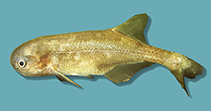 Petrocephalus catostoma
Photo von KMRD
Bilder | Google Bild
Photo von KMRD
Klassifizierung / Names Namen | Synonyme | Catalog of Fishes(Gattung, Arten) | ITIS | CoL | WoRMS | Cloffa
> Osteoglossiformes (Bony tongues) > Mormyridae (Elephantfishes)
Etymology: Petrocephalus: Latin, petra = stone + Greek, kephale = head (Ref. 45335).
More on author: Günther.
Etymology: Petrocephalus: Latin, petra = stone + Greek, kephale = head (Ref. 45335).
More on author: Günther.
Umwelt: Milieu / Klimazone / Tiefenbereich / Verbreitungsgebiet Ökologie
Verbreitung Territorien | FAO Gebiete | Ökosysteme | Vorkommen | Punkt Karte | Einführungen | Faunafri
East Africa: Rovuma River system including Niassa Reserve, and western confluences to Lake Malawi (Ref. 91771). Following a recent revision of the Petrocephalus catostoma complex (Ref. 91771), unambiquous evidence for the presence of this species in the Bangweulu-Mweru area (and consequently the Congo basin) is still lacking (Ref. 91772).
Länge bei der ersten Reifung / Größe / Gewicht / Alter
Kurzbeschreibung Bestimmungsschlüssel | Morphologie | Morphometrie
Rückenflossenstacheln (insgesamt) : 0; Rückenflossenweichstrahlen (insgesamt) : 18 - 22; Afterflossenstacheln: 0; Afterflossenweichstrahlen: 25 - 28.
Body shape (shape guide): fusiform / normal; Cross section: oval.
Body shape (shape guide): fusiform / normal; Cross section: oval.
Occurs in shallow and muddy waters, sheltered bays, in lagoons, and swampy areas; prefers quiet parts of rivers where there is abundant vegetation (Ref. 13337). Forms shoals (Ref. 13337) within quiet reaches of rivers and floodplains, and with other species with identical electric organ discharge (EOD) waveforms (Ref. 10460). Feeds on insects, found on river bed or in marginal vegetation (Ref. 12526), on insect larvae and other invertebrates at night (Ref. 5595). Known to undergo upriver migration (Ref. 13337, 10608) which may well be correlated with breeding (Ref. 13337). Breeds during the rainy season, possibly moving upstream to suitable sites (Ref. 10608). An unconfirmed report claims the males are territorial and build a nest (Ref. 7248). Caught in nets for food (5214). Oviparous (Ref. 205).
Lebenszyklus und Paarungsverhalten Geschlechtsreife | Fortpflanzung | Ablaichen | Eier | Fruchtbarkeit | Larven
Hauptreferenz
Laden Sie Ihre Referenzen hoch | Referenzen | Koordinator | Partner
Kramer, B., R. Bills, P. Skelton and M. Wink, 2012. A critical revision of the churchill snoutfish, genus Petrocephalus Marcusen, 1854 (Actinopterygii: Teleostei: Mormyridae), from southern and eastern Africa, with the recognition of Petrocephalus tanensis, and the description of five new species. Journal of Natural History 46(35-36):2179-2258. (Ref. 91771)
IUCN Rote Liste Status (Ref. 130435: Version 2025-2 (Global))
nicht bedroht (LC) ; Date assessed: 13 June 2018
CITES
Not Evaluated
Bedrohung für Menschen
Harmless
Nutzung durch Menschen
Fischereien: kleinfischerei; Aquarium: Kommerziell
FAO - Publication: search | FishSource |
Mehr Information
Trophische Ökologie
Lebensmittel (Beutetiere)
Nahrungszusammensetzung
Nahrungsaufnahme
Lebensmittelrationen
Räuber
Lebensmittel (Beutetiere)
Nahrungszusammensetzung
Nahrungsaufnahme
Lebensmittelrationen
Räuber
Populationsdynamik
Wachstumsparameter
Max. Alter/Größen
Länge-Gewicht-Rel.
Länge-Länge-Verhältnis.
Längenhäufigkeiten
Massenkonvertierung
Rekrutierung
Dichte
Wachstumsparameter
Max. Alter/Größen
Länge-Gewicht-Rel.
Länge-Länge-Verhältnis.
Längenhäufigkeiten
Massenkonvertierung
Rekrutierung
Dichte
Lebenszyklus
Fortpflanzung
Geschlechtsreife
Reifung/Kiemen rel.
Fruchtbarkeit
Ablaichen
Laichaggregationen
Eier
Eientwicklung
Larven
Larven Pop.Dyn.
Fortpflanzung
Geschlechtsreife
Reifung/Kiemen rel.
Fruchtbarkeit
Ablaichen
Laichaggregationen
Eier
Eientwicklung
Larven
Larven Pop.Dyn.
Physiologie
Körperliche Zusammensetzung
Nährstoffe
Sauerstoffverbrauch
Schwimmart
Schwimmgeschwindigkeit
Visuelle Pigmente
Fischgeräusche
Krankheiten und Parasiten
Toxizität (LC50s)
Körperliche Zusammensetzung
Nährstoffe
Sauerstoffverbrauch
Schwimmart
Schwimmgeschwindigkeit
Visuelle Pigmente
Fischgeräusche
Krankheiten und Parasiten
Toxizität (LC50s)
Genetik
Genom
Genetik
Heterozygotie
Vererbbarkeit
Genetische Vielfalt
Genom
Genetik
Heterozygotie
Vererbbarkeit
Genetische Vielfalt
Menschenbezogen
Aquakultur-Systeme
Aquakultur Profile
Zuchtlinien
Ciguatera-Fälle
Briefmarken, Münzen, Verschiedenes.
Aquakultur-Systeme
Aquakultur Profile
Zuchtlinien
Ciguatera-Fälle
Briefmarken, Münzen, Verschiedenes.
Tools
E-Book | Feldführer | Bestimmungsschlüssel | Längenhäufigkeits Tool | Lebensdaten Tool | Punkt Karte |
Catch-MSY |
Zusatzinformationen
Download XML
Zusammenfassung | Punktdaten | Namen | Photos
Internet Quellen
AFORO (otoliths) | Aquatic Commons | BHL | Cloffa | Websites from users | FishWatcher Einträge suchen | CISTI | Catalog of Fishes: Gattung, Arten | DiscoverLife | ECOTOX | FAO - Publication: search | Faunafri | Fishipedia | Fishtrace | GloBI | Google Books | Google Scholar | Google | IGFA World Record | OneZoom | Open Tree of Life | Otolith Atlas of Taiwan Fishes | PubMed | Reef Life Survey | Socotra Atlas | TreeBase | Tree of Life | Wikipedia: Gehe zu, Suchen | World Records Freshwater Fishing | Zoologischer Rekord
Schätzungen auf der Grundlage von Modellen
Phylogenetischer Diversitätsindex (Ref. 82804): PD50 = 0.5000 [Uniqueness, from 0.5 = low to 2.0 = high].
Bayesian length-weight: a=0.01349 (0.00750 - 0.02425), b=2.82 (2.67 - 2.97), in cm total length, based on LWR estimates for this species & Genus-body shape (Ref. 93245).
Trophische Ebene (Ref. 69278): 3.4 ±0.38 se; based on food items.
Generation time: 1.4 ( na - na) years. Estimated as median ln(3)/K based on 2 growth studies.
Widerstandsfähigkeit (Ref. 120179): mittel, Verdopplung der Population dauert 1,4 - 4,4 Jahre. (Fec = 116).