



Helcogramma obtusirostris (Klunzinger, 1871)
Hotlips triplefin
Adicionar as suas observações no Fish Watcher
| Native range | All suitable habitat | Point map | Year 2050 |

|
| This map was computer-generated and has not yet been reviewed. |
| Helcogramma obtusirostris AquaMaps Data sources: GBIF OBIS |
Adicionar o seu Fotografias e vídeos
Fotografias | Imagem do Google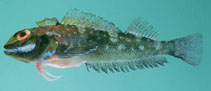 Helcogramma obtusirostris
Fotografia de Randall, J.E.
Fotografias | Imagem do Google
Fotografia de Randall, J.E.
Classificação / Nomes Nomes comuns | Sinónimos | Catalog of Fishes(Género, Espécies) | ITIS | CoL | WoRMS | Cloffa
> Blenniiformes (Blennies) > Tripterygiidae (Triplefin blennies) > Tripterygiinae
Etymology: Helcogramma: Greek, helkos, -eos, -ous = ulcer, sore + Greek, gramma = letter, mark (Ref. 45335).
More on author: Klunzinger.
Etymology: Helcogramma: Greek, helkos, -eos, -ous = ulcer, sore + Greek, gramma = letter, mark (Ref. 45335).
More on author: Klunzinger.
Ambiente: milieu / zona climática / intervalo de profundidade / gama de distribuição Ecologia
marinhas; estuarina demersal; intervalo de profundidade 0 - 30 m (Ref. 5497). Tropical
Distribuição Territórios | Áreas FAO | Ecossistemas | Ocorrências | Mapa dos pontos | Introduções | Faunafri
Southeast Atlantic: Ascension Island and St. Helena (Ref. 11441). Indo-West Pacific: Red Sea south to Transkei, South Africa and east to the western Pacific.
Tamanho / Peso / Idade
Descrição breve Chaves de identificação | Morfologia | Morfometria
Espinhos dorsais (total) : 15 - 18; Raios dorsais moles (total) : 9 - 10; Espinhos anais: 1; Raios anais moles: 18 - 19; Vértebras: 35 - 36. This species is distinguished by the following characters: D III + XII - XIII, 9-10 (usually XIII spines or 10 rays); A I, 18-19 (usually 19); pectoral rays 16 (usually 2, 7, 7). Second dorsal fin twice higher than the first. Lateral line tube scales 20-23 (usually 21-22), extending to the junction of second and third dorsal fins; total lateral scales 36-38 (usually 37-38); transverse scales 7/5. Dentary pores 4 + 1 + 4. Maxilla reaches vertical through centre of pupil; orbital cirrus small and simple. Nape and belly naked; scales do not extend to bases of first dorsal and anterior of anal fins; scale rows 2 on base of caudal fin. Pelvic rays united by membrane for half shorter ray, longest ray reaching vent. Head length 3.3-3.7 (3.5) in SL. Body translucent underwater and green when freshly out of water. Underwater, male head red on upper side and with many melanophores below eyes, extending onto base of pectoral fin; light blue line on cheek with blue patch below; body ‘with H’-bars red and streaks white, belly pinkish-red; dorsal fins translucent with white and red streaks, pelvic and caudal fins pinkish, pectoral fins translucent with red and white marks; females similar to males but overall largely white and without the distinctive pigmentation on the head and belly. Out of water, males overall mottled green, interconnecting areas darker, suffused with dull red dorso-anteriorly, head dark, eye and to branchiostegal membrane black; cheek stripe iridescent blue from lower lip through corner of mouth to preopercle, margin broad black; back saddle patches 4 pale narrow from dorsal fin base to midline, 2 below second dorsal fin and 2 below third dorsal fin; midline spots pale; belly pink; pectoral-fin base with red spot above and below, the lower one bluish anteriorly; pelvic fins dark pink proximally; first dorsal fin dusky with orange tinge, darkest on the margin, and with spot, small black at base of membrane between first and second dorsal fins; dorsal and caudal fins dusky, anal fin evenly dark. Females dull green and paler ventrally, zigzag pattern formed by dark areas; median fins with light sprinkle of pigmentation, first dorsal fin spots small black, basal third of dorsal and entire anal fins white (Ref. 88983). Measurements in %SL: head length 30.2 (26.7-33.6); eye diameter 10.2 (7.8-12.7); seventh pectoral ray 30.6 (26.6-34.1); upper jaw length 13.3 (11.6-15.0); longest pelvic ray 24.2 (19.3-29.4) (Ref. 6211).
Body shape (shape guide): elongated; Cross section: oval.
Body shape (shape guide): elongated; Cross section: oval.
Adults are found at depths of 6 m and shallower on exposed rocky coasts (Ref. 90102). Eggs are hemispherical and covered with numerous sticky threads that anchor them in the algae on the nesting sites (Ref. 240). Larvae are planktonic which occur primarily in shallow, nearshore waters (Ref. 94114).
Ciclo de vida e comportamento de acasalamento Maturidade | Reprodução | Desova | Ovos | Fecundidade | Larvas
Referência principal
Carregar as suas referências | Referências | Coordenador : Fricke, Ronald | Colaboradores
Holleman, W. and S.V. Bogorodsky, 2012. A review of the blennioid fish family Tripterygiidae (Perciformes) in the Red Sea, with description of Enneapterygius qirmiz, and reinstatement of Enneapterygius altipinnis Clark, 1980. Zootaxa 3152:36-60. (Ref. 88983)
Categoria na Lista Vermelha da IUCN (Ref. 130435: Version 2025-2 (Global))
Preocupação menor (LC) ; Date assessed: 07 May 2010
CITES
Not Evaluated
Ameaça para o homem
Harmless
Utilização humana
Pescarias: sem interesse
FAO - Publication: search | FishSource |
Mais informação
Ecologia Trófica
Produtos alimentares (presas)
Composição da dieta
Consumo alimentar
Rações alimentares
Predadores
Produtos alimentares (presas)
Composição da dieta
Consumo alimentar
Rações alimentares
Predadores
Dinâmica das populações
Parâmetros de crescimento
Idades / tamanhos máximos
Comprimento-peso rel.
Comprimento-comprimento rel.
Frequência de comprimento
Conversão de massa
Recrutamento
Abundância
Parâmetros de crescimento
Idades / tamanhos máximos
Comprimento-peso rel.
Comprimento-comprimento rel.
Frequência de comprimento
Conversão de massa
Recrutamento
Abundância
Anatomia
Área branquial
Cérebro
Otólitos
Área branquial
Cérebro
Otólitos
Fisiologia
Composição corporal
Nutrientes
Consumo de oxigénio
Tipo de natação
Velocidade de natação
Pigmentos visuais
Som de peixe
Doenças e Parasitas
Toxicidade (LC50s)
Composição corporal
Nutrientes
Consumo de oxigénio
Tipo de natação
Velocidade de natação
Pigmentos visuais
Som de peixe
Doenças e Parasitas
Toxicidade (LC50s)
Genética
genoma
Genética
Heterozigotia
Hereditariedade
Diversidade genética
genoma
Genética
Heterozigotia
Hereditariedade
Diversidade genética
Relacionado com o ser humano
Sistemas de aquacultura
Perfis para aquacultura
Estirpes
Casos de Ciguatera
Selos, moedas, diversos.
Sistemas de aquacultura
Perfis para aquacultura
Estirpes
Casos de Ciguatera
Selos, moedas, diversos.
Ferramentas
E-book | Guia de campo | Ferramenta auxiliar de frequências de comprimento | Ferramenta sobre a história de vida | Mapa dos pontos |
Captura-MSY |
Relatórios especiais
Descarregue XML
Fontes da internet
AFORO (otoliths) | Aquatic Commons | BHL | Cloffa | Websites from users | Consultar FishWatcher | CISTI | Catalog of Fishes: Género, Espécies | DiscoverLife | ECOTOX | FAO - Publication: search | Faunafri | Fishipedia | Fishtrace | GloBI | Google Books | Google Scholar | Google | IGFA World Record | Bases de dados nacionais | OneZoom | Open Tree of Life | Otolith Atlas of Taiwan Fishes | PubMed | Reef Life Survey | Socotra Atlas | TreeBase | Árvore da vida | Wikipedia: ir para, procurar | World Records Freshwater Fishing | Registo zoológico
Estimativas baseadas em modelos
Temperatura preferida (Ref. 123201): 23.8 - 29.2, mean 28.4 °C (based on 3393 cells).
Índice de diversidade filogenética (Ref. 82804): PD50 = 0.5000 [Uniqueness, from 0.5 = low to 2.0 = high].
Bayesian length-weight: a=0.00617 (0.00290 - 0.01310), b=3.04 (2.86 - 3.22), in cm total length, based on LWR estimates for this (Sub)family-body shape (Ref. 93245).
Nível Trófico (Ref. 69278): 3.1 ±0.3 se; based on size and trophs of closest relatives
Resiliência (Ref. 120179): Elevada, tempo mínimo de duplicação da população menor que 15 meses (Preliminary K or Fecundity.).