



Antennablennius bifilum (Günther, 1861)
Horned rockskipper
Aggiungete la vostra osservazione in Fish Watcher
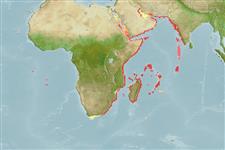
| Native range | All suitable habitat | Point map | Year 2050 |
|
| This map was computer-generated and has not yet been reviewed. |
| Antennablennius bifilum AquaMaps Data sources: GBIF OBIS |
Carica il tuo foto e Video
Immagini | Google image Antennablennius bifilum
Immagine di Wirtz, P.
Immagini | Google image
Immagine di Wirtz, P.
Classificazione / Nomi Nomi Comuni | Sinonimi | Catalog of Fishes(Genere, Specie) | ITIS | CoL | WoRMS | Cloffa
> Blenniiformes (Blennies) > Blenniidae (Combtooth blennies) > Salariinae
Etymology: Antennablennius: Latin, antenna, antemna = sensory organ; in Aristotle = horns of insects + Greek, blennios = mucus (Ref. 45335).
More on author: Günther.
Etymology: Antennablennius: Latin, antenna, antemna = sensory organ; in Aristotle = horns of insects + Greek, blennios = mucus (Ref. 45335).
More on author: Günther.
Ambiente: milieu / zona climatica / distribuzione batimetrica / gamma di distribuzione Ecologia
marino demersale; distribuzione batimetrica 18 - 37 m (Ref. 11441). Tropical
Distribuzione Territories | Aree FAO | Ecosistemi | Presenze | Mappa dei ritrovamenti | Introduzioni | Faunafri
Western Indian Ocean: Mozambique to South Africa (Eastern Cape), Madagascar, Comoros, Aldabra and Mascarenes; not known from Red Sea.
Dimensione / Peso / Età
Breve descrizione Chiavi di identificazione | Morfologia | Morfometria
Spine dorsali (totale) : 7; Raggi dorsali molli (totale) : 17 - 19; Spine anali: 2; Raggi anali molli: 17 - 20. The species can be distinguished from Antennablennius persicus by the following characters: number of segmented ray in dorsal fin, 17-18 (vs. 19-20 in A. persicus), anal fins 18-19 (vs. 20); white bars restricted to the ventral half and white spots on the anterior part of body (vs. white narrow bars on the anterior unspotted part of body below spinous portion of the dorsal fin); three black bars ventrally on the head (vs. with a black bar ventrally on the head at angle of mouth (Ref. 132085).
Cross section: oval.
Cross section: oval.
Oviparous. Eggs are demersal and adhesive (Ref. 205), and are attached to the substrate via a filamentous, adhesive pad or pedestal (Ref. 94114). Larvae are planktonic, often found in shallow, coastal waters (Ref. 94114).
Ciclo vitale e comportamento di accoppiamento Maturità | Riproduzione | Deposizione | Uova | Fecondità | Larve
Oviparous, distinct pairing (Ref. 205).
Riferimento principale
Caricare le referenze | Bibliografia | Coordinatore : Williams, Jeffrey T. | Collaboratori
Springer, V.G., 1986. Blenniidae. p. 742-755. In M.M. Smith and P.C. Heemstra (eds.) Smiths' sea fishes. Springer-Verlag, Berlin. (Ref. 4404)
Stato della Lista Rossa IUCN (Ref. 130435: Version 2025-2 (Global))
Least Concern (LC) ; Date assessed: 24 March 2009
CITES
Not Evaluated
Minaccia per l'uomo
Harmless
Usi umani
FAO - Publication: search | FishSource |
Informazioni ulteriori
Ecologia trofica
Articoli alimentari (prede)
Alimentazione
Consumo di cibo
Razioni alimentari
Predatori
Articoli alimentari (prede)
Alimentazione
Consumo di cibo
Razioni alimentari
Predatori
Ecologia
Ecologia
Ecologia
Dinamica della popolazione
Parametri di crescita
Età massima / dimensioni massime
Rapporto lunghezza-peso.
Lunghezza-lunghezza rel.
Lunghezza-frequenze
Conversione di massa
Reclutamento
Abbondanza
Parametri di crescita
Età massima / dimensioni massime
Rapporto lunghezza-peso.
Lunghezza-lunghezza rel.
Lunghezza-frequenze
Conversione di massa
Reclutamento
Abbondanza
Ciclo di vita
Riproduzione
Maturità
Maturità/Gli occhielli sono relativi.
Fecondità
Deposizione
Aggregazioni riproduttive
Uova
Sviluppo delle uova
Larve
Dinamica popolazioni larvali
Riproduzione
Maturità
Maturità/Gli occhielli sono relativi.
Fecondità
Deposizione
Aggregazioni riproduttive
Uova
Sviluppo delle uova
Larve
Dinamica popolazioni larvali
Anatomia
Area branchiale
Cervello
Otolite
Area branchiale
Cervello
Otolite
Fisiologia
Composizione corporea
Nutrienti
Consumo di ossigeno
Tipo di nuoto
Velocità di nuoto
Pigmenti visivi
Suono del pesce
Malattie e parassiti
Tossicità (LC50)
Composizione corporea
Nutrienti
Consumo di ossigeno
Tipo di nuoto
Velocità di nuoto
Pigmenti visivi
Suono del pesce
Malattie e parassiti
Tossicità (LC50)
Genetica
Genome
Genetica
Eterozigosi
Ereditarietà
Diversità genetica
Genome
Genetica
Eterozigosi
Ereditarietà
Diversità genetica
Legato all'uomo
Sistemi di acquacoltura
Profili di acquacoltura
Varietà
Casi di Ciguatera
Francobolli, monete, materiale vario.
Sistemi di acquacoltura
Profili di acquacoltura
Varietà
Casi di Ciguatera
Francobolli, monete, materiale vario.
Strumenti
Libro elettronico | Giuda pratica | Generatore frequenze di lunghezza | Strumento Parametri Biologici | Mappa dei ritrovamenti |
Cattura-MSY |
Rapporti speciali
Controllo della manutenzione dell'acquario | Verificare la presenza di schede informative sulle specie | Verifica delle schede informative sull'acquacoltura
Scarica XML
Fonti Internet
AFORO (otoliths) | Aquatic Commons | BHL | Cloffa | Websites from users | Check FishWatcher | CISTI | Catalog of Fishes: Genere, Specie | DiscoverLife | ECOTOX | FAO - Publication: search | Faunafri | Fishipedia | Fishtrace | GloBI | Google Books | Google Scholar | Google | IGFA World Record | OneZoom | Open Tree of Life | Otolith Atlas of Taiwan Fishes | PubMed | Reef Life Survey | Socotra Atlas | TreeBase | Tree of Life | Wikipedia: Go, ricerca | World Records Freshwater Fishing | Record zoologico
Stime basate su modelli
Temperatura preferita (Fonte Biblio. 123201): 23.5 - 29, mean 26.7 °C (based on 86 cells).
Indice di diversità filogenetica (Fonte Biblio. 82804): PD50 = 0.5020 [Uniqueness, from 0.5 = low to 2.0 = high].
Bayesian length-weight: a=0.00776 (0.00354 - 0.01702), b=3.00 (2.81 - 3.19), in cm total length, based on LWR estimates for this (Sub)family-body shape (Ref. 93245).
Resilienza (Fonte Biblio. 120179): Alto, tempo minimo di raddoppiamento della popolazione meno di 15 mesi (Preliminary K or Fecundity.).