This website uses cookies to enhance your browsing experience and ensure the functionality of our site. For more detailed information about the types of cookies we use and how we protect your privacy, please visit our Privacy Information page.
×
Cookie Settings
This website uses different types of cookies to enhance your experience. Please select your preferences below:
> Mugiliformes (Mullets) > Mugilidae (Mullets)
Etymology: Mugil:Latin, mugil, -ilis = grey mullet (Ref. 45335); cephalus:cephalus meaning head (Ref. 10294). More on author: Linnaeus.
Taxonomic Remarks Genetic data indicate that Mugil cephalus is globally a complex of species, At least 14 species (incl. former synonyms) have been recognized. The name should be applied only in North-East Atlantic and Mediterranean, Where species are sympatric, genetic and ecological data have confirmed the species validity (Refs. 89471,123406; 123405).
Môi trường: môi trường / vùng khí hậu / Mức độ sâu / phạm vi phân phối Sinh thái học
biển; nước ngọt; thuộc về nước lợ sống nổi và đáy; di cư sông biển (để đẻ trứng) (Ref. 138269); mức độ sâu 0 - 120 m (Ref. 9321), usually 0 - 10 m. Subtropical; 8°C - 24°C (Ref. 4944); 62°N - 57°S, 180°W - 180°E (Ref. 117425)
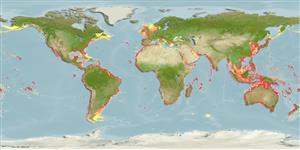
Cosmopolitan in coastal waters of the tropical, subtropical and temperate zones of all seas. Eastern Pacific: California, USA to Chile (Ref. 2850). Western Pacific: Japan to Australia (Ref. 9812). Western Indian Ocean: from India to South Africa (Ref. 4393). Western Atlantic: Nova Scotia, Canada to Brazil (Ref. 7251); Cape Cod to southern Gulf of Mexico (Ref. 26938); absent in the Bahamas and most of West Indies and Caribbean (Ref. 7251, 9761). Eastern Atlantic: Bay of Biscay to South Africa, including the Mediterranean Sea and Black Sea (Ref. 7399). Reported in Sea of Okhotsk (Ref. 50550).
Chiều dài lúc trưởng thành đầu tiên / Bộ gần gũi / Khối lượng (Trọng lượng) / Tuổi
Chín muồi sinh dục: Lm35.4, range 30 - ? cm Max length : 100.0 cm SL con đực/không giới tính; (Ref. 2804); common length : 50.0 cm SL con đực/không giới tính; (Ref. 7399); Tuổi cực đại được báo cáo: 16 các năm (Ref. 28725)
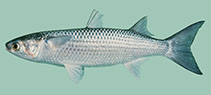
Các tia vây lưng cứng (tổng cộng) : 5; Các vây lưng mềm (tổng cộng) : 7 - 9; Tia cứng vây hậu môn: 3; Tia mềm vây hậu môn: 8 - 9. Diagnosis: body stout, cylindrical in cross-section, slightly compressed; head broad and flattened (Ref. 57400). Well developed adipose eyelid (Ref. 40476, 57400) covering most of pupil (Ref. 57400). Upper lip thin and without papillae (Ref. 57400), with 1-2 outer rows of small, moderately close-set, unicuspid teeth and up to 6 inner rows of smaller, bicuspid teeth (Ref. 81659). Lower lip with outer row of small unicuspid teeth and sometimes 1 or more inner rows of smaller, bicuspid teeth (Ref. 81659). Hind end of upper jaw reaching a vertical line from anterior eye margin; maxillary pad not visible below corner of mouth when closed; origin of 1st dorsal fin nearer to snout tip than to caudal-fin base (Ref. 57400). Anterior parts and bases of 2nd dorsal and anal fins with a moderately dense coverage of scales (Ref. 57400, 81659). Pectoral axillary process (Ref. 57400). 13-15 scale rows between origins of dorsal and pelvic fins (Ref. 57400, 81659). Pelvic fins, anal fin, and lower lobe of caudal fin yellowish in specimens from the tropical Atlantic coast of Africa (Ref. 57400, 81659).
Body shape (shape guide): fusiform / normal; Cross section: circular.
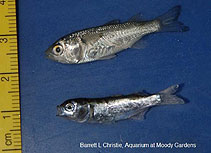
Adults are found in coastal waters (Ref. 2850, 44894, 57400), often entering estuaries and rivers (Ref. 2847, 3573, 11230, 44894, 57400), sometimes far-up-river, lagoons and hypersaline environments (Ref. 57400); and in mangrove areas (Ref. 138854). They are usually in schools over sand or mud bottom (Ref. 2850), between 0 and 10 m, occurring equally in tropical, subtropical and temperate waters (Project MUGIL). They are mainly diurnal, feeding on detritus, micro-algae and benthic organisms (Ref. 56548, 74902, 74760). Juveniles feed on zooplankton until about 3.0 cm SL (Ref. 59043). Reproduction takes place at sea, at various times of the year depending on the location (Ref. 74907, Amour). Adults form schools and migrate offshore to spawn and developing larvae migrate back inshore (Ref. 81659). There is absence of an obligatory freshwater phase in the life cycle (Ref. 74752). Females spawn 0.8 to 2.6 million eggs which develop at sea (Ref. 74912, Chen & Su 1986). Sexually mature at 3 to 4 years (Ref. 74902). Maximum length reported as 120 cm SL (Ref. 7399, 57400, 81659) remains to be confirmed (Project MUGIL). Maximum weight reported as 12 kg (Ref. 56527) seems too high for the area and remains to be confirmed (Project MUGIL). Widely cultivated in freshwater and brackish ponds (Ref. 2847, Jackson 1984, Liao 1981). Marketed fresh, dried, salted, and frozen; roe sold fresh or smoked (Ref. 9321); also used in Chinese medicine (Ref. 12166).
One spawning aggregation was observed in detail. This consisted of five fish, a female and four males. Males would press against the female, which took place as the entire group moved along slowly, facing into a fairly strong tidal flow.
Harrison, I.J., 1995. Mugilidae. Lisas. p. 1293-1298. In W. Fischer, F. Krupp, W. Schneider, C. Sommer, K.E. Carpenter and V. Niem (eds.) Guia FAO para Identification de Especies para lo Fines de la Pesca. Pacifico Centro-Oriental. 3 Vols. FAO, Rome. (Ref. 9321)
Tình trạng Sách đỏ IUCN (Ref. 130435: Version 2025-2 (Global))