



Masukkan pemerhatian anda di Fish Watcher
| Native range | All suitable habitat | Point map | Year 2050 |

|
| This map was computer-generated and has not yet been reviewed. |
| Kuhlia rupestris AquaMaps Data sources: GBIF OBIS |
muatnaik fotos/gambar dan video
Gambar | Perangko, koin, dll. | imej Google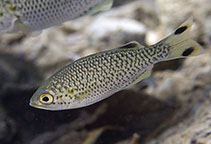 Kuhlia rupestris
foto/gambar oleh Ryan, P.
Gambar | Perangko, koin, dll. | imej Google
foto/gambar oleh Ryan, P.
klasifikasi / Nama Nama-nama umum | Sinonim (persamaan) | Catalog of Fishes(Marga, Jenis) | ITIS | CoL | WoRMS | Cloffa
> Centrarchiformes (Basses) > Kuhliidae (Aholeholes)
Etymology: Kuhlia: Because of Heindrich Kuhl, 1797-1821; researcher also with lizards (Gekkonidae).
Eponymy: Dr Heinrich Kuhl (1797–1821) was a German naturalist and zoologist. [...] (Ref. 128868), visit book page.
More on author: Lacepède.
Etymology: Kuhlia: Because of Heindrich Kuhl, 1797-1821; researcher also with lizards (Gekkonidae).
Eponymy: Dr Heinrich Kuhl (1797–1821) was a German naturalist and zoologist. [...] (Ref. 128868), visit book page.
More on author: Lacepède.
Lingkungan: lingkungan / zona iklim / kisaran kedalaman / jangkauan distribusi Ekologi
laut; air tawar; payau berasosiasi dengan karang; katadromus (ruaya dari air tawar ke laut) (Ref. 138274); kisaran kedalaman 0 - 5 m (Ref. 86942). Tropical; 20°C - 26°C (Ref. 2060)
Penyebaran Wilayah | Daerah-daerah FAO | Ekosistem | Kemunculan | peta titik | Introduksi | Faunafri
Africa to Asia and Oceania: East Africa to Samoa, north to the Ryukyu Islands, south to Queensland, Australia and New Caledonia.
Panjang pada saat jatuh tempo pertama / Ukuran / Berat / umur
Kematangan: Lm 26.5, range 26 - 27 cm
Max length : 45.0 cm TL jantan/; (Ref. 5329); common length : 25.0 cm SL jantan/; (Ref. 2847); Berat maksimum terpublikasi: 2.7 kg (Ref. 5329)
Max length : 45.0 cm TL jantan/; (Ref. 5329); common length : 25.0 cm SL jantan/; (Ref. 2847); Berat maksimum terpublikasi: 2.7 kg (Ref. 5329)
deskripsi pendek Kunci identifiaksi (pengenalan) | Morfologi | Morfometrik
Duri punggung (Keseluruhan (total)) : 10; duri punggung lunak (Keseluruhan (total)) : 10 - 12; Duri dubur: 3; Sirip dubur lunak: 9 - 11. Diagnosis: Preorbital serrae 10-15 (obsolete in large specimens); body depth 2.6-3.0 in SL; mouth large for genus, maxilla reaching to below posterior half of eye; caudal fin emarginate, lobes somewhat rounded, caudal concavity 5.3-8.7 in head length (Ref. 41640). Reduced number of lateral line scales; 17-18(19) gillrakers on lower part of first bracnhial arch; body with spots (Ref. 79840).
Coloration: Silvery, the scales dorsally on body with black edges, those on side with a black bar or spot; juveniles with a broad black zone, edged above and below in white, in soft portion of dorsal fin, and each lobe of caudal fin with a large, white-edged black spot; black areas in these fins enlarge with growth until in adults most of these fins black (caudal with upper and lower edges and corners whitish) (Ref. 41640).
Body shape (shape guide): fusiform / normal.
Body shape (shape guide): fusiform / normal.
Primarily a freshwater inhabitant but may penetrate adjacent marine habitats (Ref. 41640). Adults occur in estuaries and the middle reaches of rivers; usually in relatively fast-flowing, clear streams (Ref. 2847, 79840). Usually in rainforests, as well as in rocky pools below waterfalls (Ref. 44894). Adults are omnivorous, feeding on small fishes, insects, crustaceans and fruits (figs) that drop into the water. Specific breeding habits are unknown, but adults move downstream into estuaries or to the sea to spawn (Ref. 44894). Neither anterolateral groove nor venom gland is present (Ref. 57406). Good food fish (Ref. 5329).
Siklus hidup dan perilaku kawin Kematangan | Reproduksi, perkembang biakan | Pemijahan | telur-telur | Fekunditas | Larva
Presumably non-guarders (RF).
rujukan utama
Unggah referensi Anda | Acuan | Koordinator | mitra
Randall, J.E. and H.A. Randall, 2001. Review of the fishes of the genus Kuhlia (Perciformes: Kuhliidae) of the Central Pacific. Pac. Sci. 55(3):227-256. (Ref. 41640)
Status IUCN Red List (Ref. 130435: Version 2025-2 (Global))
kurang bimbang (LC) ; Date assessed: 14 February 2019
CITES
Not Evaluated
ancaman kepada manusia
Harmless
penggunaan manusia
Perikanan: komersial; Ikan buruan: ya
FAO - Publication: search | FishSource | Laut di Sekitar Kita
informasi lanjut
Dinamika populasi
Parameter pertumbuhan
Maks. usia / ukuran
Panjang-berat rel.
Panjang-panjang rel.
ukuran frekuensi
Konversi massa
pemulihan
Kelimpahan
Parameter pertumbuhan
Maks. usia / ukuran
Panjang-berat rel.
Panjang-panjang rel.
ukuran frekuensi
Konversi massa
pemulihan
Kelimpahan
Siklus hidup
Reproduksi, perkembang biakan
Kematangan
Kedewasaan / insang rel.
Fekunditas
Pemijahan
Agregasi pemijahan
telur-telur
pekembangan telor
Larva
Dinamika larva
Reproduksi, perkembang biakan
Kematangan
Kedewasaan / insang rel.
Fekunditas
Pemijahan
Agregasi pemijahan
telur-telur
pekembangan telor
Larva
Dinamika larva
Anatomi
Area insang
Otak
Otolith
Area insang
Otak
Otolith
Fisiologi
Komposisi tubuh
Nutrisi
Konsumsi oksigen
Jenis renang
Kecepatan berenang
Pigmen visual
Suara ikan
Penyakit & Parasit
Toksisitas (LC50)
Komposisi tubuh
Nutrisi
Konsumsi oksigen
Jenis renang
Kecepatan berenang
Pigmen visual
Suara ikan
Penyakit & Parasit
Toksisitas (LC50)
Yang berhubungan dengan manusia
Sistem akuakultur
profil budidaya air
Strain
Kasus Ciguatera
Perangko, koin, dll.
Sistem akuakultur
profil budidaya air
Strain
Kasus Ciguatera
Perangko, koin, dll.
Alat, peralatan
Kuis organik | E-book | Penuntun lapangan | Kunci identifiaksi (pengenalan) | tanda freqkuenci panjang | peringkat sejarah hidup | peta titik |
Tangkap-MSY |
laporan khas
muat turun XML
Sumber internet
AFORO (otoliths) | Alien/Invasive Species database | Aquatic Commons | BHL | Cloffa | Websites from users | semak peneliti ikan | CISTI | Catalog of Fishes: Marga, Jenis | DiscoverLife | ECOTOX | FAO - Publication: search | Faunafri | Fishipedia | Fishtrace | GloBI | Google Books | Google Scholar | Google | IGFA World Record | Pangkalan data nasional | OneZoom | Open Tree of Life | Otolith Atlas of Taiwan Fishes | PubMed | Reef Life Survey | Socotra Atlas | TreeBase | Tree of Life | Wikipedia: pergi, Cari | World Records Freshwater Fishing | Catatan Zoologi
Estimasi berdasarkan model
Suhu yang disukai (Acuan 123201): 24.2 - 29.3, mean 28.4 °C (based on 2775 cells).
Indeks keanekaragaman filogenetik (Acuan 82804): PD50 = 0.5005 [Uniqueness, from 0.5 = low to 2.0 = high].
Bayesian length-weight: a=0.01413 (0.00597 - 0.03345), b=3.06 (2.86 - 3.26), in cm total length, based on LWR estimates for this (Sub)family-body shape (Ref. 93245).
Tingkat Trofik (Acuan 69278): 3.2 ±0.45 se; based on food items.
Daya lenting (Acuan 120179): sedang, Waktu penggandaan populasi minimum 1.4 - 4.4 tahun (Preliminary K or Fecundity.).
Nutrisi (Ref. 124155): Calcium = 47.5 [26.2, 74.1] mg/100g; Iron = 0.537 [0.323, 0.863] mg/100g; Protein = 19.4 [18.3, 20.4] %; Omega3 = 0.111 [0.070, 0.175] g/100g; Selenium = 19.4 [11.2, 34.6] μg/100g; VitaminA = 80.8 [27.4, 245.9] μg/100g; Zinc = 1.58 [1.13, 2.15] mg/100g (wet weight);