



Istiophorus platypterus (Shaw, 1792)
Indo-Pacific sailfish
Aggiungete la vostra osservazione in Fish Watcher
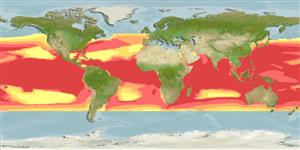
| Native range | All suitable habitat | Point map | Year 2050 |
|
| This map was computer-generated and has not yet been reviewed. |
| Istiophorus platypterus AquaMaps Data sources: GBIF OBIS |
Carica il tuo foto e Video
Immagini | Francobolli, monete, materiale vario. | Google image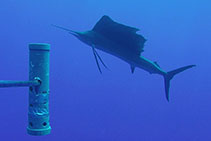 Istiophorus platypterus
Immagine di University of Western Australia (UWA)
Immagini | Francobolli, monete, materiale vario. | Google image
Immagine di University of Western Australia (UWA)
Classificazione / Nomi Nomi Comuni | Sinonimi | Catalog of Fishes(Genere, Specie) | ITIS | CoL | WoRMS | Cloffa
> Carangiformes (Jacks) > Istiophoridae (Billfishes)
Etymology: Istiophorus: Greek, istios = sail + Greek, pherein = to carry (Ref. 45335).
More on author: Shaw.
Etymology: Istiophorus: Greek, istios = sail + Greek, pherein = to carry (Ref. 45335).
More on author: Shaw.
Ambiente: milieu / zona climatica / distribuzione batimetrica / gamma di distribuzione Ecologia
marino pelagic-oceanic; oceanodromo (Ref. 71039); distribuzione batimetrica 0 - 200 m (Ref. 54238), usually 30 - ? m (Ref. 9688). Subtropical; 50°N - 43°S, 180°W - 180°E (Ref. 43)
Distribuzione Territories | Aree FAO | Ecosistemi | Presenze | Mappa dei ritrovamenti | Introduzioni | Faunafri
Indo-Pacific: tropical and temperate waters approximately 45°- 50°N and 40°-35°S in the western Pacific, 35°N and 35°S in the eastern Pacific; 45°S in western Indian Ocean and 35°S in eastern Indian Ocean. Entered Mediterranean Sea from Red sea via Suez Canal. Highly migratory species. Some authors recognize a single worldwide species, Istiophorus platypterus (Shaw & Nodder 1792) but we follow Nakamura 1990 (Ref. 10820) retaining the usage of Istiophorus platypterus for the Indo-Pacific sailfish and Istiophorus albicans for the Atlantic sailfish in recognition of the differences between them.
Dimensione / Peso / Età
Maturità: Lm ? range ? - 150 cm
Max length : 348 cm FL maschio/sesso non determinato; (Ref. 40637); common length : 270 cm TL maschio/sesso non determinato; (Ref. 9308); peso massimo pubblicato: 100.2 kg (Ref. 40637); Età massima riportata: 13 anni (Ref. 53742)
Max length : 348 cm FL maschio/sesso non determinato; (Ref. 40637); common length : 270 cm TL maschio/sesso non determinato; (Ref. 9308); peso massimo pubblicato: 100.2 kg (Ref. 40637); Età massima riportata: 13 anni (Ref. 53742)
Breve descrizione Chiavi di identificazione | Morfologia | Morfometria
Spine dorsali (totale) : 0; Raggi dorsali molli (totale) : 47 - 53; Spine anali: 2; Raggi anali molli: 12 - 15. This species is distinguished by the following characters: slender elongate and fairly compressed with a high, sail-like first dorsal fin; upper jaw prolonged into a very long beak, slender and round in cross-section; jaws and palatines with villiform teeth; no gill rakers; two dorsal fins, the first very large (42-49 rays) the second small (6-7 rays); pectoral fins 18-20 rays; pelvic fins I, 2 soft rays fused together, very long and narrow, depressible into a groove; caudal peduncle with double keels on each side; body covered with small, embedded scales with 1 or 2 blunt points. Colour of back dark with about 20 bluish vertical bars; belly pale silver; membrane of first dorsal fin blue- black with numerous dark spots; bases of first and second anal fins often tinged with silvery white; remaining fins blackish brown or dark blue (Ref. 43, 26938).
Body shape (shape guide): elongated; Cross section: compressed.
Body shape (shape guide): elongated; Cross section: compressed.
Oceanic and epipelagic species usually found above the thermocline. Most densely distributed in waters close to coasts and islands (Ref. 9688). Most likely schools by size. Undergoes spawning migrations in the Pacific. Feeds mainly on fishes, crustaceans and cephalopods. Caught mainly with longlines, set nets, and sometimes by trolling and harpooning from boats (Ref. 43). Utilized fresh, smoked and frozen; also used for sashimi and sushi; eaten broiled and baked (Ref. 9987).
Ciclo vitale e comportamento di accoppiamento Maturità | Riproduzione | Deposizione | Uova | Fecondità | Larve
Seems to spawn throughout the year in tropical and subtropical waters of the Pacific with peak spawning occurring in the respective local summer seasons. Spawning occurs with males and females swimming in pairs or with two or three males chasing a single female (probably a mating behavior). The ripe ovarian eggs are about 0.85 mm in diameter and have a single oil globule; there are no structures on the vitalize membrane and the egg is transparent. Eggs shed from captured female in the Indian Ocean averaged 1.304 mm in diameter.
Riferimento principale
Caricare le referenze | Bibliografia | Coordinatore | Collaboratori
Nakamura, I., 1985. FAO species catalogue. Vol. 5. Billfishes of the world. An annotated and illustrated catalogue of marlins, sailfishes, spearfishes and swordfishes known to date. FAO Fish. Synop. 125(5):65p. Rome: FAO. (Ref. 43)
Stato della Lista Rossa IUCN (Ref. 130435: Version 2025-2 (Global))
Vulnerabile (VU) (A2bd); Date assessed: 01 May 2021
CITES
Not Evaluated
Minaccia per l'uomo
Harmless
Usi umani
Pesca: commerciale; Pesce da pesca sportiva: si
FAO - pesca: sbarchi, profilo della specie; Publication: search | FishSource | Sea Around Us
Informazioni ulteriori
Ecologia trofica
Articoli alimentari (prede)
Alimentazione
Consumo di cibo
Razioni alimentari
Predatori
Articoli alimentari (prede)
Alimentazione
Consumo di cibo
Razioni alimentari
Predatori
Dinamica della popolazione
Parametri di crescita
Età massima / dimensioni massime
Rapporto lunghezza-peso.
Lunghezza-lunghezza rel.
Lunghezza-frequenze
Conversione di massa
Reclutamento
Abbondanza
Parametri di crescita
Età massima / dimensioni massime
Rapporto lunghezza-peso.
Lunghezza-lunghezza rel.
Lunghezza-frequenze
Conversione di massa
Reclutamento
Abbondanza
Ciclo di vita
Riproduzione
Maturità
Maturità/Gli occhielli sono relativi.
Fecondità
Deposizione
Aggregazioni riproduttive
Uova
Sviluppo delle uova
Larve
Dinamica popolazioni larvali
Riproduzione
Maturità
Maturità/Gli occhielli sono relativi.
Fecondità
Deposizione
Aggregazioni riproduttive
Uova
Sviluppo delle uova
Larve
Dinamica popolazioni larvali
Fisiologia
Composizione corporea
Nutrienti
Consumo di ossigeno
Tipo di nuoto
Velocità di nuoto
Pigmenti visivi
Suono del pesce
Malattie e parassiti
Tossicità (LC50)
Composizione corporea
Nutrienti
Consumo di ossigeno
Tipo di nuoto
Velocità di nuoto
Pigmenti visivi
Suono del pesce
Malattie e parassiti
Tossicità (LC50)
Legato all'uomo
Sistemi di acquacoltura
Profili di acquacoltura
Varietà
Casi di Ciguatera
Francobolli, monete, materiale vario.
Sistemi di acquacoltura
Profili di acquacoltura
Varietà
Casi di Ciguatera
Francobolli, monete, materiale vario.
Strumenti
Libro elettronico | Giuda pratica | Chiavi di identificazione | Generatore frequenze di lunghezza | Strumento Parametri Biologici | Mappa dei ritrovamenti |
Cattura-MSY |
Rapporti speciali
Controllo della manutenzione dell'acquario | Verificare la presenza di schede informative sulle specie | Verifica delle schede informative sull'acquacoltura
Scarica XML
Fonti Internet
AFORO (otoliths) | Aquatic Commons | BHL | Cloffa | Websites from users | Check FishWatcher | CISTI | Catalog of Fishes: Genere, Specie | DiscoverLife | ECOTOX | FAO - pesca: sbarchi, profilo della specie; Publication: search | Faunafri | Fishipedia | Fishtrace | GloBI | GoMexSI (interaction data) | Google Books | Google Scholar | Google | IGFA World Record | Database Nazionali | OneZoom | Open Tree of Life | Otolith Atlas of Taiwan Fishes | PubMed | Reef Life Survey | Socotra Atlas | TreeBase | Tree of Life | Wikipedia: Go, ricerca | World Records Freshwater Fishing | Record zoologico
Stime basate su modelli
Temperatura preferita (Fonte Biblio. 123201): 18.2 - 27.7, mean 25.6 °C (based on 513 cells).
Indice di diversità filogenetica (Fonte Biblio. 82804): PD50 = 0.7505 [Uniqueness, from 0.5 = low to 2.0 = high].
Bayesian length-weight: a=0.00589 (0.00275 - 0.01263), b=3.14 (2.94 - 3.34), in cm total length, based on LWR estimates for this species & (Sub)family-body (Ref. 93245).
Livello trofico (Fonte Biblio. 69278): 4.5 ±0.3 se; based on diet studies.
Resilienza (Fonte Biblio. 120179): Basso, tempo minimo di raddoppiamento della popolazione 4.5 - 14 anni (rm=0.11; K=0.1-0.8; tmax=13; Fec=>2M).
Prior r = 0.38, 95% CL = 0.25 - 0.57, Based on 1 full stock assessment.
Nutrienti (Ref. 124155): Calcium = 26.2 [12.9, 42.4] mg/100g; Iron = 0.856 [0.511, 1.406] mg/100g; Protein = 19.6 [18.4, 20.6] %; Omega3 = 0.209 [0.114, 0.374] g/100g; Selenium = 44.7 [23.7, 83.1] μg/100g; VitaminA = 6.44 [2.15, 18.92] μg/100g; Zinc = 0.364 [0.257, 0.521] mg/100g (wet weight);