



Erythrocles schlegelii (Richardson, 1846)
Japanese rubyfish
Hochladen Photos und videos
Bilder | Google Bild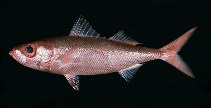 Erythrocles schlegelii
Photo von Randall, J.E.
Bilder | Google Bild
Photo von Randall, J.E.
Klassifizierung / Names Namen | Synonyme | Catalog of Fishes(Gattung, Arten) | ITIS | CoL | WoRMS | Cloffa
> Eupercaria/misc (Various families in series Eupercaria) > Emmelichthyidae (Rovers)
Etymology: Erythrocles: Greek, erythros = red + Greek, kleis, kleidos, anything used to close; collar bone (Ref. 45335).
Eponymy: Hermann Schlegel (1804–1884) was a German-born zoologist who spent much of his life in the Netherlands. [...] (Ref. 128868), visit book page.
More on author: Richardson.
Etymology: Erythrocles: Greek, erythros = red + Greek, kleis, kleidos, anything used to close; collar bone (Ref. 45335).
Eponymy: Hermann Schlegel (1804–1884) was a German-born zoologist who spent much of his life in the Netherlands. [...] (Ref. 128868), visit book page.
More on author: Richardson.
Umwelt: Milieu / Klimazone / Tiefenbereich / Verbreitungsgebiet Ökologie
seewasser demersal; tiefenbereich 100 - 500 m (Ref. 9773), usually 215 - 300 m (Ref. 33669). Deep-water
Verbreitung Territorien | FAO Gebiete | Ökosysteme | Vorkommen | Punkt Karte | Einführungen | Faunafri
Indo-West Pacific: Japan (type locality), Korea, Natal (South Africa), Kenya and Gulf of Oman. Reported from the central South China Sea (Ref. 33669).
Länge bei der ersten Reifung / Größe / Gewicht / Alter
Geschlechtsreife: Lm ?, range 22 - ? cm
Max length : 72.0 cm TL Männchen/unbestimmt; (Ref. 11228); max. veröff. Alter: 8 Jahre (Ref. 33669)
Max length : 72.0 cm TL Männchen/unbestimmt; (Ref. 11228); max. veröff. Alter: 8 Jahre (Ref. 33669)
Kurzbeschreibung Bestimmungsschlüssel | Morphologie | Morphometrie
Rückenflossenstacheln (insgesamt) : 11; Rückenflossenweichstrahlen (insgesamt) : 10 - 12; Afterflossenstacheln: 3; Afterflossenweichstrahlen: 9 - 10. Bluish grey dorsally, silvery white with pinkish tinge below; caudal and pectoral fins reddish orange (Ref. 5325).
Body shape (shape guide): fusiform / normal.
Body shape (shape guide): fusiform / normal.
Adults inhabit the continental shelf area (Ref. 5213). They feed mainly on shrimp of the family Sergistidae and also on small mesopelagic fishes of the family Myctophidae, Astronesthidae and Paralepididae (Ref. 33669). Neither anterolateral glandular groove nor venom gland is present (Ref. 57406).
Lebenszyklus und Paarungsverhalten Geschlechtsreife | Fortpflanzung | Ablaichen | Eier | Fruchtbarkeit | Larven
Hauptreferenz
Laden Sie Ihre Referenzen hoch | Referenzen | Koordinator : Heemstra, Phillip C. | Partner
Heemstra, P.C., 1986. Emmelichthyidae. p. 637-638. In M.M. Smith and P.C. Heemstra (eds.) Smiths' sea fishes. Springer-Verlag, Berlin. (Ref. 5325)
IUCN Rote Liste Status (Ref. 130435: Version 2025-2 (Global))
nicht bedroht (LC) ; Date assessed: 28 June 2018
CITES
Not Evaluated
Bedrohung für Menschen
Harmless
Nutzung durch Menschen
Fischereien: kommerziell
FAO - Publication: search | FishSource |
Mehr Information
Trophische Ökologie
Lebensmittel (Beutetiere)
Nahrungszusammensetzung
Nahrungsaufnahme
Lebensmittelrationen
Räuber
Lebensmittel (Beutetiere)
Nahrungszusammensetzung
Nahrungsaufnahme
Lebensmittelrationen
Räuber
Populationsdynamik
Wachstumsparameter
Max. Alter/Größen
Länge-Gewicht-Rel.
Länge-Länge-Verhältnis.
Längenhäufigkeiten
Massenkonvertierung
Rekrutierung
Dichte
Wachstumsparameter
Max. Alter/Größen
Länge-Gewicht-Rel.
Länge-Länge-Verhältnis.
Längenhäufigkeiten
Massenkonvertierung
Rekrutierung
Dichte
Lebenszyklus
Fortpflanzung
Geschlechtsreife
Reifung/Kiemen rel.
Fruchtbarkeit
Ablaichen
Laichaggregationen
Eier
Eientwicklung
Larven
Larven Pop.Dyn.
Fortpflanzung
Geschlechtsreife
Reifung/Kiemen rel.
Fruchtbarkeit
Ablaichen
Laichaggregationen
Eier
Eientwicklung
Larven
Larven Pop.Dyn.
Physiologie
Körperliche Zusammensetzung
Nährstoffe
Sauerstoffverbrauch
Schwimmart
Schwimmgeschwindigkeit
Visuelle Pigmente
Fischgeräusche
Krankheiten und Parasiten
Toxizität (LC50s)
Körperliche Zusammensetzung
Nährstoffe
Sauerstoffverbrauch
Schwimmart
Schwimmgeschwindigkeit
Visuelle Pigmente
Fischgeräusche
Krankheiten und Parasiten
Toxizität (LC50s)
Genetik
Genom
Genetik
Heterozygotie
Vererbbarkeit
Genetische Vielfalt
Genom
Genetik
Heterozygotie
Vererbbarkeit
Genetische Vielfalt
Menschenbezogen
Aquakultur-Systeme
Aquakultur Profile
Zuchtlinien
Ciguatera-Fälle
Briefmarken, Münzen, Verschiedenes.
Aquakultur-Systeme
Aquakultur Profile
Zuchtlinien
Ciguatera-Fälle
Briefmarken, Münzen, Verschiedenes.
Tools
E-Book | Feldführer | Bestimmungsschlüssel | Längenhäufigkeits Tool | Lebensdaten Tool | Punkt Karte |
Catch-MSY |
Zusatzinformationen
Download XML
Zusammenfassung | Punktdaten | Namen | Photos
Internet Quellen
AFORO (otoliths) | Aquatic Commons | BHL | Cloffa | Websites from users | FishWatcher Einträge suchen | CISTI | Catalog of Fishes: Gattung, Arten | DiscoverLife | ECOTOX | FAO - Publication: search | Faunafri | Fishipedia | Fishtrace | GloBI | Google Books | Google Scholar | Google | IGFA World Record | Nationale Datenbanken | OneZoom | Open Tree of Life | Otolith Atlas of Taiwan Fishes | PubMed | Reef Life Survey | Socotra Atlas | TreeBase | Tree of Life | Wikipedia: Gehe zu, Suchen | | Zoologischer Rekord
Schätzungen auf der Grundlage von Modellen
|
Phylogenetischer Diversitätsindex (Ref. 82804) |
PD50 = 0.5156 [Uniqueness, from 0.5 = low to 2.0 = high]. |
| Bayesian length-weight | a=0.00977 (0.00473 - 0.02021), b=3.10 (2.91 - 3.29), in cm total length, based on LWR estimates for this species & (Sub)family-body (Ref. 93245). |
|
Trophische Ebene (Ref. 69278) |
3.2 ±0.36 se; based on food items. |
|
Widerstandsfähigkeit (Ref. 120179) |
mittel, Verdopplung der Population dauert 1,4 - 4,4 Jahre. (K=0.3; tmax=8; tm=2;). |
|
Anfälligkeit der Fischerei (Ref. 59153) |
Moderate vulnerability (40 of 100). 🛈 |
|
Preiskategorie (Ref. 80766) |
High. |