



Beobachtung melden im Fish Watcher
| Native range | All suitable habitat | Point map | Year 2050 |

|
| This map was computer-generated and has not yet been reviewed. |
| Rajella fyllae AquaMaps Data sources: GBIF OBIS |
Hochladen Photos und videos
Bilder | videos | Google Bild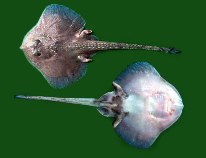 Rajella fyllae
Photo von Byrkjedal, I.
Bilder | videos | Google Bild
Photo von Byrkjedal, I.
Klassifizierung / Names Namen | Synonyme | Catalog of Fishes(Gattung, Arten) | ITIS | CoL | WoRMS | Cloffa
Elasmobranchii (Haie und Rochen) (sharks and rays) > Rajiformes (Skates and rays) > Rajidae (Skates)
Etymology: Rajella: Latin, raja, -ae = a sting ray (Raja sp.) (Ref. 45335).
Eponymy: This species is named after the Danish vessel ‘Fylla’ which was used for expeditions to Greenland (1884 & 1886), on one of which the holotype was collected. (Ref. 128868), visit book page.
More on author: Lütken.
Etymology: Rajella: Latin, raja, -ae = a sting ray (Raja sp.) (Ref. 45335).
Eponymy: This species is named after the Danish vessel ‘Fylla’ which was used for expeditions to Greenland (1884 & 1886), on one of which the holotype was collected. (Ref. 128868), visit book page.
More on author: Lütken.
Umwelt: Milieu / Klimazone / Tiefenbereich / Verbreitungsgebiet Ökologie
seewasser bathydemersal; tiefenbereich 147 - 2055 m (Ref. 106604), usually 300 - 800 m (Ref. 3167). Deep-water; 1°C - 7°C (Ref. 117245); 84°N - 40°N, 75°W - 55°E (Ref. 114953)
Verbreitung Territorien | FAO Gebiete | Ökosysteme | Vorkommen | Punkt Karte | Einführungen | Faunafri
North Atlantic and adjacent fringes of the Arctic Region: offshore of Gulf of Maine and slopes off Newfoundland banks and Labrador to southern Baffin Bay, around southern Greenland to Denmark Strait, south of Iceland, and along Faroe-Shetland ridge to the Skagerrak; west of British Isles from Porcupine Bank and Rockall Plateau to Faroe Islands; and off Norwegian coasts to western Barents Sea and Svalbard.
Größe / Gewicht / Alter
Kurzbeschreibung Bestimmungsschlüssel | Morphologie | Morphometrie
Snout is short and obtuse. Midbelt of its disc and upper surface of its tail are rough with large thorns in irregular rows. Upper surface ash gray to chocolate brown. Lower surface white, grayish white, pale gray or light fawn color, sooty patches on pelvic fins and axils of pectoral fins (Ref. 6902).
Body shape (shape guide): other.
Body shape (shape guide): other.
Found in deeper shelf and slope waters, in 3-5.5°C water temperature (6902). Benthic (Ref. 58426). Feed on all kinds of bottom animals with preference for invertebrates (Ref. 3167) like copepods, amphipods and mysids (Ref. 6902). Oviparous. Distinct pairing with embrace. Young may tend to follow large objects, such as their mother (Ref. 205). Eggs are oblong capsules with stiff pointed horns at the corners deposited in sandy or muddy flats (Ref. 205). Egg capsules are 3.8-4.2 cm long and 2.4-2.6 cm wide (Ref. 41303, 41251, 41301). It is captured at low level by-catch in bottom-trawl and longline fisheries (Ref. 117245).
Lebenszyklus und Paarungsverhalten Geschlechtsreife | Fortpflanzung | Ablaichen | Eier | Fruchtbarkeit | Larven
Oviparous, paired eggs are laid. Embryos feed solely on yolk (Ref. 50449). Distinct pairing with embrace. Young may tend to follow large objects, such as their mother (Ref. 205).
Hauptreferenz
Laden Sie Ihre Referenzen hoch | Referenzen | Koordinator : McEachran, John | Partner
McEachran, J.D. and K.A. Dunn, 1998. Phylogenetic analysis of skates, a morphologically conservative clade of elasmobranchs (Chondrichthyes: Rajidae). Copeia 1998(2):271-290. (Ref. 27314)
IUCN Rote Liste Status (Ref. 130435: Version 2025-2 (Global))
nicht bedroht (LC) ; Date assessed: 20 June 2019
CITES
Not Evaluated
Bedrohung für Menschen
Harmless
Nutzung durch Menschen
Fischereien: nicht kommerziell
FAO - Publication: search | FishSource |
Mehr Information
Trophische Ökologie
Lebensmittel (Beutetiere)
Nahrungszusammensetzung
Nahrungsaufnahme
Lebensmittelrationen
Räuber
Lebensmittel (Beutetiere)
Nahrungszusammensetzung
Nahrungsaufnahme
Lebensmittelrationen
Räuber
Populationsdynamik
Wachstumsparameter
Max. Alter/Größen
Länge-Gewicht-Rel.
Länge-Länge-Verhältnis.
Längenhäufigkeiten
Massenkonvertierung
Rekrutierung
Dichte
Wachstumsparameter
Max. Alter/Größen
Länge-Gewicht-Rel.
Länge-Länge-Verhältnis.
Längenhäufigkeiten
Massenkonvertierung
Rekrutierung
Dichte
Lebenszyklus
Fortpflanzung
Geschlechtsreife
Reifung/Kiemen rel.
Fruchtbarkeit
Ablaichen
Laichaggregationen
Eier
Eientwicklung
Larven
Larven Pop.Dyn.
Fortpflanzung
Geschlechtsreife
Reifung/Kiemen rel.
Fruchtbarkeit
Ablaichen
Laichaggregationen
Eier
Eientwicklung
Larven
Larven Pop.Dyn.
Physiologie
Körperliche Zusammensetzung
Nährstoffe
Sauerstoffverbrauch
Schwimmart
Schwimmgeschwindigkeit
Visuelle Pigmente
Fischgeräusche
Krankheiten und Parasiten
Toxizität (LC50s)
Körperliche Zusammensetzung
Nährstoffe
Sauerstoffverbrauch
Schwimmart
Schwimmgeschwindigkeit
Visuelle Pigmente
Fischgeräusche
Krankheiten und Parasiten
Toxizität (LC50s)
Menschenbezogen
Aquakultur-Systeme
Aquakultur Profile
Zuchtlinien
Ciguatera-Fälle
Briefmarken, Münzen, Verschiedenes.
Aquakultur-Systeme
Aquakultur Profile
Zuchtlinien
Ciguatera-Fälle
Briefmarken, Münzen, Verschiedenes.
Tools
E-Book | Feldführer | Bestimmungsschlüssel | Längenhäufigkeits Tool | Lebensdaten Tool | Punkt Karte |
Catch-MSY |
Zusatzinformationen
Download XML
Zusammenfassung | Punktdaten | Namen | Photos
Internet Quellen
AFORO (otoliths) | Aquatic Commons | BHL | Cloffa | Websites from users | FishWatcher Einträge suchen | CISTI | Catalog of Fishes: Gattung, Arten | DiscoverLife | ECOTOX | FAO - Publication: search | Faunafri | Fishipedia | Fishtrace | GloBI | Google Books | Google Scholar | Google | IGFA World Record | Nationale Datenbanken | OneZoom | Open Tree of Life | Otolith Atlas of Taiwan Fishes | PubMed | Reef Life Survey | Socotra Atlas | TreeBase | Tree of Life | Wikipedia: Gehe zu, Suchen | World Records Freshwater Fishing | Zoologischer Rekord
Schätzungen auf der Grundlage von Modellen
Bevorzugte Temperatur (Ref. 123201): 0.7 - 9.5, mean 3.6 °C (based on 707 cells).
Phylogenetischer Diversitätsindex (Ref. 82804): PD50 = 0.5000 [Uniqueness, from 0.5 = low to 2.0 = high].
Bayesian length-weight: a=0.00302 (0.00141 - 0.00645), b=3.24 (3.07 - 3.41), in cm total length, based on LWR estimates for this (Sub)family-body shape (Ref. 93245).
Trophische Ebene (Ref. 69278): 3.4 ±0.2 se; based on diet studies.
Widerstandsfähigkeit (Ref. 120179): niedrig, Verdopplung der Population dauert 4,5 - 14 Jahre. (Fec assumed to be <100).
Nährstoffe (Ref. 124155): Calcium = 5.49 [0.80, 107.06] mg/100g; Iron = 0.328 [0.031, 4.452] mg/100g; Protein = 15.1 [13.0, 17.1] %; Omega3 = 0.494 [0.195, 1.253] g/100g; Selenium = 17.8 [3.1, 85.5] μg/100g; VitaminA = 4.75 [0.34, 63.37] μg/100g; Zinc = 0.305 [0.021, 3.468] mg/100g (wet weight);