



Orectolobus ornatus (De Vis, 1883)
Ornate wobbegong
Ajouter votre observation dans Fish Watcher
| Native range | All suitable habitat | Point map | Year 2050 |

|
| This map was computer-generated and has not yet been reviewed. |
| Orectolobus ornatus AquaMaps Data sources: GBIF OBIS |
Envoyez vos Photos et vidéos
Images | vidéos | Images Google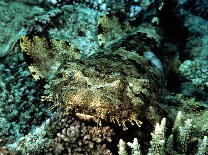 Orectolobus ornatus
Photo de Randall, J.E.
Images | vidéos | Images Google
Photo de Randall, J.E.
Classification / Noms Noms communs | Synonymes | Catalog of Fishes(Genre, Espèce) | ITIS | CoL | WoRMS | Cloffa
Élasmobranches (requins et raies) (sharks and rays) > Orectolobiformes (Carpet sharks) > Orectolobidae (Carpet or nurse sharks)
Etymology: Orectolobus: orektos (Gr.), stretched out; lobus (L.), from lobos (Gr.), rounded projection or protuberance, referring to long nasal barbels of Squalus barbatus (=O. maculatus) (See ETYFish); ornatus: Latin for adorned or decorated, presumably referring to its color pattern, described as yellowish with broad dark crossbands (the hinder ones encircling the tail), and two dorsal bands with “deeply fretted edges”, each enclosing a pairs of ocelli; name could also refer to the “tentacular fringe” around the head (See ETYFish).
Etymology: Orectolobus: orektos (Gr.), stretched out; lobus (L.), from lobos (Gr.), rounded projection or protuberance, referring to long nasal barbels of Squalus barbatus (=O. maculatus) (See ETYFish); ornatus: Latin for adorned or decorated, presumably referring to its color pattern, described as yellowish with broad dark crossbands (the hinder ones encircling the tail), and two dorsal bands with “deeply fretted edges”, each enclosing a pairs of ocelli; name could also refer to the “tentacular fringe” around the head (See ETYFish).
Taxonomic Remarks
To be split. The subspecies O. o. halei is a valid species according to Huveneers 2006 (Ref. 58832).
Environnement : milieu / zone climatique / profondeur / gamme de distribution Écologie
marin récifal; profondeur 0 - 100 m (Ref. 54689). Tropical
Distribution Territoires | Zones FAO | Écosystèmes | Occurrences | Carte par point | Introductions | Faunafri
Southwest Pacific: east Australia and southern Papua New Guinea.
Longueur à la première maturité / Taille / Poids / Âge
Description synthétique Clés d'identification | Morphologie | Morphométrie
Épines dorsales (Total) : 0; Épines anales: 0. Back with light areas between dark saddles marked with dark, light-centered blotches and spots, not reticulated lines (Ref. 13577). Caudal fin with its upper lobe hardly elevated above the body axis, with a strong terminal lobe and subterminal notch but no ventral lobe (Ref. 13577).
Body shape (shape guide): elongated.
Body shape (shape guide): elongated.
A common bottom shark of inshore continental waters, on algal-covered rocky areas and coral reefs (Ref. 247). Nocturnal, resting on the bottom during the day and prowling on its reef habitat at night (Ref. 247). Presumably feeding on bottom invertebrates and fishes but diet unrecorded (Ref. 13577). Ovoviviparous (Ref. 50449). Attacks waders and fishers in tide pools (Ref. 247). Interest to fisheries limited; its skin very tough and attractively patterned and utilized for leather (Ref. 13577).
Cycle de vie et comportement reproducteur Maturité | Reproduction | Frai | Œufs | Fécondité | Larves
Ovoviviparous, embryos feed solely on yolk (Ref. 50449).
Référence principale
Téléchargez vos références | Références | Coordinateur | Collaborateurs
Compagno, L.J.V., 1984. FAO Species Catalogue. Vol. 4. Sharks of the world. An annotated and illustrated catalogue of shark species known to date. Part 1 - Hexanchiformes to Lamniformes. FAO Fish. Synop. 125(4/1):1-249. Rome, FAO. (Ref. 247)
Statut dans la liste rouge de l'IUCN (Ref. 130435: Version 2025-2 (Global))
Préoccupation mineure (LC) ; Date assessed: 20 February 2015
CITES
Not Evaluated
Menace pour l'homme
Traumatogenic (Ref. 247)
Utilisations par l'homme
FAO - pêcheries: Résumé espèce; Publication: search | FishSource |
Plus d'informations
Écologie trophique
Aliments (proies)
Composition du régime alimentaire
Consommation alimentaire
Rations alimentaires
Prédateurs
Aliments (proies)
Composition du régime alimentaire
Consommation alimentaire
Rations alimentaires
Prédateurs
Dynamique des populations
Paramètres de croissance
Âges / tailles maximales
Longueur-poids rel.
Rel. longueur-longueur.
Fréquences de longueurs
Conversion de masse
Recrutement
Abondance
Paramètres de croissance
Âges / tailles maximales
Longueur-poids rel.
Rel. longueur-longueur.
Fréquences de longueurs
Conversion de masse
Recrutement
Abondance
Cycle de vie
Reproduction
Maturité
Maturité/épines rel.
Fécondité
Frai
Agrégats de frai
Œufs
Développement de l'œuf
Larves
Dynamique des populations larvaires
Reproduction
Maturité
Maturité/épines rel.
Fécondité
Frai
Agrégats de frai
Œufs
Développement de l'œuf
Larves
Dynamique des populations larvaires
Physiologie
Composition corporelle
Nutriments
Consommation d'oxygène
Type de natation
Vitesse de nage
Pigments visuels
Son de poisson
Maladies et parasites
Toxicité (CL50)
Composition corporelle
Nutriments
Consommation d'oxygène
Type de natation
Vitesse de nage
Pigments visuels
Son de poisson
Maladies et parasites
Toxicité (CL50)
Génétique
génôme
Génétique
Hétérozygotie
Héritabilité
Diversité génétique
génôme
Génétique
Hétérozygotie
Héritabilité
Diversité génétique
Liées à l'homme
Systèmes d'aquaculture
Profils d'aquaculture
Souches
Cas de ciguatera
Timbres, pièces de monnaie, divers
Systèmes d'aquaculture
Profils d'aquaculture
Souches
Cas de ciguatera
Timbres, pièces de monnaie, divers
Outils
Quiz bio | E-book | Guide de terrain | Clés d'identification | Générateur de fréquences de longueur | Outil de dynamique de population | Carte par point |
Capture-MSY |
Articles particuliers
Télécharger en XML
Sources Internet
AFORO (otoliths) | Aquatic Commons | BHL | Cloffa | Websites from users | FishWatcher | CISTI | Catalog of Fishes: Genre, Espèce | DiscoverLife | ECOTOX | FAO - pêcheries: Résumé espèce; Publication: search | Faunafri | Fishipedia | Fishtrace | GloBI | Google Books | Google Scholar | Google | IGFA World Record | OneZoom | Open Tree of Life | Otolith Atlas of Taiwan Fishes | Aquariums publics | PubMed | Reef Life Survey | Socotra Atlas | TreeBase | Arbre de Vie | Wikipedia: aller à, chercher | | Zoological Record
Estimations basées sur des modèles
|
Indice de diversité phylogénétique (Réf. 82804) |
PD50 = 0.5012 [Uniqueness, from 0.5 = low to 2.0 = high]. |
| Bayesian length-weight | a=0.00389 (0.00180 - 0.00842), b=3.12 (2.94 - 3.30), in cm total length, based on all LWR estimates for this body shape (Ref. 93245). |
|
Niveau trophique (Réf. 69278) |
4.0 ±0.60 se; based on food items. |
|
Résilience (Réf. 120179) |
Faible, temps minimum de doublement de population : 4,5 à 14 années (tmax=20; K=0.19;). |
|
Vulnérabilité de la pêche (Ref. 59153) |
High to very high vulnerability (66 of 100). 🛈 |
|
Nutriments (Ref. 124155) |
Calcium = 7.76 [1.75, 30.74] mg/100g; Iron = 0.33 [0.08, 0.92] mg/100g; Protein = 19.8 [17.6, 21.9] %; Omega3 = 0.0801 [, ] g/100g; Selenium = 46.2 [13.2, 130.7] μg/100g; VitaminA = 23 [8, 62] μg/100g; Zinc = 0.57 [0.28, 1.16] mg/100g (wet weight); |