



Eucrossorhinus dasypogon (Bleeker, 1867)
Tasselled wobbegong
Ajouter votre observation dans Fish Watcher
| Native range | All suitable habitat | Point map | Year 2050 |

|
| This map was computer-generated and has not yet been reviewed. |
| Eucrossorhinus dasypogon AquaMaps Data sources: GBIF OBIS |
Classification / Noms Noms communs | Synonymes | Catalog of Fishes(Genre, Espèce) | ITIS | CoL | WoRMS | Cloffa
Élasmobranches (requins et raies) (sharks and rays) > Orectolobiformes (Carpet sharks) > Orectolobidae (Carpet or nurse sharks)
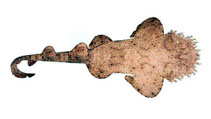
Etymology: Eucrossorhinus: eu (Gr.), very; Crossorhinus (=Orectolobus), previous genus, from krossos (Gr.), fringe or tassel, referring to tassel of dermal lobes fringing the head, and rhinus, an ancient name for sharks, from rhine (Gr.), rasp, alluding to their rasp-like skin, or rhinos, snout, referring to “lobe-like attachments from the nose” (translation, from Müller & Henle’s 1837 description of Crossorhinus) (See ETYFish); dasypogon: dasys (Gr.), hairy; pogon (Gr.), beard, referring to dense beard-like tassel of dermal lobes fringing the head (See ETYFish).
More on author: Bleeker.
Etymology: Eucrossorhinus: eu (Gr.), very; Crossorhinus (=Orectolobus), previous genus, from krossos (Gr.), fringe or tassel, referring to tassel of dermal lobes fringing the head, and rhinus, an ancient name for sharks, from rhine (Gr.), rasp, alluding to their rasp-like skin, or rhinos, snout, referring to “lobe-like attachments from the nose” (translation, from Müller & Henle’s 1837 description of Crossorhinus) (See ETYFish); dasypogon: dasys (Gr.), hairy; pogon (Gr.), beard, referring to dense beard-like tassel of dermal lobes fringing the head (See ETYFish).
More on author: Bleeker.
Environnement : milieu / zone climatique / profondeur / gamme de distribution Écologie
marin récifal; profondeur 2 - 50 m (Ref. 106604). Deep-water; 1°N - 23°S, 115°E - 155°E
Distribution Territoires | Zones FAO | Écosystèmes | Occurrences | Carte par point | Introductions | Faunafri
Indo-West Pacific: eastern Indonesia, Papua New Guinea, and northern Australia (including Barrow Island, Western Australia). Questionable occurrence in Malaysia.
Taille / Poids / Âge
Maturité: Lm ? range ? - ? cm
Max length : 366 cm TL mâle / non sexé; (Ref. 90102); common length : 180 cm TL mâle / non sexé; (Ref. 90102)
Max length : 366 cm TL mâle / non sexé; (Ref. 90102); common length : 180 cm TL mâle / non sexé; (Ref. 90102)
Description synthétique Clés d'identification | Morphologie | Morphométrie
Épines dorsales (Total) : 0; Épines anales: 0. Body with a reticular pattern of narrow dark lines (Ref. 13577). Caudal fin with its upper lobe hardly elevated above the body axis, with a strong terminal lobe and subterminal notch but no ventral lobe (Ref. 13577).
Body shape (shape guide): elongated.
Body shape (shape guide): elongated.
A little-known shark (Ref. 247) found on the continental shelf and offshore reefs (Ref. 6871). Probably feeds on bottom fishes and invertebrates (Ref. 13577, 43278); also known to eat nocturnal teleost fishes such as squirrelfish and soldierfish (Holocentridae) and sweepers (Pempheridae) (Ref. 43278). Ovoviviparous (Ref. 50449). Might bite in self-defense or when mistaking a human foot for its usual prey (Ref. 247). Its tough skin sometimes used for leather (Ref. 13577). The maximum length of 366 cm TL reported for this species is uncertain (Ref. 247, 90102).
Cycle de vie et comportement reproducteur Maturité | Reproduction | Frai | Œufs | Fécondité | Larves
Ovoviviparous, embryos feed solely on yolk (Ref. 50449).
Référence principale
Téléchargez vos références | Références | Coordinateur | Collaborateurs
Compagno, L.J.V., 1984. FAO Species Catalogue. Vol. 4. Sharks of the world. An annotated and illustrated catalogue of shark species known to date. Part 1 - Hexanchiformes to Lamniformes. FAO Fish. Synop. 125(4/1):1-249. Rome, FAO. (Ref. 247)
Statut dans la liste rouge de l'IUCN (Ref. 130435: Version 2025-2 (Global))
Préoccupation mineure (LC) ; Date assessed: 12 September 2023
CITES
Not Evaluated
Menace pour l'homme
Traumatogenic (Ref. 247)
Utilisations par l'homme
Pêcheries: bycatch
FAO - pêcheries: Résumé espèce; Publication: search | FishSource |
Plus d'informations
Écologie trophique
Aliments (proies)
Composition du régime alimentaire
Consommation alimentaire
Rations alimentaires
Prédateurs
Aliments (proies)
Composition du régime alimentaire
Consommation alimentaire
Rations alimentaires
Prédateurs
Dynamique des populations
Paramètres de croissance
Âges / tailles maximales
Longueur-poids rel.
Rel. longueur-longueur.
Fréquences de longueurs
Conversion de masse
Recrutement
Abondance
Paramètres de croissance
Âges / tailles maximales
Longueur-poids rel.
Rel. longueur-longueur.
Fréquences de longueurs
Conversion de masse
Recrutement
Abondance
Cycle de vie
Reproduction
Maturité
Maturité/épines rel.
Fécondité
Frai
Agrégats de frai
Œufs
Développement de l'œuf
Larves
Dynamique des populations larvaires
Reproduction
Maturité
Maturité/épines rel.
Fécondité
Frai
Agrégats de frai
Œufs
Développement de l'œuf
Larves
Dynamique des populations larvaires
Anatomie
Surface branchiale
Cerveau
Otolithe
Surface branchiale
Cerveau
Otolithe
Physiologie
Composition corporelle
Nutriments
Consommation d'oxygène
Type de natation
Vitesse de nage
Pigments visuels
Son de poisson
Maladies et parasites
Toxicité (CL50)
Composition corporelle
Nutriments
Consommation d'oxygène
Type de natation
Vitesse de nage
Pigments visuels
Son de poisson
Maladies et parasites
Toxicité (CL50)
Génétique
génôme
Génétique
Hétérozygotie
Héritabilité
Diversité génétique
génôme
Génétique
Hétérozygotie
Héritabilité
Diversité génétique
Liées à l'homme
Systèmes d'aquaculture
Profils d'aquaculture
Souches
Cas de ciguatera
Timbres, pièces de monnaie, divers
Systèmes d'aquaculture
Profils d'aquaculture
Souches
Cas de ciguatera
Timbres, pièces de monnaie, divers
Outils
E-book | Guide de terrain | Clés d'identification | Générateur de fréquences de longueur | Outil de dynamique de population | Carte par point |
Capture-MSY |
Articles particuliers
Télécharger en XML
Sources Internet
AFORO (otoliths) | Aquatic Commons | BHL | Cloffa | Websites from users | FishWatcher | CISTI | Catalog of Fishes: Genre, Espèce | DiscoverLife | ECOTOX | FAO - pêcheries: Résumé espèce; Publication: search | Faunafri | Fishipedia | Fishtrace | GloBI | Google Books | Google Scholar | Google | IGFA World Record | OneZoom | Open Tree of Life | Otolith Atlas of Taiwan Fishes | PubMed | Reef Life Survey | Socotra Atlas | TreeBase | Arbre de Vie | Wikipedia: aller à, chercher | World Records Freshwater Fishing | Zoological Record
Estimations basées sur des modèles
Température préférée (Réf. 123201): 26.2 - 28.8, mean 27.8 °C (based on 294 cells).
Indice de diversité phylogénétique (Réf. 82804): PD50 = 1.0002 [Uniqueness, from 0.5 = low to 2.0 = high].
Bayesian length-weight: a=0.00389 (0.00180 - 0.00842), b=3.12 (2.94 - 3.30), in cm total length, based on all LWR estimates for this body shape (Ref. 93245).
Niveau trophique (Réf. 69278): 4.0 ±0.60 se; based on food items.
Résilience (Réf. 120179): Faible, temps minimum de doublement de population : 4,5 à 14 années (Fec assumed to be <100).
Nutriments (Ref. 124155): Calcium = 1.57 [0.18, 7.23] mg/100g; Iron = 0.125 [0.027, 0.423] mg/100g; Protein = 19.4 [17.1, 21.6] %; Omega3 = 0.0936 [, ] g/100g; Selenium = 7.92 [2.19, 30.75] μg/100g; VitaminA = 13.4 [2.3, 84.0] μg/100g; Zinc = 0.248 [0.114, 0.523] mg/100g (wet weight);