



Mordacia mordax (Richardson, 1846)
Shorthead lamprey
Aggiungete la vostra osservazione in Fish Watcher
| Native range | All suitable habitat | Point map | Year 2050 |

|
| This map was computer-generated and has not yet been reviewed. |
| Mordacia mordax AquaMaps Data sources: GBIF OBIS |
Carica il tuo foto e Video
Immagini | Google image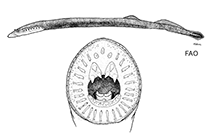 Mordacia mordax
Immagine di FAO
Immagini | Google image
Immagine di FAO
Classificazione / Nomi Nomi Comuni | Sinonimi | Catalog of Fishes(Genere, Specie) | ITIS | CoL | WoRMS | Cloffa
> Petromyzontiformes (Lampreys) > Mordaciidae (Southern topeyed lampreys)
Etymology: Mordacia: Etymology not explained, likely derived from mordax (L.), biting, referring to specific name of M. mordax (See ETYFish); mordax: Latin for biting, perhaps referring to its parasitic behavior and/or serrated, cutting teeth (See ETYFish).
More on author: Richardson.
Etymology: Mordacia: Etymology not explained, likely derived from mordax (L.), biting, referring to specific name of M. mordax (See ETYFish); mordax: Latin for biting, perhaps referring to its parasitic behavior and/or serrated, cutting teeth (See ETYFish).
More on author: Richardson.
Ambiente: milieu / zona climatica / distribuzione batimetrica / gamma di distribuzione Ecologia
marino; acqua dolce; salmastro demersale; anadromo (Ref. 89241). Temperate; 35°S - 44°S (Ref. 26213)
Distribuzione Territories | Aree FAO | Ecosistemi | Presenze | Mappa dei ritrovamenti | Introduzioni | Faunafri
Southern Ocean: Southeastern Australia from Shoalhaven River, New South Wales to Gulf of St. Vincent, South Australia.
Dimensione / Peso / Età
Maturità: Lm ? range ? - ? cm
Max length : 50.0 cm TL maschio/sesso non determinato; (Ref. 5259); common length : 37.5 cm TL maschio/sesso non determinato; (Ref. 5259)
Max length : 50.0 cm TL maschio/sesso non determinato; (Ref. 5259); common length : 37.5 cm TL maschio/sesso non determinato; (Ref. 5259)
Breve descrizione Chiavi di identificazione | Morfologia | Morfometria
Adults: 11.3-43.2 cm TL; body proportions of pre-spawning specimens, as percentage of TL (based on 125 prespawning specimens measuring 11.3-42.1 cm TL): 8.5-11.3 prebranchial length, 7.1-9.8 branchial length, 60.4-68.3 trunk length, 14.4-20.1 tail length, 1.1-1.7 eye length and 4.9-6.6 disc length. Body proportions of spawning male specimens, as percentage of TL (based on 8 spawning males measuring 27.7-37.6 cm TL): 11.4-16.6 prebranchial length, 8.8-10.1 branchial length, 60.1-65.3 trunk length, 13.3-15.7 tail length, 8.1-11.2 disc length. Mature males with some loose skin in gular region. Urogenital papilla not prominent in mature adults; trunk myomeres, 84-96. Adult dentition: 2 triangular supraoral laminae each with 3 unicuspid teeth, 1 per apex; infraoral lamina, 7-9 unicuspid teeth of various size (these teeth become greatly enlarged with sexual maturation); 5-7 endolateral plates on either side each bearing 2-3 unicuspid teeth, usually 3; endolateral formula, typically 2-3-3-3-3-3 in immature individuals and 5-7 individual cusps on either side in mature individuals; 1 row of anterials; first row of anterials, 2 unicuspid teeth plus 1-2 bicuspid teeth or 3 unicuspid teeth flanked on either side by 1 bicuspid tooth; 1 row of exolaterals on each side; 1 row of posterials; first row of posterials, 12-14 posterial plates, the 2-4 lateralmost tricuspid and the internal ones bicuspid in immature individuals and 12-14 unicuspid teeth in mature individuals; transverse lingual lamina w-shaped, with 29 unicuspid teeth, the median one and the 2 subterminal ones slightly enlarged; longitudinal lingual laminae interrupted j-shaped, each with an undetermined number of unicuspid teeth. Velar tentacles in adults, 3-4, smooth. Body coloration (live) of immature adults brownish gray on dorsal surface and silvery on ventral surface; lateral line neuromasts darkly pigmented; caudal fin pigmentation, 25% to <75% coverage; caudal fin shape, spade-like; oral papillae, 25-45 (Ref. 89241).
Body shape (shape guide): eel-like.
Body shape (shape guide): eel-like.
Adults inhabit the sea for an undetermined period and are parasitic on fishes; enter freshwater to breed. Majority of adulthood is spent in estuaries or at sea. Upstream spawning migrants occur in fast-flowing sections of rivers with a mud, sand or silt substrate, sometimes seen congregated below barriers to upstream movement such as weirs. Ammocoetes live in slow-flowing streams, burrowed in mud or silt. Common length is 35-40 cm (Ref. 44894). Larval life is 3.5 yrs. During the spawning migration, adults burrow in the substrate of rivers during the day and migrate upstream during the night. Fecundity, 3,789-13,372 eggs/female. De Castelnau (1872) states that the adults from the lower Yarra River, Victoria, are considered good food (Ref. 89241).
Ciclo vitale e comportamento di accoppiamento Maturità | Riproduzione | Deposizione | Uova | Fecondità | Larve
Riferimento principale
Caricare le referenze | Bibliografia | Coordinatore | Collaboratori
Allen, G.R., 1989. Freshwater fishes of Australia. T.F.H. Publications, Inc., Neptune City, New Jersey. (Ref. 5259)
Stato della Lista Rossa IUCN (Ref. 130435: Version 2025-2 (Global))
Least Concern (LC) ; Date assessed: 12 February 2019
CITES
Not Evaluated
Minaccia per l'uomo
Harmless
Usi umani
FAO - Publication: search | FishSource |
Informazioni ulteriori
Ecologia trofica
Articoli alimentari (prede)
Alimentazione
Consumo di cibo
Razioni alimentari
Predatori
Articoli alimentari (prede)
Alimentazione
Consumo di cibo
Razioni alimentari
Predatori
Dinamica della popolazione
Parametri di crescita
Età massima / dimensioni massime
Rapporto lunghezza-peso.
Lunghezza-lunghezza rel.
Lunghezza-frequenze
Conversione di massa
Reclutamento
Abbondanza
Parametri di crescita
Età massima / dimensioni massime
Rapporto lunghezza-peso.
Lunghezza-lunghezza rel.
Lunghezza-frequenze
Conversione di massa
Reclutamento
Abbondanza
Ciclo di vita
Riproduzione
Maturità
Maturità/Gli occhielli sono relativi.
Fecondità
Deposizione
Aggregazioni riproduttive
Uova
Sviluppo delle uova
Larve
Dinamica popolazioni larvali
Riproduzione
Maturità
Maturità/Gli occhielli sono relativi.
Fecondità
Deposizione
Aggregazioni riproduttive
Uova
Sviluppo delle uova
Larve
Dinamica popolazioni larvali
Fisiologia
Composizione corporea
Nutrienti
Consumo di ossigeno
Tipo di nuoto
Velocità di nuoto
Pigmenti visivi
Suono del pesce
Malattie e parassiti
Tossicità (LC50)
Composizione corporea
Nutrienti
Consumo di ossigeno
Tipo di nuoto
Velocità di nuoto
Pigmenti visivi
Suono del pesce
Malattie e parassiti
Tossicità (LC50)
Legato all'uomo
Sistemi di acquacoltura
Profili di acquacoltura
Varietà
Casi di Ciguatera
Francobolli, monete, materiale vario.
Sistemi di acquacoltura
Profili di acquacoltura
Varietà
Casi di Ciguatera
Francobolli, monete, materiale vario.
Strumenti
Libro elettronico | Giuda pratica | Chiavi di identificazione | Generatore frequenze di lunghezza | Strumento Parametri Biologici | Mappa dei ritrovamenti |
Cattura-MSY |
Rapporti speciali
Controllo della manutenzione dell'acquario | Verificare la presenza di schede informative sulle specie | Verifica delle schede informative sull'acquacoltura
Scarica XML
Fonti Internet
AFORO (otoliths) | Aquatic Commons | BHL | Cloffa | Websites from users | Check FishWatcher | CISTI | Catalog of Fishes: Genere, Specie | DiscoverLife | ECOTOX | FAO - Publication: search | Faunafri | Fishipedia | Fishtrace | GloBI | Google Books | Google Scholar | Google | IGFA World Record | OneZoom | Open Tree of Life | Otolith Atlas of Taiwan Fishes | PubMed | Reef Life Survey | Socotra Atlas | TreeBase | Tree of Life | Wikipedia: Go, ricerca | World Records Freshwater Fishing | Record zoologico
Stime basate su modelli
Temperatura preferita (Fonte Biblio. 123201): 14.3 - 16.8, mean 15.4 °C (based on 44 cells).
Indice di diversità filogenetica (Fonte Biblio. 82804): PD50 = 0.7500 [Uniqueness, from 0.5 = low to 2.0 = high].
Bayesian length-weight: a=0.00102 (0.00046 - 0.00225), b=3.06 (2.88 - 3.24), in cm total length, based on all LWR estimates for this body shape (Ref. 93245).
Livello trofico (Fonte Biblio. 69278): 4.3 ±0.8 se; based on size and trophs of closest relatives
Resilienza (Fonte Biblio. 120179): Basso, tempo minimo di raddoppiamento della popolazione 4.5 - 14 anni (Semelparous species, assuming tm (= tmax) > 4).