This website uses cookies to enhance your browsing experience and ensure the functionality of our site. For more detailed information about the types of cookies we use and how we protect your privacy, please visit our Privacy Information page.
×
Cookie Settings
This website uses different types of cookies to enhance your experience. Please select your preferences below:
Carcharodon carcharias, Great white shark : fisheries, gamefish
Elasmobranchii (haaien en roggen) (sharks and rays) > Lamniformes (Mackerel sharks) > Lamnidae (Mackerel sharks or white shark)
Etymology: Carcharodon:carchar-, presumably referring to Carcharias (Odontaspidae); odon (Gr.), tooth, “Teeth as in Carchari[a]s, serrated on both edges” (See ETYFish); carcharias:From the Ancient Greek karkharías, shark, derived from kárkharos, sharp or jagged, referring to its teeth (“dentibus serratus”) (See ETYFish). More on author: Linnaeus.
Milieu: milieu / Klimaatzone / Diepte / verspreidingsgebied Ecologie
marien; brak water pelagic-oceanic; oceanodroom (Ref. 87829); diepte 0 - 1280 m (Ref. 106604), usually 0 - 250 m (Ref. 55270). Subtropical; 61°N - 58°S, 180°W - 180°E
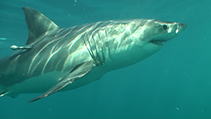
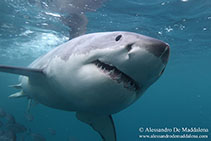
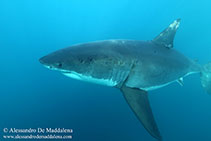
Dorsale stekels (totaal) : 0; Anale stekels: 0. A huge, spindle-shaped shark with conspicuous black eyes, a blunt, conical snout and large, triangular, saw-edged teeth (Ref. 5578). First dorsal-fin origin usually over the pectoral-fin inner margins (Ref. 43278, 6871). Caudal fin crescentic (Ref. 247). Lead-grey to brown or black above, lighter on sides, and abruptly white below (Ref. 6851). Black spot at rear pectoral fin base (Ref. 6851). Body shape (shape guide): fusiform / normal.
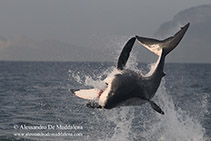
Primarily a coastal and offshore inhabitant of continental and insular shelves, but may also occur off oceanic islands far from land (Ref. 247, 43278, 58302). Often close inshore to the surf line and even penetrates shallow bays (Ref. 247). Maximum depth of 700 fathoms (or 1280 m) reported by Bigelow & Schroeder, 1948 is erroneous (Francis et al., 2012 in Ref. 106604). Pelagic, capable of migration across oceanic regions (Ref. 58302). Usually solitary or in pairs but can be found in feeding aggregations of 10 or more; does not form schools (Ref. 247). Feeds on bony fishes, sharks, rays, seals, dolphins and porpoises, sea birds, carrion, squid, octopi and crabs (Ref. 5578) and whales (Ref. 32140). Ovoviviparous, embryos feeding on yolk sac and other ova produced by the mother (Ref. 43278, 50449). Number of young born per litter, 7 (Ref. 31395) to 14 (Ref. 26346). Reported by some experts to attack humans which they mistake for their normal prey (Ref. 47). Most attacks occur in estuaries. Caught by big-game anglers and line boats for its jaws (Ref. 5578). Reported to cause poisoning (Ref. 4690). Flesh is utilized fresh, dried-salted, and smoked for human consumption, the skin for leather, liver for oil, carcass for fishmeal, fins for shark-fin soup, and teeth and jaws for decorations (Ref. 13574). Maximum total length is leading to much speculation and some measurements are found to be doubtful. Possibly to 6.4 m or more in length (Ref. 43278), considered the world's largest predator with a broad prey spectrum. The record of 10.98 m is incorrect (Ref. 13574). Maximum total length for male from Ref. 91029. Sometimes considered the most dangerous shark in the world (Ref. 26938). Maximum depth reported taken from Ref. 86942.
Exhibit ovoviparity (aplacental viviparity), with embryos feeding on other ova produced by the mother (oophagy) after the yolk sac is absorbed (Ref. 50449). Up to 10, possibly 14 young born at 120-150 cm (Ref. 26346). Distinct pairing with embrace (Ref. 205). Male and female may swim in parallel while copulating (Ref. 28042, 49562).
Compagno, L.J.V., 1984. FAO Species Catalogue. Vol. 4. Sharks of the world. An annotated and illustrated catalogue of shark species known to date. Part 1 - Hexanchiformes to Lamniformes. FAO Fish. Synop. 125(4/1):1-249. Rome, FAO. (Ref. 247)
Status op de Rode Lijst van het IUCN (Ref. 130435: Version 2025-2 (Global))