



Heterodontus portusjacksoni (Meyer, 1793)
Port Jackson shark
個人による観察記録の追加 Fish Watcher
| Native range | All suitable habitat | Point map | Year 2050 |

|
| This map was computer-generated and has not yet been reviewed. |
| Heterodontus portusjacksoni AquaMaps Data sources: GBIF OBIS |
分類 / 名前 共通名の | 類義語 | Catalog of Fishes(部類, 種) | ITIS | CoL | WoRMS | Cloffa
板鰓亜鋼(サメとエイ類) (sharks and rays) > Heterodontiformes (Bullhead and horn sharks) > Heterodontidae (Bullhead, horn, or Port Jackson sharks)
Etymology: Heterodontus: heteros (Gr.), different; odontos (Gr.), tooth, referring to pointy teeth (for clutching prey) at front of jaws, different than rounded molar-like teeth (for grinding hard-shelled invertebrates) at the back (See ETYFish); portusjacksoni: Of Port Jackson, Sydney, New South Wales, near Botany Bay, type locality (See ETYFish).
Eponymy: As the name implies, this shark is named after a place: Port Jackson, Sydney, New South Wales, near Botany Bay, where the type specimen was collected. [...] (Ref. 128868), visit book page.
Etymology: Heterodontus: heteros (Gr.), different; odontos (Gr.), tooth, referring to pointy teeth (for clutching prey) at front of jaws, different than rounded molar-like teeth (for grinding hard-shelled invertebrates) at the back (See ETYFish); portusjacksoni: Of Port Jackson, Sydney, New South Wales, near Botany Bay, type locality (See ETYFish).
Eponymy: As the name implies, this shark is named after a place: Port Jackson, Sydney, New South Wales, near Botany Bay, where the type specimen was collected. [...] (Ref. 128868), visit book page.
環境:環境 / 気候帯 / 深さの範囲 / 分布範囲 生態学
分布 領土 | 国連食糧農業機関の区域 | エコシステム | 事件 | 目的のマップ | 導入 | Faunafri
Western Pacific: southern Australia (including Western Australia) and one record from New Zealand. Heterodontus bona-spei from South Africa probably refers to this species.
初回成熟時の長さ / サイズ / 重さ / 年齢
成熟: Lm 87.5, range 80 - 95 cm
Max length : 165 cm TL オス/雌雄の選別がない; (Ref. 247); common length : 137 cm TL オス/雌雄の選別がない; (Ref. 247)
Max length : 165 cm TL オス/雌雄の選別がない; (Ref. 247); common length : 137 cm TL オス/雌雄の選別がない; (Ref. 247)
簡単な記述 検索表 | 形態学 | 形態計測学
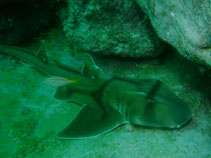
背面の脊椎 (合計) : 2; 肛門の骨: 0. Harness-like narrow dark stripes on back (Ref. 9838).
Body shape (shape guide): elongated.
Body shape (shape guide): elongated.
A common shark of the continental shelves (Ref. 9838), from close inshore at the intertidal zone to 275 m (Ref. 6871). Segregates by sex and maturity stage (Ref. 6871). Nocturnal, hides in caves and rocky gullies during the day (Ref. 6871). Feeds on benthic invertebrates, primarily echinoderms (Ref. 247). Oviparous (Ref. 50449). Eggs with spiral flanges but lack tendrils (Ref. 6871). Undergoes yearly migrations to spawning sites during breeding season (Ref. 247). Considered harmless to people, but can deliver a painful nip when provoked (Ref. 247).
ライフサイクルと交尾行動 成熟 | 繁殖 | 放精 | 卵 | 生産力 | 幼生
Oviparous. Distinct pairing with embrace (Ref. 205). Undergoes yearly migrations to breeding sites. Females lay about 10 to 16 (commonly 10-12) eggs in rock crevices on shallow sheltered reefs at depths of 1-5 m (rarely 20-30 m) during August and September (rarely in July and October). In captivity, females lay 2 eggs a day every 8-17 days. Eggs are hatched after 9-12 months and young then move into nursery areas in bays and estuaries. After the breeding season, males move into deeper waters followed by the females in late September or October.
主な参考文献
参考文献のアップロード | 参考文献 | コーディネーター | 協力者
Compagno, L.J.V., 1984. FAO Species Catalogue. Vol. 4. Sharks of the world. An annotated and illustrated catalogue of shark species known to date. Part 1 - Hexanchiformes to Lamniformes. FAO Fish. Synop. 125(4/1):1-249. Rome, FAO. (Ref. 247)
CITES
Not Evaluated
人間に対する脅威
Traumatogenic (Ref. 247)
人間の用途
水産業: 少数商業の; 水族館・水槽: 公共の水族館
FAO - 水産業: 種の外形; Publication: search | FishSource |
より多くの情報
解剖学
カマ
脳
オトリス
カマ
脳
オトリス
生理学
体組成
栄養素
酸素消費
水泳タイプ
泳ぐ速さ
視覚色素
フィッシュ・サウンド
病気と寄生虫
毒性(LC50)
体組成
栄養素
酸素消費
水泳タイプ
泳ぐ速さ
視覚色素
フィッシュ・サウンド
病気と寄生虫
毒性(LC50)
遺伝子の
ゲノム
遺伝子の
ヘテロ接合性
遺伝
遺伝的多様性
ゲノム
遺伝子の
ヘテロ接合性
遺伝
遺伝的多様性
用具
オーガニック・クイズ | 電子書籍 | 野外観察図鑑 | 検索表 | 長さ-周波数ウィザード | 生活史の基盤ツール | 目的のマップ |
キャッチ-MSY |
特記事項
XMLをダウンロードして下さい
インターネットの情報源
AFORO (otoliths) | Aquatic Commons | BHL | Cloffa | Websites from users | Check FishWatcher | CISTI | Catalog of Fishes: 部類, 種 | DiscoverLife | ECOTOX | FAO - 水産業: 種の外形; Publication: search | Faunafri | Fishipedia | Fishtrace | GloBI | Google Books | Google Scholar | Google | IGFA World Record | OneZoom | Open Tree of Life | Otolith Atlas of Taiwan Fishes | 公共の水族館 | PubMed | Reef Life Survey | Socotra Atlas | TreeBase | 生命の木 | Wikipedia: 行く, 検索する | World Records Freshwater Fishing | 動物に関する記録
モデルに基づく推定値
好ましい温度 (参照 123201): 14.1 - 22.6, mean 16.8 °C (based on 178 cells).
系統多様性指数 (参照 82804): PD50 = 0.5029 [Uniqueness, from 0.5 = low to 2.0 = high].
Bayesian length-weight: a=0.00347 (0.00258 - 0.00466), b=3.17 (3.08 - 3.26), in cm total length, based on LWR estimates for this species (Ref. 93245).
栄養段階 (参照 69278): 3.5 ±0.48 se; based on food items.
回復力 (参照 120179): 低い, 4.5年~14年の倍増期間の最小個体群 (tm=8-10; Fec=10).
栄養素 (Ref. 124155): Calcium = 17.6 [3.6, 78.9] mg/100g; Iron = 0.653 [0.164, 1.934] mg/100g; Protein = 19.2 [17.1, 21.1] %; Omega3 = 0.215 [0.096, 0.466] g/100g; Selenium = 34.5 [10.4, 97.4] μg/100g; VitaminA = 5.8 [1.9, 16.9] μg/100g; Zinc = 0.526 [0.262, 0.951] mg/100g (wet weight);