



Lägg till din observation i Fish Watcher
| Native range | All suitable habitat | Point map | Year 2050 |

|
| This map was computer-generated and has not yet been reviewed. |
| Squatina squatina AquaMaps Data sources: GBIF OBIS |
Ladda upp din foton och Videor
Bilder | Google image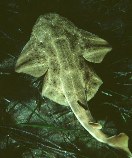 Squatina squatina
Bild av Hernández-González, C.L.
Bilder | Google image
Bild av Hernández-González, C.L.
Klassificering / Namn Populärnamn | synonymer | Catalog of Fishes(Släkte, Arter) | ITIS | CoL | WoRMS | Cloffa
Elasmobranchii (hajar och rockor) (sharks and rays) > Squatiniformes (Angel sharks) > Squatinidae (Angel sharks)
Etymology: Squatina: Latin for skate, which angel sharks superficially resemble, presumably tautonymous with Squalus squatina Linnaeus 1758 (no species mentioned) (See ETYFish); squatina: Latin for skate, which angel sharks superficially resemble (See ETYFish).
More on author: Linnaeus.
Etymology: Squatina: Latin for skate, which angel sharks superficially resemble, presumably tautonymous with Squalus squatina Linnaeus 1758 (no species mentioned) (See ETYFish); squatina: Latin for skate, which angel sharks superficially resemble (See ETYFish).
More on author: Linnaeus.
Miljö: miljö / Klimatzon / djupintervall / distributionsområde Ekologi
marina; brackvatten bottenlevande; havsvandrande (Ref. 51243); djupintervall 5 - 150 m (Ref. 247). Temperate; 63°N - 21°N, 19°W - 42°E
Utbredning Territorier | FAO områden | Ekosystem | Förekomster | Prickkarta | Utplanteringar | Faunafri
East Atlantic. Its range and abundance is declining severely throughout its range. There is a proposed legal protection in Britain (Ref. 58085). The European Council Regulations 43/2009, 23/2010, 57/2011, 44/2012, 40/2013, 43/2014, 2015/104 and 2016/72 prohibit to fish for, to retain on board, to tranship and to land this species in all waters from the European Community (F. Osaer, pers.comm. 04/2016).
Längd vid första mognad / Storlek / Vikt / Ålder
Könsmognad: Lm 147.5, range 102 - 169 cm
Max length : 183 cm TL hane/ej könsbestämd; (Ref. 247); 244.0 cm TL (female); common length : 150 cm TL hane/ej könsbestämd; (Ref. ); publicerad maxvikt: 80.0 kg (Ref. 35388)
Max length : 183 cm TL hane/ej könsbestämd; (Ref. 247); 244.0 cm TL (female); common length : 150 cm TL hane/ej könsbestämd; (Ref. ); publicerad maxvikt: 80.0 kg (Ref. 35388)
Kort beskrivning Bestämningsnycklar | Morfologi | Morfometri
Taggstrålar i ryggfenan (totalt) : 0. Broad flattened body, with enlarged pectoral and pelvic fins, no anal fin. Eyes and large spiracles dorsally. Gill openings at the sides of the head. The mouth is terminal. Coloration variable, from grey to reddish or greenish-brown with scattered small white spots and blackish dots dorsally (Ref. 78469). No ocelli on body (Ref. 247).
Body shape (shape guide): other.
Body shape (shape guide): other.
A benthic species that occurs inshore, on coasts and along the continental shelf; may enter estuaries (Ref. 247, 58085). Found mainly on sand or mud bottoms; sluggish by day, lying buried with eyes protruding. Also utilizes areas with macroalgae, kelp or rocks (Ref. 88920). Nocturnal species, swims off bottom at night. Feeds mainly on flatfishes and other benthic fishes, but also on skates, crustaceans and molluscs, with one record of swallowed cormorant (Ref. 247, 28070). Moves to deeper waters during winter, returning to the shallower depths in the spring (Ref. 88187), moving northwards in summer. Ovoviviparous (Ref. 50449, 107715). Females generally grow larger than males (Ref. 58137, 107710, 107713, 107715). Detects weak electric fields generated by other organisms (e.g. potential prey) (Ref. 10311). The marine leech Stibarobdella macrothela is a common parasite (Ref. 107712) and the isopod Aegapheles deshaysiana a common micropredator (Ref. 107714) for this shark species in the Canary Islands. Utilized fresh and dried salted for human consumption, and possibly for oil and fishmeal (Ref. 247). Reaches 250 cm (Ref. 35388).
Livscykel och parningsbeteende Könsmognad | Reproduktion | Lek | Ägg | Fekunditet | Larver
Ovoviviparous, produce 7-25 pups/litter (Ref. 58085), 13.0 +/- 1.9 pups in the Canary Is (Ref. 107713) with litter number increasing with female size. Gestation period lasts for 8-10 months (born Dec-Feb in Mediterranean, July in England) (Ref. 58085), and +/- 6 months in the Canary Is (Ref. 107713). Size at birth ranges from 24-30 cm TL (Ref. 58085). Embryos feed solely on yolk (Ref. 50449). Full term embryos weighed 189-200 g; no egg capsules found around ova or embryos (Ref. 107715). A biannual reproductive cycle is likely the case for this species (Ref. 32746), triannual cycle in the Canary Is (Ref. 107713).
Huvudreferens
Ladda upp dina referenser | referenser | Koordinator : Compagno, Leonard J.V. | Medarbetare
Compagno, L.J.V., 1984. FAO Species Catalogue. Vol. 4. Sharks of the world. An annotated and illustrated catalogue of shark species known to date. Part 1 - Hexanchiformes to Lamniformes. FAO Fish. Synop. 125(4/1):1-249. Rome, FAO. (Ref. 247)
Status på IUCN:s rödlista (Ref. 130435: Version 2025-2 (Global))
Critically Endangered (CR) (A2bcd); Date assessed: 12 July 2017
CITES
Not Evaluated
Hot mot människor
Traumatogenic
Mänskliga användningsområden
Fiskeri: mindre kommeriell; sportfisk: ja
FAO - fiskeri: landningar, artprofil; Publication: search | FishSource | Havet omkring oss
Ytterligare information
Populationsdynamik
Tillväxtparametrar
Max. åldrar / storlekar
Längd-vikt rel.
Längd-längd rel.
Längd-frekvenser
Massakonvertering
Rekrytering
Abundans
Tillväxtparametrar
Max. åldrar / storlekar
Längd-vikt rel.
Längd-längd rel.
Längd-frekvenser
Massakonvertering
Rekrytering
Abundans
Livscykel
Reproduktion
Könsmognad
Mognad/Gills rel.
Fekunditet
Lek
Lekande aggregat
Ägg
Utveckling av ägg
Larver
Larvdynamik
Reproduktion
Könsmognad
Mognad/Gills rel.
Fekunditet
Lek
Lekande aggregat
Ägg
Utveckling av ägg
Larver
Larvdynamik
Fysiologi
Kroppssammansättning
Näringsämnen
Syreförbrukning
Typ av simning
Simhastighet
Visuella pigment
Ljud från fisk
Sjukdomar & Parasiter
Toxicitet (LC50)
Kroppssammansättning
Näringsämnen
Syreförbrukning
Typ av simning
Simhastighet
Visuella pigment
Ljud från fisk
Sjukdomar & Parasiter
Toxicitet (LC50)
Människorelaterad
Vattenbrukssystem
Vattenbruksprofiler
Avelslinjer
Ciguatera-fall
Frimärken, mynt, diverse.
Vattenbrukssystem
Vattenbruksprofiler
Avelslinjer
Ciguatera-fall
Frimärken, mynt, diverse.
Verktyg
Organisk frågesport | E-bok | Fälthandbok | Längdfördelnings-verktyg | Livshistorie-verktyg | Prickkarta |
Fångst-MSY |
Särskilda rapporter
Kontrollera för underhåll av akvarium | Kontrollera om det finns faktablad om arter | Kontrollera om det finns faktablad om vattenbruk
Ladda ner XML
Internet-källor
AFORO (otoliths) | Aquatic Commons | BHL | Cloffa | Websites from users | Check FishWatcher | CISTI | Catalog of Fishes: Släkte, Arter | DiscoverLife | DORIS | ECOTOX | FAO - fiskeri: landningar, artprofil; Publication: search | Faunafri | Fishipedia | Fishtrace | GloBI | Google Books | Google Scholar | Google | IGFA World Record | Nationella databaser | OneZoom | Open Tree of Life | Otolith Atlas of Taiwan Fishes | Offentliga akvarier | PubMed | Reef Life Survey | Socotra Atlas | TreeBase | Tree of Life | Wikipedia: Go, sök | World Records Freshwater Fishing | Zoologiskt register
Uppskattningar baserade på modeller
Önskad temperatur (Ref. 123201): 7.7 - 19.4, mean 11.4 °C (based on 854 cells).
Index för fylogenetisk mångfald (Ref. 82804): PD50 = 0.5000 [Uniqueness, from 0.5 = low to 2.0 = high].
Bayesian length-weight: a=0.00832 (0.00430 - 0.01608), b=3.05 (2.87 - 3.23), in cm total length, based on LWR estimates for this species & Genus-body shape (Ref. 93245).
Trofisk nivå (Ref. 69278): 4.1 ±0.5 se; based on diet studies.
Resiliens (Ref. 120179): Låg, lägsta populationsfördubblingstid 4,5-14 år (Fec=9-20).
Prior r = 0.27, 95% CL = 0.18 - 0.41, Based on 1 data-limited stock assessment.
Näringsämnen (Ref. 124155): Calcium = 3.58 [0.60, 65.38] mg/100g; Iron = 0.23 [0.02, 2.63] mg/100g; Protein = 18.2 [16.1, 20.5] %; Omega3 = 0.464 [0.160, 1.307] g/100g; Selenium = 12.7 [2.6, 61.3] μg/100g; VitaminA = 6.41 [0.58, 72.79] μg/100g; Zinc = 0.324 [0.023, 3.530] mg/100g (wet weight);