This website uses cookies to enhance your browsing experience and ensure the functionality of our site. For more detailed information about the types of cookies we use and how we protect your privacy, please visit our Privacy Information page.
×
Cookie Settings
This website uses different types of cookies to enhance your experience. Please select your preferences below:
Indo-Pacific: East Africa (except the Red Sea) to the Line and Society Islands, north to Ryukyu and Wake Islands, south to Vanuatu; throughout Micronesia (Ref. 1602). Lessepsian migrant (Ref. 124038) to be confirmed because the species is absent from the Red Sea (NB303)..
Größe / Gewicht / Alter
Geschlechtsreife: Lm? range ? - ? cm Max length : 19.5 cm TL Männchen/unbestimmt; (Ref. 90102)
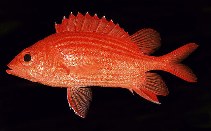
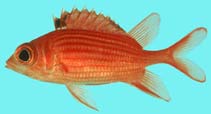
Rückenflossenstacheln (insgesamt) : 11; Rückenflossenweichstrahlen (insgesamt) : 12 - 14; Afterflossenstacheln: 4; Afterflossenweichstrahlen: 9 - 10. Body silvery pink with longitudinal red stripes; head red with silvery reflections on the cheek and opercle; spinous dorsal pink (or light red) with submarginal dark red band, the membranes tipped in white; other fins red to yellowish red, with the upper and lower edges of the caudal fin darker red; leading edges of anal and pelvic fins white with a submarginal darker red band, base of pectoral fins darker red (Ref. 4201 and 27370). Four oblique scale rows on cheek; body depth 2.6-2.9 in SL; head length (HL) 2.6-2.85 in SL; snout length 3.45-3.95 in HL; mouth often terminal; maxilla extending to between verticals just short of front of the pupil and just about center of the eye, upper jaw length 2.45-2.6 in HL; premaxillary groove reaching to a vertical at front edge of the orbit; anterior end of nasal bone with 2 short diverging spines; surface and medial margin of nasal bone spineless; moderately large nasal fossa often spineless on margin (an 11.8 cm SL specimen from Comoros, ROM 56585, has 2 spinules on the edge of the fossa, one on each side; a 9.4 cm, FMNH 17947, has a small spinule on one side on the edge of the fossa); upper edge of suborbital bones uniformly serrate; preopercular spine about 2/3 orbit diameter, 3.8-4.7 in HL; opercular spines 2, the lower from 2/3 as long to nearly as long as upper spine; short dorsal spines, 3rd to 5th dorsal spines subequal, 4th usually longest, 2.25-2.7 in HL; 3rd anal spine 1.25-1.6 in HL (Ref. 27370). Body shape (shape guide): fusiform / normal; Cross section: compressed.
Found in relatively deep waters of outer reef slopes and has been collected on reef flat and lagoon patch reefs. Feeds mainly on benthic crabs and shrimps at night. Spine of preopercle venomous. Maximum depth reported taken from Ref. 128797.
Randall, J.E., 1998. Revision of the Indo-Pacific squirrelfishes (Beryciformes: Holocentridae: Holocentrinae) of the genus Sargocentron, with descriptions of four new species. Indo-Pac. Fish. (27):105 p. (Ref. 27370)
IUCN Rote Liste Status (Ref. 130435: Version 2025-2 (Global))
Bevorzugte Temperatur (Ref. 123201): 26.6 - 29.3, mean 28.5 °C (based on 2259 cells).
Phylogenetischer Diversitätsindex (Ref. 82804): PD50 = 0.5000 [Uniqueness, from 0.5 = low to 2.0 = high].
Bayesian length-weight: a=0.01698 (0.00810 - 0.03560), b=2.96 (2.79 - 3.13), in cm total length, based on LWR estimates for this Genus-body shape (Ref. 93245).
Trophische Ebene (Ref. 69278): 3.6 ±0.60 se; based on food items.
Widerstandsfähigkeit (Ref. 120179): hoch, Verdopplung der Population dauert weniger als 15 Monate. (Preliminary K or Fecundity.).
Anfälligkeit der Fischerei (Ref. 59153): Low vulnerability (10 of 100). 🛈