



Osteogaster oharai Tencatt, Carvalho, Silva & Britto, 2025
Envoyez vos Photos et vidéos
Images Google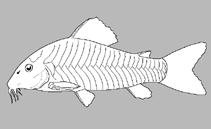 No image available for this species;
drawing shows typical species in Callichthyidae.
Images Google
drawing shows typical species in Callichthyidae.
Classification / Noms Noms communs | Synonymes | Catalog of Fishes(Genre, Espèce) | ITIS | CoL | WoRMS | Cloffa
> Siluriformes (Catfishes) > Callichthyidae (Callichthyid armored catfishes) > Corydoradinae
Etymology: oharai: Named after Dr. Willian Massaharu Ohara, a distinctive ichthyologist, for his extensive contributions to knowledge of South American freshwater fishes, and his fundamental role in the professional history of LFCT, having generously donated dozens of species of Corydoradinae collected by him over the last decade; noun in a genitive case.
Etymology: oharai: Named after Dr. Willian Massaharu Ohara, a distinctive ichthyologist, for his extensive contributions to knowledge of South American freshwater fishes, and his fundamental role in the professional history of LFCT, having generously donated dozens of species of Corydoradinae collected by him over the last decade; noun in a genitive case.
Environnement : milieu / zone climatique / profondeur / gamme de distribution Écologie
; eau douce démersal. Tropical
Distribution Territoires | Zones FAO | Écosystèmes | Occurrences | Carte par point | Introductions | Faunafri
South America: Brazil.
Taille / Poids / Âge
Description synthétique Clés d'identification | Morphologie | Morphométrie
This species is distinguished by the following characters: with an oblique dorsolateral longitudinal dark stripe on flanks, starting at first dorsolateral body plate and gradually descending towards middle portion of caudal-fin base, variably extending diffuse on ventral lobe of caudal fin; with a moderately-developed posterolateral portion of scapulocoracoid, not expanded mesially; dorsolateral stripe not extending anteriorly and meeting its counterpart on head (Ref. 138114).
Body shape (shape guide): elongated; Cross section: oval.
Body shape (shape guide): elongated; Cross section: oval.
Captured in small streams, tributaries of the rio Aripuanã upstream the Dardanelos-Andorinhas waterfalls complex, where the average width was estimated in 2.18 m ± 0.80, depth in 17.0 cm ± 7.6, water current in 3.83 m/s ± 7.4, dissolved oxygen in 1.18 mg/l ± 0.99, and temperature in 25.1 °C ± 2.0. In the rio Juruena basin, most specimens were collected in small and shallow isolated pools of intermittent streams, directly flowing into the rio Juruena, also occurring in larger/deeper streams, as the igarapé do Boi Preto. In these sites (rio Juruena basin), the streams have dense marginal vegetation, muddy or dark tea-colored water, and substrate composed by sand and/or clay, leaf litter, submerged logs and branches, and large rocks. In the rio Juruena basin, no additional Corydoradinae species was found in syntopy (Ref. 138114).
Cycle de vie et comportement reproducteur Maturité | Reproduction | Frai | Œufs | Fécondité | Larves
Référence principale
Téléchargez vos références | Références | Coordinateur : Reis, Roberto E. | Collaborateurs
Tencatt, L.F.C., V. Carvalho, H.P. Silva and M.R. Britto, 2025. A new striped Osteogaster (Siluriformes: Callichthyidae) from the Madeira and Tapajós river basins, Brazil, with a new generic diagnosis and an identification key to the species of Osteogaster. Neotrop. Ichthyol. 23(2):e240134. (Ref. 138114)
CITES
Not Evaluated
Menace pour l'homme
Harmless
Utilisations par l'homme
FAO - Publication: search | FishSource |
Plus d'informations
Écologie trophique
Aliments (proies)
Composition du régime alimentaire
Consommation alimentaire
Rations alimentaires
Prédateurs
Aliments (proies)
Composition du régime alimentaire
Consommation alimentaire
Rations alimentaires
Prédateurs
Écologie
Écologie
Écologie
Dynamique des populations
Paramètres de croissance
Âges / tailles maximales
Longueur-poids rel.
Rel. longueur-longueur.
Fréquences de longueurs
Conversion de masse
Recrutement
Abondance
Paramètres de croissance
Âges / tailles maximales
Longueur-poids rel.
Rel. longueur-longueur.
Fréquences de longueurs
Conversion de masse
Recrutement
Abondance
Cycle de vie
Reproduction
Maturité
Maturité/épines rel.
Fécondité
Frai
Agrégats de frai
Œufs
Développement de l'œuf
Larves
Dynamique des populations larvaires
Reproduction
Maturité
Maturité/épines rel.
Fécondité
Frai
Agrégats de frai
Œufs
Développement de l'œuf
Larves
Dynamique des populations larvaires
Anatomie
Surface branchiale
Cerveau
Otolithe
Surface branchiale
Cerveau
Otolithe
Physiologie
Composition corporelle
Nutriments
Consommation d'oxygène
Type de natation
Vitesse de nage
Pigments visuels
Son de poisson
Maladies et parasites
Toxicité (CL50)
Composition corporelle
Nutriments
Consommation d'oxygène
Type de natation
Vitesse de nage
Pigments visuels
Son de poisson
Maladies et parasites
Toxicité (CL50)
Génétique
génôme
Génétique
Hétérozygotie
Héritabilité
Diversité génétique
génôme
Génétique
Hétérozygotie
Héritabilité
Diversité génétique
Liées à l'homme
Systèmes d'aquaculture
Profils d'aquaculture
Souches
Cas de ciguatera
Timbres, pièces de monnaie, divers
Systèmes d'aquaculture
Profils d'aquaculture
Souches
Cas de ciguatera
Timbres, pièces de monnaie, divers
Outils
E-book | Guide de terrain | Générateur de fréquences de longueur | Outil de dynamique de population | Carte par point |
Capture-MSY |
Articles particuliers
Télécharger en XML
Sources Internet
AFORO (otoliths) | Aquatic Commons | BHL | Cloffa | Websites from users | FishWatcher | CISTI | Catalog of Fishes: Genre, Espèce | DiscoverLife | ECOTOX | FAO - Publication: search | Faunafri | Fishipedia | Fishtrace | GloBI | Google Books | Google Scholar | Google | IGFA World Record | OneZoom | Open Tree of Life | Otolith Atlas of Taiwan Fishes | PubMed | Reef Life Survey | Socotra Atlas | TreeBase | Arbre de Vie | Wikipedia: aller à, chercher | World Records Freshwater Fishing | Zoobank | Zoological Record
Estimations basées sur des modèles
Indice de diversité phylogénétique (Réf. 82804): PD50 = 0.5039 [Uniqueness, from 0.5 = low to 2.0 = high].
Bayesian length-weight: a=0.00741 (0.00287 - 0.01912), b=3.14 (2.92 - 3.36), in cm total length, based on LWR estimates for this (Sub)family-body shape (Ref. 93245).
Niveau trophique (Réf. 69278): 3.0 ±0.3 se; based on size and trophs of closest relatives
Résilience (Réf. 120179): Haut, temps minimum de doublement de population inférieur à 15 mois (Preliminary K or Fecundity.).