



分类 / 名称 俗名 | 同种异名 | Catalog of Fishes(属, 种) | ITIS | CoL | WoRMS | Cloffa
Teleostei > Siluriformes (Catfishes) > Callichthyidae (Callichthyid armored catfishes) > Corydoradinae
Etymology: Aspidoras: Greek, aspis, -idos = shield + Greek, dora = skin (Ref. 45335); mephisto: Name refers to the shortened name of Mephistopheles, demon from the German folklore. Mephistopheles comes from the Greek by the combination of three words: με (me), a negation, φῶB (phōs), meaning light, and φιλιB (philis), meaning loving, literally ‘not-light-loving’, or the one who does not love the light, referring to the subterranean behavior of the new species; noun in apposition.
Etymology: Aspidoras: Greek, aspis, -idos = shield + Greek, dora = skin (Ref. 45335); mephisto: Name refers to the shortened name of Mephistopheles, demon from the German folklore. Mephistopheles comes from the Greek by the combination of three words: με (me), a negation, φῶB (phōs), meaning light, and φιλιB (philis), meaning loving, literally ‘not-light-loving’, or the one who does not love the light, referring to the subterranean behavior of the new species; noun in apposition.
环境:氛围 / 气候带 / 深度上下限 / 分布范围 生态学
; 淡水 居于水底的.
分布 领土 | FAO区域 | 生态系 | 标本纪录 | 分布图 | 简介 | Faunafri
South America: Brazil.
大小 / 重量 / 年龄
简单描述 检索表 | 型态特徵 | 形态测量图
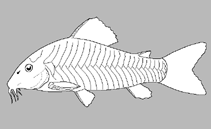
This species is distinguished from all of its congeners by the following characters: with a conspicuous reduction of pigmentation and orbit in most specimens; with smaller preadipose azygous plates; presence of dorsal-fin spinelet; parieto-supraoccipital fontanel located mesially on bone; no distinct dark brown or black stripe from anteroventral portion of eye to upper lip lateral area, and absence of striated small platelets on ventral surface of trunk; infraorbital 1 generally with well-developed ventral laminar, or moderately-developed; with poorly-developed serrations on posterior margin of pectoral spine; dorsal fin, even in conspicuously colored specimens, with only dark brown or black chromatophores concentrated on rays, forming spots in some specimens, the membranes hyaline, or with isolated dark brown or black chromatophores on membranes, not forming any conspicuous pattern; nuchal plate not externally visible (Ref. 118110).
Body shape (shape guide): elongated; Cross section: oval.
Body shape (shape guide): elongated; Cross section: oval.
This species prefers slow waters (small values of dissolved oxygen), small depths (ca. 0.05 m) and bottom formed by silt, clay and boulders, showing higher values of Total Dissolved Solutes compared to the epigean drainage. Abundance is relatively high compared to other troglobitic fishes (ca. 50 individuals in pools), and population densities of 5±6 inds.m-2. Juveniles were observed along small stretches of the drainage, always in lentic and shallow places, isolated from the adults and frequently under roots. It forages calmly close to small submersed roots and silty-bottom, using the anterior extremity of the snout exploring the substrate in a parallel position or forming an angle of ca. 60° in relation to the bottom, sometimes under the small roots. The fish showed this behavior throughout the entire observation time (ca. 20 min) and did not show escape and/or avoidance behavior due to lamp-light or other external disturbances (e.g. presence of the observer). A detailed courtship behavior at the AneÂsio III cave is shown in a video file (https://www.youtube.com/watch?v=ksrV1af0NZY and https://figshare.com/articles/Aspidoras_mephisto_new_species/4583974).
Two individuals were observed close to each other; the smaller one (considered the first male) starts to go around the larger (supposedly the female), and gives gentle touches on the flanks, head and tail. A third individual (the second male) arrives, and then the three stop parallel to each other. After a few seconds, they swim in the opposite direction, the female stops for a few seconds, then swims in the direction of the first male, showing a preference for this individual. However, the second male arrives and the first one swims in the opposite direction, avoiding contact. At this time, the second male, touches abruptly and quickly the female in the flanks and tail, but the female escapes immediately, avoiding the copula. Appearance of several juvenile individuals along the drainage, suggests that the fish were in the reproductive period (dry season); in contrast to the stated behavior of many troglobitic organisms, that show a reproductive peak in the beginning or middle of the rainy season, when food availability and input is higher. One possible explanation is that the AneÂsio-Russão cave-system can sustain the population due the large amount of submerged roots, which represent shelter and food source for this catfish, thus food is probably not the main limiting factor. Captive observations suggest that this species has a high life expectancy, which is a typical characteristic of troglobitic organisms. The holotype captured in adult stage on April 7, 2007 and was kept alive until its preservation, on April 20, 2016 (nine years in captivity). In addition, one of the paratypes, MCP 40634, also captured in adult stage on April 7, 2008 was maintained alive in the aquarium until February 13, 2015 (seven years in captivity). Considering that no evidence or study shows how much time it takes until they reach the adult stage, a minimal life expectancy of at least ten years could be possible for A. mephisto (Ref. 118110).
生命周期和交配行为 成熟度 | 繁殖 | 产卵场 | 卵 | 孕卵数 | 仔鱼
主要参考文献
上传您的参考资料 | 参考文献 | 合作者 : Reis, Roberto E. | 合作者
Tencatt, L.F.C. and M.E. Bichuette, 2017. Aspidoras mephisto, new species: The first troglobitic Callichthyidae (Teleostei: Siluriformes) from South America. PLoS ONE 12(3): e0171309. (Ref. 118110)
CITES
Not Evaluated
对人类的威胁
人类利用
FAO - Publication: search | FishSource |
更多信息
营养生态学
食物(猎物)
食性组成
食物消耗量
口粮
捕食者
食物(猎物)
食性组成
食物消耗量
口粮
捕食者
生态学
生态学
生态学
人口动态
成长参数
最大年龄/尺寸
长度-重量关系
长短关系
体长-频率
质量转换
入添量
丰度
成长参数
最大年龄/尺寸
长度-重量关系
长短关系
体长-频率
质量转换
入添量
丰度
解剖学
鳃区
大脑
耳石
鳃区
大脑
耳石
生理学
身体成分
营养素
耗氧量
游泳类型
游泳速度
视觉色素
鱼声
疾病与寄生虫
毒性(半数致死浓度)
身体成分
营养素
耗氧量
游泳类型
游泳速度
视觉色素
鱼声
疾病与寄生虫
毒性(半数致死浓度)
遗传学
基因组
遗传学
异质性
遗传率
基因多样性
基因组
遗传学
异质性
遗传率
基因多样性
工具
特别资料
下载 XML
网络资源
AFORO (otoliths) | Aquatic Commons | BHL | Cloffa | Websites from users | 核实 FishWatcher | CISTI | Catalog of Fishes: 属, 种 | DiscoverLife | ECOTOX | FAO - Publication: search | Faunafri | Fishipedia | Fishtrace | GloBI | Google Books | Google Scholar | Google | IGFA World Record | OneZoom | Open Tree of Life | Otolith Atlas of Taiwan Fishes | PubMed | Reef Life Survey | Socotra Atlas | TreeBase | 树状分类阶层 | Wikipedia: 转至, 搜寻 | World Records Freshwater Fishing | Zoobank | 动物学的记录
基于模型的估算
系统发育多样性指数 (参考文献 82804): PD50 = 0.5000 [Uniqueness, from 0.5 = low to 2.0 = high].
Bayesian length-weight: a=0.00741 (0.00287 - 0.01912), b=3.14 (2.92 - 3.36), in cm total length, based on LWR estimates for this (Sub)family-body shape (Ref. 93245).
营养阶层 (参考文献 69278): 3.0 ±0.3 se; based on size and trophs of closest relatives
回复力 (参考文献 120179): 高度, 族群倍增时间少于 15个月 (Preliminary K or Fecundity.).