



Sube tu fotos y Vídeos
Google image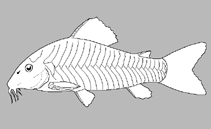 No image available for this species;
drawing shows typical species in Callichthyidae.
Google image
drawing shows typical species in Callichthyidae.
Clasificación / Nombres Nombres comunes | Sinónimos | Catalog of Fishes(Género, Especie) | ITIS | CoL | WoRMS | Cloffa
> Siluriformes (Catfishes) > Callichthyidae (Callichthyid armored catfishes) > Corydoradinae
Etymology: Aspidoras: Greek, aspis, -idos = shield + Greek, dora = skin (Ref. 45335); aldebaran: Named after the red giant Aldebaran or Alpha Tauri (α Tauri), the brightest star of the Taurus constellation, deriving from the Arabic al Dabarān, which means 'the follower', This star presents a bright orange glow and it is positioned at the left eye of the mythological bull. A. aldebaran was firstly found among the Aspidoras taurus type series, recognized as a different and new species by its peculiar morphology and color pattern; noun in apposition.
Etymology: Aspidoras: Greek, aspis, -idos = shield + Greek, dora = skin (Ref. 45335); aldebaran: Named after the red giant Aldebaran or Alpha Tauri (α Tauri), the brightest star of the Taurus constellation, deriving from the Arabic al Dabarān, which means 'the follower', This star presents a bright orange glow and it is positioned at the left eye of the mythological bull. A. aldebaran was firstly found among the Aspidoras taurus type series, recognized as a different and new species by its peculiar morphology and color pattern; noun in apposition.
Entorno: milieu / zona climática / rango de profundidad / gama de distribución Ecología
; agua dulce demersal; rango de profundidad 0 - 1 m (Ref. 129024). Tropical
Distribución Territorios | Áreas FAO | Ecosistemas | Ocurrencias, apariciones | Mapa de puntos | Introducciones | Faunafri
South America: Brazil.
Tamaño / Peso / Edad
Descripción breve Claves de identificación | Morfología | Morfometría
This species is distinguished from its congeners by the following characters: parapophysis of the complex vertebra well developed; inner laminar expansion of infraorbital 1 ranging from well developed to extremely well developed; frontal bone narrow, with width slightly smaller than half of entire length; presence of small black spots on dorsal fin (Ref. 129024).
Body shape (shape guide): elongated; Cross section: oval.
Body shape (shape guide): elongated; Cross section: oval.
The site where some of the paratypes were collected, córrego Gordura, is a medium-sized tributary to the upper rio Araguaia basin with highly transparent and clear water, width ranging from less than one meter to about 15 m, and the depth ranging from about 10 cm to nearly two meters. The species was found in shallow (up to about 20 cm) stretches in the upper portion of the córrego Gordura, with moderate current and substrate composed mainly by sand and gravel. At this site, it was found in syntopy with Aspidoras velites, Characidium sp., and Hypostomus cf. careopinnatus. This species and A. velites were placed in a small biotope aquarium (i.e., one that recreates the natural habitat) to record their color pattern in life. During this event, A. velites displayed aggressive behavior towards an A. aldebaran, chasing and pushing it throughout the aquarium, with the latter specimen not reacting aggressively but tried to evade the assaults by the A. velites. Interestingly, A. aldebaran is generally larger and a clearly more robust than A. velites. In nature, such confrontations seem unlikely considering that the A. aldebaran was generally found associated with the sandy substrate of small shores whereas A. velites was most commonly captured in areas associated with marginal and/or submerged vegetation (Ref. 129024).
Ciclo vital y comportamiento de apareamiento Madurez | Reproducción | Puesta | Huevos | Fecundidad | Larva
Referencia principal
Suba sus referencias | Referencias | Coordinador : Reis, Roberto E. | Colaboradores
Tencatt, L.F.C., M.R. Britto, I.J.H. Isbrücker and C.S. Pavanelli, 2022. Taxonomy of the armored catfish genus Aspidoras (Siluriformes: Callichthyidae) revisited, with the description of a new species. Neotropical Ichthyology 20(3):1-159. (Ref. 129024)
CITES
Not Evaluated
Amenaza para el ser humano
Harmless
Usos humanos
FAO - Publication: search | FishSource |
Más información
Ecología Trófica
Alimentos (presas)
Composición de la dieta
consumo de alimento
Raciones de comida
Despredadores
Alimentos (presas)
Composición de la dieta
consumo de alimento
Raciones de comida
Despredadores
Ecología
Ecología
Ecología
Dinámica de la población
Coeficiente del crecimiento para
Edades / tallas máximas
Longitud-peso rel.
Longitud-longitud rel.
Longitud-frecuencias
Conversión de masas
Reclutamiento
Abundancia
Coeficiente del crecimiento para
Edades / tallas máximas
Longitud-peso rel.
Longitud-longitud rel.
Longitud-frecuencias
Conversión de masas
Reclutamiento
Abundancia
Ciclo de vida
Reproducción
Madurez
Madurez/Gills rel.
Fecundidad
Puesta
Agregaciones de desove
Huevos
Desarrollo de los huevos
Larva
Dinámica larvaria
Reproducción
Madurez
Madurez/Gills rel.
Fecundidad
Puesta
Agregaciones de desove
Huevos
Desarrollo de los huevos
Larva
Dinámica larvaria
Distribución
Territorios
Áreas FAO
Ecosistemas
Ocurrencias, apariciones
Introducciones
BRUVS - Vídeos
Territorios
Áreas FAO
Ecosistemas
Ocurrencias, apariciones
Introducciones
BRUVS - Vídeos
Anatomía
Superficie branquial
Cerebro
Otolito
Superficie branquial
Cerebro
Otolito
Fisiología
Composición corporal
Nutrientes
Consumo del oxígeno
Tipo de natación
Velocidad de natación
Pigmentos visuales
Sonido de peces
Enfermedades y parásitos
Toxicidad (CL50)
Composición corporal
Nutrientes
Consumo del oxígeno
Tipo de natación
Velocidad de natación
Pigmentos visuales
Sonido de peces
Enfermedades y parásitos
Toxicidad (CL50)
Genética
Genoma
Genética
Heterocigosidad
heritabilidad
Diversidad genética
Genoma
Genética
Heterocigosidad
heritabilidad
Diversidad genética
Relacionados con el ser humano
Sistemas de acuicultura
Perfiles de acuicultura
Razas
Ciguatera cases
Sellos, monedas, varios
Sistemas de acuicultura
Perfiles de acuicultura
Razas
Ciguatera cases
Sellos, monedas, varios
Herramientas
Libro electrónico | Guía de campo | Asistente para frecuencias de tallas | Herramienta de ciclo de vida | Mapa de puntos |
Catch-MSY |
Informes especiales
Comprobar el mantenimiento del acuario | Buscar fichas sobre especies | Consulte las hojas informativas sobre acuicultura
Descargar XML
Fuentes de Internet
AFORO (otoliths) | Aquatic Commons | BHL | Cloffa | Websites from users | Check FishWatcher | CISTI | Catalog of Fishes: Género, Especie | DiscoverLife | ECOTOX | FAO - Publication: search | Faunafri | Fishipedia | Fishtrace | GloBI | Google Books | Google Scholar | Google | IGFA World Record | OneZoom | Open Tree of Life | Otolith Atlas of Taiwan Fishes | PubMed | Reef Life Survey | Socotra Atlas | TreeBase | Árbol de la vida | Wikipedia: Go, búsqueda | World Records Freshwater Fishing | Zoobank | Expediente Zoológico
Estimaciones basadas en modelos
Índice de diversidad filogenética (Referencia 82804): PD50 = 0.5000 [Uniqueness, from 0.5 = low to 2.0 = high].
Bayesian length-weight: a=0.00741 (0.00287 - 0.01912), b=3.14 (2.92 - 3.36), in cm total length, based on LWR estimates for this (Sub)family-body shape (Ref. 93245).
Nivel trófico (Referencia 69278): 3.0 ±0.3 se; based on size and trophs of closest relatives
Resiliencia (Referencia 120179): Alto, población duplicada en un tiempo mínimo inferior a 15 meses (Preliminary K or Fecundity.).