



Plectranthias maekawa Wada, Senou & Motomura, 2018
Maekawa’s perchlet
Carregue seu(sua) Fotos e vídeos
Imagem do Google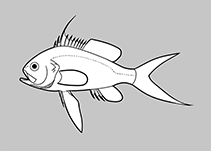 No image available for this species;
drawing shows typical species in Anthiadidae.
Imagem do Google
drawing shows typical species in Anthiadidae.
Classificação / Nomes Nomes comuns | Sinônimos | Catalog of Fishes(Gênero, Espécies) | ITIS | CoL | WoRMS | Cloffa
> Perciformes/Serranoidei (Groupers) > Anthiadidae (Fairy basslets or Streamer basses)
Etymology: Plectranthias: Bleeker (1873) disagrees with the generic placement of Plectropoma anthioides by Günther. He, therefore, erected Plectranthias to accommodate Pl. anthioides. The name is presumably the combination of the first part of Plectropoma (plectrum), and anthias. Plectrum = Plektron = πλῆκτρον (Greek, plektron = anyhting to strike with, spur + Greek, anthias = a fish, Ref. 45335); maekawa: Named for Mr. Takanori Maekawa (and the Maekawa Fisheries Co., Ltd.), who has kindly supported our ichthyofaunal research in the Ryukyu Islands; noun in apposition.
Eponymy: Takanori Maekawa is an amateur ichthyologist working in the industry who has often presented fish gleaned as by-catch from catches and fish markets that he recognises as being possibly new to science. [...] (Ref. 128868), visit book page.
Etymology: Plectranthias: Bleeker (1873) disagrees with the generic placement of Plectropoma anthioides by Günther. He, therefore, erected Plectranthias to accommodate Pl. anthioides. The name is presumably the combination of the first part of Plectropoma (plectrum), and anthias. Plectrum = Plektron = πλῆκτρον (Greek, plektron = anyhting to strike with, spur + Greek, anthias = a fish, Ref. 45335); maekawa: Named for Mr. Takanori Maekawa (and the Maekawa Fisheries Co., Ltd.), who has kindly supported our ichthyofaunal research in the Ryukyu Islands; noun in apposition.
Eponymy: Takanori Maekawa is an amateur ichthyologist working in the industry who has often presented fish gleaned as by-catch from catches and fish markets that he recognises as being possibly new to science. [...] (Ref. 128868), visit book page.
Meio ambiente: milieu / Zona climática / intervalo de profundidade / faixa de distribuição Ecologia
marinhas demersal; intervalo de profundidade 150 - 200 m (Ref. 138292). Subtropical
Distribuição Territórios | Áreas da FAO | Ecossistemas | Ocorrências | Mapa de pontos | Introduções | Faunafri
Northwest Pacific: Japan.
Tamanho / Peso / Idade
Descrição suscinta Chaves de identificação | Morfologia | Morfometria
Espinhos dorsais (total) : 10; Raios dorsais (total) : 15 - 16; Espinhos anais: 3; Raios anais : 7. This speces is distinguished from all its congeners by the following set of characters: D X,15-16; pectoral-fin rays 14; lateral line complete, pored scales 30; scale rows above lateral line 3; diagonal rows of large scales on cheek between eye and corner of preopercle 6; antrorse spines on ventral margin of preopercle 2; margins of subopercle and interopercle smooth; its body depth 33.5-34.7% of SL, its width 17.2-17.4% of SL; third dorsal-fin spine longest, with length 46.2-47.2% of HL; caudal-peduncle depth 58.0-63.2% of caudal-peduncle length. Colouration: when fresh: body pinkish-white with five orange-red bands on lateral surface, first band broadest, first, fourth and fifth bands vertical to body longitudinal axis, second and third bands slightly backwardly oblique; small poorly defined yellow blotches scattered below the lateral line, especially along red bands; scales above lateral line white, with distinct red margins; most cheek scales white or yellowish-white, without distinct red or yellow margins; when preserved, body uniformly pale, with reduced nape pigmentation (Ref. 138292).
Body shape (shape guide): fusiform / normal; Cross section: compressed.
Body shape (shape guide): fusiform / normal; Cross section: compressed.
Occurs over rocky substrate (Ref. 138292).
Ciclo de vida ou comportamento de acasalamento Maturidade | Reprodução | Desova | Ovos | Fecundidade | Larvas
Referência principal
Carregar suas referências | Referências | Coordenador | Colaboradores
Wada, H., H. Senou and H. Motomura, 2018. Plectranthias maekawa, a new species of perchlet from the Tokara Islands, Kagoshima, Japan, with a review of Japanese records of P. wheeleri (Serranidae: Anthiadinae). Ichthyol. Res. 66(2):269-279. (Ref. 138292)
CITES
Not Evaluated
Ameaça para os humanos
Harmless
Uso pelos humanos
Pescarias: de interesse potencial
FAO - Publication: search | FishSource |
Mais informação
Ecologia Trófica
Itens alimentares (presas)
Composição da dieta
Consumo alimentar
Rações alimentares
Predadores
Itens alimentares (presas)
Composição da dieta
Consumo alimentar
Rações alimentares
Predadores
Ecologia
Ecologia
Ecologia
Dinâmica populacional
Parâmetros de crescimento
Idade máxima / tamanhos
Relação comprimento-peso.
Relação comprimento-comprimento.
Frequências de comprimento
Conversão de massa
Recrutamento
Abundância
Parâmetros de crescimento
Idade máxima / tamanhos
Relação comprimento-peso.
Relação comprimento-comprimento.
Frequências de comprimento
Conversão de massa
Recrutamento
Abundância
Ciclo de vida
Reprodução
Maturidade
Maturidade/Rel. das guelras
Fecundidade
Desova
Agregações de desova
Ovos
Desenvolvimento dos ovos
Larvas
Dinâmica larval
Reprodução
Maturidade
Maturidade/Rel. das guelras
Fecundidade
Desova
Agregações de desova
Ovos
Desenvolvimento dos ovos
Larvas
Dinâmica larval
Anatomia
Área branquial
Cérebro
Otólito
Área branquial
Cérebro
Otólito
Fisiologia
Composição corporal
Nutrientes
Consumo de oxigênio
Tipo de natação
Velocidade de natação
Pigmentos visuais
Som de peixe
Doenças e Parasitas
Toxicidade (LC50s)
Composição corporal
Nutrientes
Consumo de oxigênio
Tipo de natação
Velocidade de natação
Pigmentos visuais
Som de peixe
Doenças e Parasitas
Toxicidade (LC50s)
Genética
genoma
Genética
Heterozigosidade
Hereditariedade
Diversidade genética
genoma
Genética
Heterozigosidade
Hereditariedade
Diversidade genética
Relacionado a humanos
Sistemas de aquicultura
Perfis para aquacultura
Estirpes
Casos de Ciguatera
Selos, moedas, diversos.
Sistemas de aquicultura
Perfis para aquacultura
Estirpes
Casos de Ciguatera
Selos, moedas, diversos.
Ferramentas
Livro eletrônico | Guia de campo | Ferramenta auxiliar de frequências de comprimento | Ferramenta sobre a história de vida | Mapa de pontos |
Catch-MSY |
Relatórios especiais
Checar Manutenção em Aquário | Checar Planilhas de Fatos sobre as Espécies | Checar Planilhas de Fatos sobre Aquicultura
Baixar XML
Fontes da internet
AFORO (otoliths) | Aquatic Commons | BHL | Cloffa | Websites from users | Checar Observador de Peixes (FishWatcher) | CISTI | Catalog of Fishes: Gênero, Espécies | DiscoverLife | ECOTOX | FAO - Publication: search | Faunafri | Fishipedia | Fishtrace | GloBI | Google Books | Google Scholar | Google | IGFA World Record | OneZoom | Open Tree of Life | Otolith Atlas of Taiwan Fishes | PubMed | Reef Life Survey | Socotra Atlas | TreeBase | Árvore da vida | Wikipedia: Ir para, procura | World Records Freshwater Fishing | Zoobank | Registro zoológico
Estimativas baseadas em modelos
Índice de diversidade filogenética (Ref. 82804): PD50 = 0.5000 [Uniqueness, from 0.5 = low to 2.0 = high].
Bayesian length-weight: a=0.01413 (0.00621 - 0.03212), b=3.00 (2.81 - 3.19), in cm total length, based on LWR estimates for this (Sub)family-body shape (Ref. 93245).
Nível Trófico (Ref. 69278): 3.5 ±0.6 se; based on size and trophs of closest relatives
Resiliência (Ref. 120179): Elevada, tempo mínimo de duplicação da população menor que 15 meses (Preliminary K or Fecundity.).