



Birdsongichthys rectus Tornabene, Manning, Robertson, Van Tassell & Baldwin, 2022
Straightfinned goby
Carregue seu(sua) Fotos e vídeos
Imagem do Google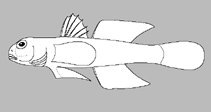 No image available for this species;
drawing shows typical species in Gobiidae.
Imagem do Google
drawing shows typical species in Gobiidae.
Classificação / Nomes Nomes comuns | Sinônimos | Catalog of Fishes(Gênero, Espécies) | ITIS | CoL | WoRMS | Cloffa
> Gobiiformes (Gobies) > Gobiidae (Gobies) > Gobiinae
Etymology: Birdsongichthys: Named for Dr Ray S. Birdsong, who contributed substantially to the knowledge on the systematics of the family Gobiidae, especially taxa from the tropical western Atlantic and eastern Pacific Oceans. the systematics of the family Gobiidae, especially taxa from the tropical western Atlantic and eastern Pacific Oceans. The root ‘ichthys’ is derived from the Greek ‘ikhthū́s’ (ιχθύς), fish.
Etymology: Birdsongichthys: Named for Dr Ray S. Birdsong, who contributed substantially to the knowledge on the systematics of the family Gobiidae, especially taxa from the tropical western Atlantic and eastern Pacific Oceans. the systematics of the family Gobiidae, especially taxa from the tropical western Atlantic and eastern Pacific Oceans. The root ‘ichthys’ is derived from the Greek ‘ikhthū́s’ (ιχθύς), fish.
Meio ambiente: milieu / Zona climática / intervalo de profundidade / faixa de distribuição Ecologia
marinhas demersal; intervalo de profundidade 110 - 241 m (Ref. 130191). Tropical
Distribuição Territórios | Áreas da FAO | Ecossistemas | Ocorrências | Mapa de pontos | Introduções | Faunafri
Caribbean: Honduras and Saint Eustatius, Caribbean Netherlands.
Tamanho / Peso / Idade
Descrição suscinta Chaves de identificação | Morfologia | Morfometria
Espinhos dorsais (total) : 8; Raios dorsais (total) : 9; Espinhos anais: 1; Raios anais : 8; Vértebras: 28. This species is distinguished by having the following characters: possesses all taxonomic characters present in most members of the Gobiosomatini and the Gobiosoma group: D1 VII; dorsal pterygiophore insertion pattern 3-221110; vertebrae: precaudal 11 + 27 and caudal 16; hypurals 1 and 2 fused to some extent with hypurals 3 and 4 and the terminal vertebral element; epural 1; no ventral postcleithrum; pelvic fins separate, no anterior frenum connecting spines, no membrane connecting innermost rays absent or weakly developed; pelvic-fin rays 1-5 unbranched and without fleshy or flattened tips; pelvic-fin rays are long, extending posteriorly to a point between middle or end of anal fin; side of body covered with ctenoid scales, including two modified basicaudal scales; anal-fin pterygiophores 2 inserted before first haemal spine; with cephalic sensory canals; D2 I,9; A I,8. Colouration: body with three horizontal series of bright yellow spots, one along dorsal midline, one along lateral midline and one along ventral midline; anterior profile of head with gradual slope, it is not blunt or nearly vertical; eye large (~8.3-10.6% SL) (Ref. 130191).
Body shape (shape guide): elongated; Cross section: compressed.
Body shape (shape guide): elongated; Cross section: compressed.
Occurs on sand and rubble substrates situated on or around the base of walls or steep rocky slopes on deep reefs (Ref. 130191).
Ciclo de vida ou comportamento de acasalamento Maturidade | Reprodução | Desova | Ovos | Fecundidade | Larvas
Referência principal
Carregar suas referências | Referências | Coordenador | Colaboradores
Tornabene, L., R. Manning, D.R. Robertson, J.L. Van Tassell and C.C. Baldwin, 2022. A new lineage of deep-reef gobies from the Caribbean, including two new species and one new genus (Teleostei: Gobiidae: Gobiosomatini). Zool. J. Linn. Soc.197(2):322-343. (Ref. 130191)
Status na Lista Vermelha da UICN (Ref. 130435: Version 2025-2 (Global))
Segura ou pouco preocupante (LC) ; Date assessed: 15 February 2024
CITES
Not Evaluated
Ameaça para os humanos
Harmless
Uso pelos humanos
FAO - Publication: search | FishSource |
Mais informação
Ecologia Trófica
Itens alimentares (presas)
Composição da dieta
Consumo alimentar
Rações alimentares
Predadores
Itens alimentares (presas)
Composição da dieta
Consumo alimentar
Rações alimentares
Predadores
Ecologia
Ecologia
Ecologia
Dinâmica populacional
Parâmetros de crescimento
Idade máxima / tamanhos
Relação comprimento-peso.
Relação comprimento-comprimento.
Frequências de comprimento
Conversão de massa
Recrutamento
Abundância
Parâmetros de crescimento
Idade máxima / tamanhos
Relação comprimento-peso.
Relação comprimento-comprimento.
Frequências de comprimento
Conversão de massa
Recrutamento
Abundância
Ciclo de vida
Reprodução
Maturidade
Maturidade/Rel. das guelras
Fecundidade
Desova
Agregações de desova
Ovos
Desenvolvimento dos ovos
Larvas
Dinâmica larval
Reprodução
Maturidade
Maturidade/Rel. das guelras
Fecundidade
Desova
Agregações de desova
Ovos
Desenvolvimento dos ovos
Larvas
Dinâmica larval
Anatomia
Área branquial
Cérebro
Otólito
Área branquial
Cérebro
Otólito
Fisiologia
Composição corporal
Nutrientes
Consumo de oxigênio
Tipo de natação
Velocidade de natação
Pigmentos visuais
Som de peixe
Doenças e Parasitas
Toxicidade (LC50s)
Composição corporal
Nutrientes
Consumo de oxigênio
Tipo de natação
Velocidade de natação
Pigmentos visuais
Som de peixe
Doenças e Parasitas
Toxicidade (LC50s)
Genética
genoma
Genética
Heterozigosidade
Hereditariedade
Diversidade genética
genoma
Genética
Heterozigosidade
Hereditariedade
Diversidade genética
Relacionado a humanos
Sistemas de aquicultura
Perfis para aquacultura
Estirpes
Casos de Ciguatera
Selos, moedas, diversos.
Sistemas de aquicultura
Perfis para aquacultura
Estirpes
Casos de Ciguatera
Selos, moedas, diversos.
Ferramentas
Livro eletrônico | Guia de campo | Ferramenta auxiliar de frequências de comprimento | Ferramenta sobre a história de vida | Mapa de pontos |
Catch-MSY |
Relatórios especiais
Checar Manutenção em Aquário | Checar Planilhas de Fatos sobre as Espécies | Checar Planilhas de Fatos sobre Aquicultura
Baixar XML
Fontes da internet
AFORO (otoliths) | Aquatic Commons | BHL | Cloffa | Websites from users | Checar Observador de Peixes (FishWatcher) | CISTI | Catalog of Fishes: Gênero, Espécies | DiscoverLife | ECOTOX | FAO - Publication: search | Faunafri | Fishipedia | Fishtrace | GloBI | Google Books | Google Scholar | Google | IGFA World Record | OneZoom | Open Tree of Life | Otolith Atlas of Taiwan Fishes | PubMed | Reef Life Survey | Socotra Atlas | TreeBase | Árvore da vida | Wikipedia: Ir para, procura | World Records Freshwater Fishing | Zoobank | Registro zoológico
Estimativas baseadas em modelos
Índice de diversidade filogenética (Ref. 82804): PD50 = 1.0000 [Uniqueness, from 0.5 = low to 2.0 = high].
Bayesian length-weight: a=0.00741 (0.00347 - 0.01582), b=3.09 (2.91 - 3.27), in cm total length, based on LWR estimates for this (Sub)family-body shape (Ref. 93245).
Nível Trófico (Ref. 69278): 2.9 ±0.3 se; based on size and trophs of closest relatives
Resiliência (Ref. 120179): Elevada, tempo mínimo de duplicação da população menor que 15 meses (Preliminary K or Fecundity.).