



Uploaden van uw Foto's en video's
Google afbeelding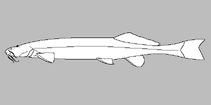 No image available for this species;
drawing shows typical species in Trichomycteridae.
Google afbeelding
drawing shows typical species in Trichomycteridae.
Classificatie / Namen Lokale namen | Synoniemen | Catalog of Fishes(Genus, Soort(en)) | ITIS | CoL | WoRMS | Cloffa
> Siluriformes (Catfishes) > Trichomycteridae (Pencil or parasitic catfishes) > Tridentinae
Etymology: Tridens: Greek, tres tria = three + Latin, dens = teeth (Ref. 45335); vitreus: Name vitreus from the Latin word 'viteus', meaning 'glossy, translucent', in reference to the transparency of the head and body in life.
Etymology: Tridens: Greek, tres tria = three + Latin, dens = teeth (Ref. 45335); vitreus: Name vitreus from the Latin word 'viteus', meaning 'glossy, translucent', in reference to the transparency of the head and body in life.
Milieu: milieu / Klimaatzone / Diepte / verspreidingsgebied Ecologie
; zoet water demersaal. Tropical
Verspreiding Gebieden | FAO regio's | Ecosystemen | Voorkomen | Verspreidingskaart | Introducties | Faunafri
South America: Brazil.
Grootte / Gewicht / Leeftijd
Korte beschrijving Determinatiesleutels | Morfologie | Morfometrie
Dorsale zachte stralen (totaal) : 14; Anale zachte stralen: 21; Wervels: 48 - 49. This species is distinguished by the following set of characters: pelvic fin and girdle absent; 48 or 49 vertebrae and a total of 14 dorsal-fin rays; emarginate caudal fin; anal and the urogenital openings situated at a vertical through the centrum of the 25th vertebra; anal-fin origin at a vertical through the centrum of the 27th or 28th vertebrae; the mesehtmoid axis completely over its cornu; a shorter maxillary barbel, its tip reaching the first anterior 25% of the orbit length; premaxillary teeth 81-82; dorsal-fin rays 14; anal-fin rays 21; lateral-line pores 2; a slender frontal, its anterior half approximately two times wider than its posterior half width; a cartilaginous maxilla; a robust maxilla; a narrow joint between quadrate and hyomandibula; posterodorsal process of the hyomandibula 5% of the hyomandibula length; slender opercular patch of odontodes; interopercular odontodes 5; the upper hypural plate cartilage occupying about 25% of its length; the presence of a proximal, distal and ventral cartilages on the ventral hypohyal; 4 lateral process on the basibranchial present; cartilage block on the lateral process of the autopalatine absent; well developed ossification on the proximal margin of the ventral hypohyal absent; hypobranchial foramen absent; and anterior joint between the quadrate and base of the posterodorsal process of the hyomandibula absent (Ref. 137638).
Body shape (shape guide): elongated; Cross section: oval.
Body shape (shape guide): elongated; Cross section: oval.
This species inhabits small white water stream with slow current and substrate predominantly composed of sand (Ref. 137638).
Levenscyclus en paargedrag Maturiteit | Voortplanting | Paaien | Eieren | Fecunditeit | Larven
Hoofdreferentie
Upload uw referenties | Referenties | Coördinator : Pinna, Mário de | Medewerkers
Henschel, E., W.M. Ohara and W.J.E.M. Costa, 2023. Two newminiature translucent catfish species of the rare genus Tridens (Siluriformes: Trichomycteridae) from the Madeira River basin, northern Brazil. J Fish Biol. 103:155-171. (Ref. 137638)
CITES
Not Evaluated
Gevaar voor de mens
Harmless
Gebruik door de mens
Visserij: van geen belang
FAO - Publication: search | FishSource |
Meer informatie
Trofische ecologie
Voedsel (prooien)
Dieetsamenstelling
Voedselconsumptie
Voedselrantsoenen
Predatoren
Voedsel (prooien)
Dieetsamenstelling
Voedselconsumptie
Voedselrantsoenen
Predatoren
Populatiedynamica
Groeiparameters
Max. leeftijden / maten
Lengte-gewicht rel.
Lengte-lengte rel.
Lengtefrequenties
Massaconversie
Rekrutering
Abundantie
Groeiparameters
Max. leeftijden / maten
Lengte-gewicht rel.
Lengte-lengte rel.
Lengtefrequenties
Massaconversie
Rekrutering
Abundantie
Levenscyclus
Voortplanting
Maturiteit
Rijpheid/kieuwen rel.
Fecunditeit
Paaien
Paaibestanden
Eieren
Ontwikkeling van de eieren
Larven
Larvale populatiedynamiek
Voortplanting
Maturiteit
Rijpheid/kieuwen rel.
Fecunditeit
Paaien
Paaibestanden
Eieren
Ontwikkeling van de eieren
Larven
Larvale populatiedynamiek
Anatomie
Kieuwoppervlak
Hersenen
Otoliet
Kieuwoppervlak
Hersenen
Otoliet
Fysiologie
Lichaamssamenstelling
Voedingsstoffen
Zuurstofverbruik
Type zwemmen
Zwemsnelheid
Visuele pigmenten
Vis geluid
Ziekten en parasieten
Toxiciteit (LC50)
Lichaamssamenstelling
Voedingsstoffen
Zuurstofverbruik
Type zwemmen
Zwemsnelheid
Visuele pigmenten
Vis geluid
Ziekten en parasieten
Toxiciteit (LC50)
Genetica
genoom
Genetica
Heterozygositeit
Erfelijkheid
Genetische diversiteit
genoom
Genetica
Heterozygositeit
Erfelijkheid
Genetische diversiteit
Menselijk gerelateerd
Aquacultuursystemen
Aquacultuurprofielen
Kweeklijnen
Ciguatera gevallen
Postzegels, munten, diversen.
Aquacultuursystemen
Aquacultuurprofielen
Kweeklijnen
Ciguatera gevallen
Postzegels, munten, diversen.
Tools
Speciale rapporten
Bekijk gegevens voor het houden in een aquarium | Bekijk Fact Sheets voor de soort | Bekijk Aquacultuur Fact Sheets
Download XML
Internetbronnen
AFORO (otoliths) | Aquatic Commons | BHL | Cloffa | Websites from users | Bekijk FishWatcher | CISTI | Catalog of Fishes: Genus, Soort(en) | DiscoverLife | ECOTOX | FAO - Publication: search | Faunafri | Fishipedia | Fishtrace | GloBI | Google Books | Google Scholar | Google | IGFA World Record | OneZoom | Open Tree of Life | Otolith Atlas of Taiwan Fishes | PubMed | Reef Life Survey | Socotra Atlas | TreeBase | Tree of Life | Wikipedia: ga naar, zoek | World Records Freshwater Fishing | Zoobank | Zoological Record
Schattingen op basis van modellen
Fylogenetische diversiteitsindex (Ref. 82804): PD50 = 0.6250 [Uniqueness, from 0.5 = low to 2.0 = high].
Bayesian length-weight: a=0.00389 (0.00180 - 0.00842), b=3.12 (2.94 - 3.30), in cm total length, based on all LWR estimates for this body shape (Ref. 93245).
Trofisch niveau (Ref. 69278): 3.0 ±0.3 se; based on size and trophs of closest relatives