



Uploaden van uw Foto's en video's
Google afbeelding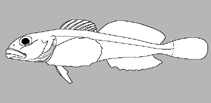 No image available for this species;
drawing shows typical species in Cottidae.
Google afbeelding
drawing shows typical species in Cottidae.
Classificatie / Namen Lokale namen | Synoniemen | Catalog of Fishes(Genus, Soort(en)) | ITIS | CoL | WoRMS | Cloffa
> Perciformes/Cottoidei (Sculpins) > Cottidae (Sculpins)
Etymology: Cottus: Greek, kottos = a fish (Ref. 45335); dorofeevi: Name 'dorofeevi' in honor of zoologist Sergei A. Dorofeev, who organized and took part in the collection of type specimens in tributaries of the Western Dvina River.
Etymology: Cottus: Greek, kottos = a fish (Ref. 45335); dorofeevi: Name 'dorofeevi' in honor of zoologist Sergei A. Dorofeev, who organized and took part in the collection of type specimens in tributaries of the Western Dvina River.
Milieu: milieu / Klimaatzone / Diepte / verspreidingsgebied Ecologie
; zoet water demersaal. Temperate
Verspreiding Gebieden | FAO regio's | Ecosystemen | Voorkomen | Verspreidingskaart | Introducties | Faunafri
Europe: Belarus.
Grootte / Gewicht / Leeftijd
Korte beschrijving Determinatiesleutels | Morfologie | Morfometrie
Wervels: 31 - 34. This species is distinguished from its congeners by the following set of characters: head pointed anteriorly and considerably flattened in dorso-ventral direction; dermal papillae on top and sides of head; large bony prickles under pectoral fins; long second dorsal fin (length of its base 40% SL); long pelvic fins reaching anus; incomplete trunk canal of seismosensory system with 25-27 pores, its end on vertical of last rays of anal fin; semicircular shape of genital papilla in males; all fins (including pelvic and anal) with dark spots. The new species differs from the closely related C. koshewnikowi in following features: abundance of melanophores on ventral side of body (vs. absence of melanophores); dermal papillae on upper and lateral parts of head (vs. absence of papillae and presence of dermal wrinkles); longer caudal peduncle (14.6±2.1 vs. 8.3±0.5% SL); large eye diameter (23.1±1.1 vs. 19.1±0.6% of head length); wider interorbital space (16.3±3.4 vs. 9.8±0.5% of head length). Cottus dorofeevi differs from another Eastern European species C. gratzianowi in following characters: branched rays in pectoral fin absent (vs. frequent presence in C. gratzianowi); gap absent and three pores in occipital commissure of lateral line system present (vs. presence of gap and four pores in C. gratzianowi); poorly developed lower lobes of mouth (vs. massive lobes in C. gratzianowi) (Ref. 132919).
Body shape (shape guide): elongated; Cross section: flattened.
Body shape (shape guide): elongated; Cross section: flattened.
Levenscyclus en paargedrag Maturiteit | Voortplanting | Paaien | Eieren | Fecunditeit | Larven
Hoofdreferentie
Upload uw referenties | Referenties | Coördinator | Medewerkers
Sideleva, V.G. and Z.V. Zhidkov, 2024. Description of a new species of Cottus Linnaeus (Cottidae) from the Western Dvina / Daugava River system, Baltic Sea basin, based on integrative taxonomy. Zootaxa 5447(4):473-495. (Ref. 132919)
CITES
Not Evaluated
Gevaar voor de mens
Harmless
Gebruik door de mens
Visserij: van geen belang
FAO - Publication: search | FishSource |
Meer informatie
Trofische ecologie
Voedsel (prooien)
Dieetsamenstelling
Voedselconsumptie
Voedselrantsoenen
Predatoren
Voedsel (prooien)
Dieetsamenstelling
Voedselconsumptie
Voedselrantsoenen
Predatoren
Ecologie
Ecologie
Ecologie
Populatiedynamica
Groeiparameters
Max. leeftijden / maten
Lengte-gewicht rel.
Lengte-lengte rel.
Lengtefrequenties
Massaconversie
Rekrutering
Abundantie
Groeiparameters
Max. leeftijden / maten
Lengte-gewicht rel.
Lengte-lengte rel.
Lengtefrequenties
Massaconversie
Rekrutering
Abundantie
Levenscyclus
Voortplanting
Maturiteit
Rijpheid/kieuwen rel.
Fecunditeit
Paaien
Paaibestanden
Eieren
Ontwikkeling van de eieren
Larven
Larvale populatiedynamiek
Voortplanting
Maturiteit
Rijpheid/kieuwen rel.
Fecunditeit
Paaien
Paaibestanden
Eieren
Ontwikkeling van de eieren
Larven
Larvale populatiedynamiek
Anatomie
Kieuwoppervlak
Hersenen
Otoliet
Kieuwoppervlak
Hersenen
Otoliet
Fysiologie
Lichaamssamenstelling
Voedingsstoffen
Zuurstofverbruik
Type zwemmen
Zwemsnelheid
Visuele pigmenten
Vis geluid
Ziekten en parasieten
Toxiciteit (LC50)
Lichaamssamenstelling
Voedingsstoffen
Zuurstofverbruik
Type zwemmen
Zwemsnelheid
Visuele pigmenten
Vis geluid
Ziekten en parasieten
Toxiciteit (LC50)
Genetica
genoom
Genetica
Heterozygositeit
Erfelijkheid
Genetische diversiteit
genoom
Genetica
Heterozygositeit
Erfelijkheid
Genetische diversiteit
Menselijk gerelateerd
Aquacultuursystemen
Aquacultuurprofielen
Kweeklijnen
Ciguatera gevallen
Postzegels, munten, diversen.
Aquacultuursystemen
Aquacultuurprofielen
Kweeklijnen
Ciguatera gevallen
Postzegels, munten, diversen.
Tools
Speciale rapporten
Bekijk gegevens voor het houden in een aquarium | Bekijk Fact Sheets voor de soort | Bekijk Aquacultuur Fact Sheets
Download XML
Internetbronnen
AFORO (otoliths) | Aquatic Commons | BHL | Cloffa | Websites from users | Bekijk FishWatcher | CISTI | Catalog of Fishes: Genus, Soort(en) | DiscoverLife | ECOTOX | FAO - Publication: search | Faunafri | Fishipedia | Fishtrace | GloBI | Google Books | Google Scholar | Google | IGFA World Record | OneZoom | Open Tree of Life | Otolith Atlas of Taiwan Fishes | PubMed | Reef Life Survey | Socotra Atlas | TreeBase | Tree of Life | Wikipedia: ga naar, zoek | World Records Freshwater Fishing | Zoobank | Zoological Record
Schattingen op basis van modellen
Fylogenetische diversiteitsindex (Ref. 82804): PD50 = 0.5000 [Uniqueness, from 0.5 = low to 2.0 = high].
Bayesian length-weight: a=0.00832 (0.00345 - 0.02005), b=3.16 (2.98 - 3.34), in cm total length, based on LWR estimates for this Genus-body shape (Ref. 93245).
Trofisch niveau (Ref. 69278): 3.2 ±0.4 se; based on size and trophs of closest relatives
Weerstandsvermogen (Ref. 120179): Gemiddeld, minimale populatieverdubbelingstijd 1,4-4,4 jaar (Preliminary K or Fecundity.).