



Ostichthys alamai Matsunuma, Fukui & Motomura, 2018
Alama’s soldierfish
Uploaden van uw Foto's en video's
Google afbeelding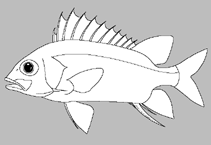 No image available for this species;
drawing shows typical species in Holocentridae.
Google afbeelding
drawing shows typical species in Holocentridae.
Classificatie / Namen Lokale namen | Synoniemen | Catalog of Fishes(Genus, Soort(en)) | ITIS | CoL | WoRMS | Cloffa
> Holocentriformes (Squirrelfishes, soldierfishes) > Holocentridae (Squirrelfishes, soldierfishes) > Myripristinae
Etymology: Ostichthys: Greek,osteon = bone + Greek, ichthys = fish (Ref. 45335); alamai: Named after Mr. Ulysses Alama, Museum of Natural Sciences, College of Fisheries and Ocean Sciences, University of the Philippines Visayas, for his great contributions to the authors’ and other collaborators’ surveys at Iloilo during 2013-2017, when the new species was collected.
Eponymy: Ulysses B Alama is on the staff of the Museum of Natural Sciences, College of Fisheries and Ocean Sciences, University of the Philippines, Visayas. [...] (Ref. 128868), visit book page.
Etymology: Ostichthys: Greek,osteon = bone + Greek, ichthys = fish (Ref. 45335); alamai: Named after Mr. Ulysses Alama, Museum of Natural Sciences, College of Fisheries and Ocean Sciences, University of the Philippines Visayas, for his great contributions to the authors’ and other collaborators’ surveys at Iloilo during 2013-2017, when the new species was collected.
Eponymy: Ulysses B Alama is on the staff of the Museum of Natural Sciences, College of Fisheries and Ocean Sciences, University of the Philippines, Visayas. [...] (Ref. 128868), visit book page.
Milieu: milieu / Klimaatzone / Diepte / verspreidingsgebied Ecologie
marien rifbewoner. Tropical
Verspreiding Gebieden | FAO regio's | Ecosystemen | Voorkomen | Verspreidingskaart | Introducties | Faunafri
West Pacific: Indonesia and the Philippines.
Grootte / Gewicht / Leeftijd
Korte beschrijving Determinatiesleutels | Morfologie | Morfometrie
Dorsale stekels (totaal) : 12; Dorsale zachte stralen (totaal) : 13. This species is distinguished by the following characters: D XII,13; pectoral-fin rays 17-18 (modally 17); pored lateral-line scales 28-29 (28); scale rows between lateral line and middle of
spinous dorsal-fin base 3.5; lower gill rakers, with all rudiments 13 or 14 (13); middle dorsal-fin spines are relatively long, 7th dorsal-fin spine 14.5-18.3 (mean 16.3) % of SL; last 3 dorsal-fin spines are relatively long [10th dorsal-fin spine 7.7-9.8 (8.8) % of SL, 11th (penultimate) dorsal-fin spine 5.8-8.3 (6.8), 12th (posteriormost) dorsal-fin spine 7.0-9.8 (8.3) % of SL]; second to fourth anal-fin spines relatively long [second anal-fin spine 5.5-8.6 (7.1) % of SL, third anal-fin spine 15.2-18.3 (16.8) % of SL, fourth anal-fin spine 12.6-14.6 (13.5) % of SL]; caudal peduncle relatively long, its length 10.3-12.2 (11.2) % of SL; posteriormost dorsal-fin spine fused to the first dorsal-fin soft ray, the space between spine and ray about half that between bases of former and penultimate dorsal-fin spines; first body scale row usually below first dorsal-fin spine base (60 %) or between bases of first and second dorsal-fin spines (40 %); ventral part of maxilla not expanded ventrally even in large specimens; body scales with closely set, many developed spinules, fewer young spinules; narrow longitudinal white bands or rows of spots laterally on body when fresh (including large specimens), (usually lost after being preserved); dark red blotch on upper origin of pectoral-fin base (Ref. 119380).
Cross section: compressed.
Cross section: compressed.
Levenscyclus en paargedrag Maturiteit | Voortplanting | Paaien | Eieren | Fecunditeit | Larven
Hoofdreferentie
Upload uw referenties | Referenties | Coördinator : Randall, John E. | Medewerkers
Matsunuma, M., Y. Fukui and H. Motomura, 2018. Review of the Ostichthys japonicus complex (Beryciformes: Holocentridae: Myripristinae) in the northwestern Pacific Ocean, with description of a new species. Ichthyol. Res. 65:285-314. (Ref. 119380)
CITES
Not Evaluated
Gevaar voor de mens
Harmless
Gebruik door de mens
Visserij: van potentieel belang
FAO - Publication: search | FishSource |
Meer informatie
Trofische ecologie
Voedsel (prooien)
Dieetsamenstelling
Voedselconsumptie
Voedselrantsoenen
Predatoren
Voedsel (prooien)
Dieetsamenstelling
Voedselconsumptie
Voedselrantsoenen
Predatoren
Ecologie
Ecologie
Ecologie
Populatiedynamica
Groeiparameters
Max. leeftijden / maten
Lengte-gewicht rel.
Lengte-lengte rel.
Lengtefrequenties
Massaconversie
Rekrutering
Abundantie
Groeiparameters
Max. leeftijden / maten
Lengte-gewicht rel.
Lengte-lengte rel.
Lengtefrequenties
Massaconversie
Rekrutering
Abundantie
Levenscyclus
Voortplanting
Maturiteit
Rijpheid/kieuwen rel.
Fecunditeit
Paaien
Paaibestanden
Eieren
Ontwikkeling van de eieren
Larven
Larvale populatiedynamiek
Voortplanting
Maturiteit
Rijpheid/kieuwen rel.
Fecunditeit
Paaien
Paaibestanden
Eieren
Ontwikkeling van de eieren
Larven
Larvale populatiedynamiek
Anatomie
Kieuwoppervlak
Hersenen
Otoliet
Kieuwoppervlak
Hersenen
Otoliet
Fysiologie
Lichaamssamenstelling
Voedingsstoffen
Zuurstofverbruik
Type zwemmen
Zwemsnelheid
Visuele pigmenten
Vis geluid
Ziekten en parasieten
Toxiciteit (LC50)
Lichaamssamenstelling
Voedingsstoffen
Zuurstofverbruik
Type zwemmen
Zwemsnelheid
Visuele pigmenten
Vis geluid
Ziekten en parasieten
Toxiciteit (LC50)
Genetica
genoom
Genetica
Heterozygositeit
Erfelijkheid
Genetische diversiteit
genoom
Genetica
Heterozygositeit
Erfelijkheid
Genetische diversiteit
Menselijk gerelateerd
Aquacultuursystemen
Aquacultuurprofielen
Kweeklijnen
Ciguatera gevallen
Postzegels, munten, diversen.
Aquacultuursystemen
Aquacultuurprofielen
Kweeklijnen
Ciguatera gevallen
Postzegels, munten, diversen.
Tools
Speciale rapporten
Bekijk gegevens voor het houden in een aquarium | Bekijk Fact Sheets voor de soort | Bekijk Aquacultuur Fact Sheets
Download XML
Internetbronnen
AFORO (otoliths) | Aquatic Commons | BHL | Cloffa | Websites from users | Bekijk FishWatcher | CISTI | Catalog of Fishes: Genus, Soort(en) | DiscoverLife | ECOTOX | FAO - Publication: search | Faunafri | Fishipedia | Fishtrace | GloBI | Google Books | Google Scholar | Google | IGFA World Record | OneZoom | Open Tree of Life | Otolith Atlas of Taiwan Fishes | PubMed | Reef Life Survey | Socotra Atlas | TreeBase | Tree of Life | Wikipedia: ga naar, zoek | World Records Freshwater Fishing | Zoobank | Zoological Record
Schattingen op basis van modellen
Fylogenetische diversiteitsindex (Ref. 82804): PD50 = 0.5000 [Uniqueness, from 0.5 = low to 2.0 = high].
Bayesian length-weight: a=0.01778 (0.00692 - 0.04567), b=3.02 (2.79 - 3.25), in cm total length, based on LWR estimates for this (Sub)family-body shape (Ref. 93245).
Trofisch niveau (Ref. 69278): 3.8 ±0.6 se; based on size and trophs of closest relatives
Weerstandsvermogen (Ref. 120179): Hoog, minimale populatieverdubbelingstijd minder dan 15 maanden (Preliminary K or Fecundity.).