



Myroconger pietschi Espíndola, Caires, Tighe, de Pinna & Melo, 2021
Ladda upp din foton och Videor
Google image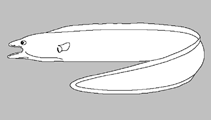 No image available for this species;
drawing shows typical species in Myrocongridae.
Google image
drawing shows typical species in Myrocongridae.
Klassificering / Namn Populärnamn | synonymer | Catalog of Fishes(Släkte, Arter) | ITIS | CoL | WoRMS | Cloffa
> Anguilliformes (Eels and morays) > Myrocongridae (Atlantic red eels)
Etymology: Myroconger: Greek, myros, -ou = male of morey eel + Latin, conger = conger (Ref. 45335); pietschi: Named for Theodore Wells Pietsch III for his contributions to the knowledge of deep-sea fishes (Ref. 124570).
Eponymy: Dr Theodore ‘Ted’ Wells Pietsch III (d: 1945) was a professor of ichthyology at the University of Washington, Seattle (1978 onwards) and is an American systematist and evolutionary biologist especially known for his studies of anglerfishes. [...] (Ref. 128868), visit book page.
Etymology: Myroconger: Greek, myros, -ou = male of morey eel + Latin, conger = conger (Ref. 45335); pietschi: Named for Theodore Wells Pietsch III for his contributions to the knowledge of deep-sea fishes (Ref. 124570).
Eponymy: Dr Theodore ‘Ted’ Wells Pietsch III (d: 1945) was a professor of ichthyology at the University of Washington, Seattle (1978 onwards) and is an American systematist and evolutionary biologist especially known for his studies of anglerfishes. [...] (Ref. 128868), visit book page.
Miljö: miljö / Klimatzon / djupintervall / distributionsområde Ekologi
marina djupbottenlevande; djupintervall 253 - ? m (Ref. 124570). Tropical
Utbredning Territorier | FAO områden | Ekosystem | Förekomster | Prickkarta | Utplanteringar | Faunafri
Southwest Atlantic: Brazil.
Storlek / Vikt / Ålder
Kort beskrivning Bestämningsnycklar | Morfologi | Morfometri
Mjukstrålar i ryggfenan (totalt) : 291; Mjukstrålar i analfenan: 190; Ryggkotor: 125. This species can be distinguished from its congeners by the following characters: A 190; D 291; V 125; a short pectoral fin (16.6 % HL); the posterior portion of the ethmovomerine teeth arranged in a single row, teeth on lower and upper pharyngeal tooth plate 24 and 27, and 10 branchiostegal rays; having five lateral-line pores; ethmovomerine tooth patch extending to nearly half-length of upper jaw; preanal vertebrae 48; preoperculomandibular pores six. Colouration of preserved specimen: head and body generally orange; body whitish on belly and ventral third of caudal portion; ventral surface of the head is light yellow, covering the lower jaw and the ventral portion of the cheek; a single, broad, dichromatic stripe runs along the flank, pale yellow on the dorsal and ventral margins with a brown center, extending medially from the last lateral-line pore to the posterior third of the body; pectoral fin is predominantly orange, becoming lighter towards its distal third; anterior half of the dorsal fin is orange, transitioning to yellowish in the posterior half; anal fin whitish on its anterior third, while the posterior two-thirds are yellow (Ref. 124570).
Livscykel och parningsbeteende Könsmognad | Reproduktion | Lek | Ägg | Fekunditet | Larver
Huvudreferens
Ladda upp dina referenser | referenser | Koordinator | Medarbetare
Espíndola, V.C., R.A. Caires, K.A. Tighe, M.C.C. De Pinna and M.R.S. De Melo, 2021. A new species of the rare genus Myroconger Günther, 1870 (Anguilliformes: Myrocongridae) from Brazilian waters, tropical western Atlantic. Zootaxa 4965(3):529-540. (Ref. 124570)
Status på IUCN:s rödlista (Ref. 130435: Version 2025-2 (Global))
Data deficient (DD) ; Date assessed: 02 July 2024
CITES
Not Evaluated
Hot mot människor
Harmless
Mänskliga användningsområden
Fiskeri: saknar intresse
FAO - Publication: search | FishSource |
Ytterligare information
Trofisk ekologi
Livsmedelsartiklar (preys)
Födosammansättning
Födointag
Matransoner
Predatorer
Livsmedelsartiklar (preys)
Födosammansättning
Födointag
Matransoner
Predatorer
Ekologi
Ekologi
Ekologi
Populationsdynamik
Tillväxtparametrar
Max. åldrar / storlekar
Längd-vikt rel.
Längd-längd rel.
Längd-frekvenser
Massakonvertering
Rekrytering
Abundans
Tillväxtparametrar
Max. åldrar / storlekar
Längd-vikt rel.
Längd-längd rel.
Längd-frekvenser
Massakonvertering
Rekrytering
Abundans
Livscykel
Reproduktion
Könsmognad
Mognad/Gills rel.
Fekunditet
Lek
Lekande aggregat
Ägg
Utveckling av ägg
Larver
Larvdynamik
Reproduktion
Könsmognad
Mognad/Gills rel.
Fekunditet
Lek
Lekande aggregat
Ägg
Utveckling av ägg
Larver
Larvdynamik
Anatomi
Gälyta
Hjärna
Otolit
Gälyta
Hjärna
Otolit
Fysiologi
Kroppssammansättning
Näringsämnen
Syreförbrukning
Typ av simning
Simhastighet
Visuella pigment
Ljud från fisk
Sjukdomar & Parasiter
Toxicitet (LC50)
Kroppssammansättning
Näringsämnen
Syreförbrukning
Typ av simning
Simhastighet
Visuella pigment
Ljud från fisk
Sjukdomar & Parasiter
Toxicitet (LC50)
Genetik
Genom
Genetik
Heterozygositet
Ärftlighet
Genetisk mångfald
Genom
Genetik
Heterozygositet
Ärftlighet
Genetisk mångfald
Människorelaterad
Vattenbrukssystem
Vattenbruksprofiler
Avelslinjer
Ciguatera-fall
Frimärken, mynt, diverse.
Vattenbrukssystem
Vattenbruksprofiler
Avelslinjer
Ciguatera-fall
Frimärken, mynt, diverse.
Verktyg
Särskilda rapporter
Kontrollera för underhåll av akvarium | Kontrollera om det finns faktablad om arter | Kontrollera om det finns faktablad om vattenbruk
Ladda ner XML
Internet-källor
AFORO (otoliths) | Aquatic Commons | BHL | Cloffa | Websites from users | Check FishWatcher | CISTI | Catalog of Fishes: Släkte, Arter | DiscoverLife | ECOTOX | FAO - Publication: search | Faunafri | Fishipedia | Fishtrace | GloBI | Google Books | Google Scholar | Google | IGFA World Record | OneZoom | Open Tree of Life | Otolith Atlas of Taiwan Fishes | PubMed | Reef Life Survey | Socotra Atlas | TreeBase | Tree of Life | Wikipedia: Go, sök | World Records Freshwater Fishing | Zoobank | Zoologiskt register
Uppskattningar baserade på modeller
Index för fylogenetisk mångfald (Ref. 82804): PD50 = 0.5312 [Uniqueness, from 0.5 = low to 2.0 = high].
Bayesian length-weight: a=0.00102 (0.00046 - 0.00225), b=3.06 (2.88 - 3.24), in cm total length, based on all LWR estimates for this body shape (Ref. 93245).
Trofisk nivå (Ref. 69278): 3.7 ±0.6 se; based on size and trophs of closest relatives