



Stolephorus astrum Hata & Motomura, 2024
Astral anchovy
Ladda upp din foton och Videor
Google image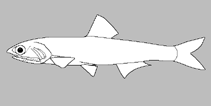 No image available for this species;
drawing shows typical species in Engraulidae.
Google image
drawing shows typical species in Engraulidae.
Klassificering / Namn Populärnamn | synonymer | Catalog of Fishes(Släkte, Arter) | ITIS | CoL | WoRMS | Cloffa
> Clupeiformes (Herrings) > Engraulidae (Anchovies) > Engraulinae
Etymology: Stolephorus: Greek, stole, -es = garment + Greek, pherein = to carry (Ref. 45335); astrum: Named for its starry black spots on the pectoral fins of this new species.
Etymology: Stolephorus: Greek, stole, -es = garment + Greek, pherein = to carry (Ref. 45335); astrum: Named for its starry black spots on the pectoral fins of this new species.
Miljö: miljö / Klimatzon / djupintervall / distributionsområde Ekologi
marina; brackvatten pelagic-neritic; djupintervall 0 - 15 m (Ref. 131038). Tropical
Utbredning Territorier | FAO områden | Ekosystem | Förekomster | Prickkarta | Utplanteringar | Faunafri
Western Pacific: Palau,
Storlek / Vikt / Ålder
Kort beskrivning Bestämningsnycklar | Morfologi | Morfometri
Ryggkotor: 38 - 39. This species is distinguished by the following set of characters: maxilla short, 15.9-17.8% of
SL, posterior tip just reaching to or slightly beyond anterior margin of preopercle (just short of anterior margin in individuals < 3.6 cm SL); posterior margin of preopercle convex, rounded; predorsal scutes absent; prepelvic scutes 1-4 (modally 4); pelvic scute no spine; dorsal fin with three unbranched and 12-14 (13) branched rays; anal fin with three unbranched and 18-19 (18) branched rays, the origin located just below base of ninth to eleventh dorsal-fin ray; gill rakers at first (1) gill arch, upper (1UGR) 20-24 + lower (1LGR) 30-34 = 50-56 (1TGR); 2UGR 15-18 + 2LGR 26-30 = 2TGR 42-48; 3UGR 12-13 + 3LGR 15-17 = 3TGR 27-30; 4UGR 9-10 + 4LGR 12-14 = 4TGR 21-24; gill rakers 5-7 on the posterior face of third gill arch; transverse scales 8; pseudobranchial filaments 16-21; total vertebrae 38 or 39; pelvic fin short, 10.2-11.3% of SL, depressed tip reaching posteriorly to vertical through 3rd to 6th dorsal-fin ray origin; pectoral fin short, 15.9-16.3% of SL; predorsal fin length short, 50.1-53.6% of SL; caudal peduncle rather long, 16.8-18.6% of SL; body slender, 16.8-19.0% of SL, distance between dorsal-fin origin and pelvic-fin insertion 20.1-23.4% of SL, between origins of dorsal and anal fins 19.1-20.3%. Colouration: pairs of dark patches on parietal and occipital areas; no dark lines on dorsum; black spots on the tips of snout and lower jaw, but not on suborbital area; melanophores scattered on second to eigth uppermost pectoral-fin rays (Ref. 131038).
Cross section: compressed.
Cross section: compressed.
Livscykel och parningsbeteende Könsmognad | Reproduktion | Lek | Ägg | Fekunditet | Larver
Huvudreferens
Ladda upp dina referenser | referenser | Koordinator | Medarbetare
Hata, H. and H. Motomura, 2024. A new species of the anchovy genus Stolephorus Lacepède 1803, and redescriptions of Stolephorus carpentariae (De Vis 1882) and Stolephorus holodon (Boulenger 1900) (Clupeiformes: Engraulidae). Ichthyol. Res. 72(1):98-116 (Ref. 131038)
CITES
Not Evaluated
Hot mot människor
Harmless
Mänskliga användningsområden
Fiskeri: kommersiell
FAO - Publication: search | FishSource |
Ytterligare information
Trofisk ekologi
Livsmedelsartiklar (preys)
Födosammansättning
Födointag
Matransoner
Predatorer
Livsmedelsartiklar (preys)
Födosammansättning
Födointag
Matransoner
Predatorer
Ekologi
Ekologi
Ekologi
Populationsdynamik
Tillväxtparametrar
Max. åldrar / storlekar
Längd-vikt rel.
Längd-längd rel.
Längd-frekvenser
Massakonvertering
Rekrytering
Abundans
Tillväxtparametrar
Max. åldrar / storlekar
Längd-vikt rel.
Längd-längd rel.
Längd-frekvenser
Massakonvertering
Rekrytering
Abundans
Livscykel
Reproduktion
Könsmognad
Mognad/Gills rel.
Fekunditet
Lek
Lekande aggregat
Ägg
Utveckling av ägg
Larver
Larvdynamik
Reproduktion
Könsmognad
Mognad/Gills rel.
Fekunditet
Lek
Lekande aggregat
Ägg
Utveckling av ägg
Larver
Larvdynamik
Anatomi
Gälyta
Hjärna
Otolit
Gälyta
Hjärna
Otolit
Fysiologi
Kroppssammansättning
Näringsämnen
Syreförbrukning
Typ av simning
Simhastighet
Visuella pigment
Ljud från fisk
Sjukdomar & Parasiter
Toxicitet (LC50)
Kroppssammansättning
Näringsämnen
Syreförbrukning
Typ av simning
Simhastighet
Visuella pigment
Ljud från fisk
Sjukdomar & Parasiter
Toxicitet (LC50)
Genetik
Genom
Genetik
Heterozygositet
Ärftlighet
Genetisk mångfald
Genom
Genetik
Heterozygositet
Ärftlighet
Genetisk mångfald
Människorelaterad
Vattenbrukssystem
Vattenbruksprofiler
Avelslinjer
Ciguatera-fall
Frimärken, mynt, diverse.
Vattenbrukssystem
Vattenbruksprofiler
Avelslinjer
Ciguatera-fall
Frimärken, mynt, diverse.
Verktyg
Särskilda rapporter
Kontrollera för underhåll av akvarium | Kontrollera om det finns faktablad om arter | Kontrollera om det finns faktablad om vattenbruk
Ladda ner XML
Internet-källor
AFORO (otoliths) | Aquatic Commons | BHL | Cloffa | Websites from users | Check FishWatcher | CISTI | Catalog of Fishes: Släkte, Arter | DiscoverLife | ECOTOX | FAO - Publication: search | Faunafri | Fishipedia | Fishtrace | GloBI | Google Books | Google Scholar | Google | IGFA World Record | OneZoom | Open Tree of Life | Otolith Atlas of Taiwan Fishes | PubMed | Reef Life Survey | Socotra Atlas | TreeBase | Tree of Life | Wikipedia: Go, sök | World Records Freshwater Fishing | Zoobank | Zoologiskt register
Uppskattningar baserade på modeller
Index för fylogenetisk mångfald (Ref. 82804): PD50 = 0.5000 [Uniqueness, from 0.5 = low to 2.0 = high].
Bayesian length-weight: a=0.00501 (0.00217 - 0.01155), b=3.14 (2.97 - 3.31), in cm total length, based on LWR estimates for this Genus-body shape (Ref. 93245).
Trofisk nivå (Ref. 69278): 3.2 ±0.4 se; based on size and trophs of closest relatives
Resiliens (Ref. 120179): Hög, lägsta populationsfördubblingstid mindre än 15 månader (Preliminary K or Fecundity.).