



Cyprinella leptocheilus Tracy, Rohde & Jenkins, 2024
Siouan thinlip chub
Hochladen Photos und videos
Google Bild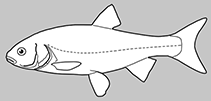 No image available for this species;
drawing shows typical species in Leuciscidae.
Google Bild
drawing shows typical species in Leuciscidae.
Klassifizierung / Names Namen | Synonyme | Catalog of Fishes(Gattung, Arten) | ITIS | CoL | WoRMS | Cloffa
> Cypriniformes (Carps) > Leuciscidae (Minnows) > Pogonichthyinae
Etymology: Cyprinella: Latin, cyprinus = carp (Ref. 45335); leptocheilus: Name from Greek 'leptocheilus', combination of 'leptós' (Greek λεπτός), meaning fine or thin and 'cheilus' from cheíl̄os (Greek χεῖλος), for thin lip; this was proposed by Drs. Robert E. Jenkins and Ernest A. Lachner in the early 1970s.
Etymology: Cyprinella: Latin, cyprinus = carp (Ref. 45335); leptocheilus: Name from Greek 'leptocheilus', combination of 'leptós' (Greek λεπτός), meaning fine or thin and 'cheilus' from cheíl̄os (Greek χεῖλος), for thin lip; this was proposed by Drs. Robert E. Jenkins and Ernest A. Lachner in the early 1970s.
Umwelt: Milieu / Klimazone / Tiefenbereich / Verbreitungsgebiet Ökologie
; süßwasser benthopelagisch; tiefenbereich 1 - 3 m (Ref. 132547). Subtropical
Verbreitung Territorien | FAO Gebiete | Ökosysteme | Vorkommen | Punkt Karte | Einführungen | Faunafri
North America: USA.
Größe / Gewicht / Alter
Geschlechtsreife: Lm ? range ? - ? cm
Max length : 7.1 cm TL Männchen/unbestimmt; (Ref. 132547); max. veröff. Alter: 4 Jahre
Max length : 7.1 cm TL Männchen/unbestimmt; (Ref. 132547); max. veröff. Alter: 4 Jahre
Kurzbeschreibung Bestimmungsschlüssel | Morphologie | Morphometrie
Rückenflossenweichstrahlen (insgesamt) : 8; Afterflossenweichstrahlen: 8. This species is distinguished from its congeners except C. labrosa and C. zanema by the following characters: with maxillary barbels; differs from labrosa the number of modally 40 lateral-line scales (vs. 37), no dark blotches or cross hatching on back and side (vs. small, dark blotches and cross hatching on back and side), no white spot at anterior base of dorsal fin (vs. white spot present), side of body well pigmented below lateral line (vs. minimal pigmentation), with a line drawn from the posterior corner of the upper lip, immediately anterior to the barbel, extending vertically posterior to the anterior edge of the bony orbit (line drawn from the posterior corner of the upper lip, immediately anterior to the barbel, extending vertically anterior to the anterior edge of the bony orbit: differs from zanema by having the dorsal-fin origin positioned modally 1.5 scales posterior to the pelvic-fin origin (vs. positioned modally 2.5 scales posterior to the pelvic-fin origin0 with mean upper lip width at midpoint 2.1% of head length (vs. 3.5% of HL), mean upper lip width at midline 2.9% of HL (vs. 4.1% ofHL), mean maxillary barbel length 3.5% of HL (vs. 8.0% of HL) (Ref. 132547).
Cross section: oval.
Cross section: oval.
This species prefers shallow pool areas of medium-sized, from clear to turbid to tannin-stained to dark blackwater, warm water creeks and rivers with moderate velocity, over clean, sandy and gravelly substrates. Usually form schools near stumps or other cover but can also be found mid-channel. In the Lynches River, this fish was reported to have been taken over gravel-bottom riffles and more commonly, in sand-bottom runs. In the Lumber and Black rivers, schools were observed moving along the edges of sandbars, also in sand-bottomed runs. In the Lower Little River (Cape Fear River basin) in late July to mid-August 2021, it was found in low specific conductance waters, 25–50 μS/cm . It has also been observed in the Lynches River in moderately swift current, mid-stream, over a sandy substrate at a depth of 1-3 ft; and associated with C. nivea, C. pyrrhomelas, and Notropis scepticus. In other collections over the years from the Lynches River, it has been collected alongside Alburnops petersoni, C. analostana, Hybognathus regius, Miniellus procne, N. leptocephalus, Notemigonus crysoleucas, Notropis amoenus, Pteronotropis cummingsae and in the Black River with A. petersoni, C. nivea, H. regius, and N. amoenus. Stomach contents of this fish from the Lynches River in May 1996 contained primarily dipteran larvae; mayfly and stonefly nymphs and caddisfly larvae were of minor importance. Reported maximum longevity is estimated to be four years (Ref. 132547).
Lebenszyklus und Paarungsverhalten Geschlechtsreife | Fortpflanzung | Ablaichen | Eier | Fruchtbarkeit | Larven
Hauptreferenz
Laden Sie Ihre Referenzen hoch | Referenzen | Koordinator | Partner
Tracy, B. H., F.C. Rohde, M.A. Perkins, L.M. Lee, K.B. Carlson, M. McCutcheon, Jones. B.K. and H.K. Evans, 2024. A long-recognized but undescribed new species of Cyprinella (Cypriniformes: Leuciscidae) from North Carolina and South Carolina, United States. Southeastern Fisheries Council Proceedings 1(64):35-76. (Ref. 132547)
CITES
Not Evaluated
Bedrohung für Menschen
Harmless
Nutzung durch Menschen
FAO - Publication: search | FishSource |
Mehr Information
Trophische Ökologie
Lebensmittel (Beutetiere)
Nahrungszusammensetzung
Nahrungsaufnahme
Lebensmittelrationen
Räuber
Lebensmittel (Beutetiere)
Nahrungszusammensetzung
Nahrungsaufnahme
Lebensmittelrationen
Räuber
Ökologie
Ökologie
Ökologie
Populationsdynamik
Wachstumsparameter
Max. Alter/Größen
Länge-Gewicht-Rel.
Länge-Länge-Verhältnis.
Längenhäufigkeiten
Massenkonvertierung
Rekrutierung
Dichte
Wachstumsparameter
Max. Alter/Größen
Länge-Gewicht-Rel.
Länge-Länge-Verhältnis.
Längenhäufigkeiten
Massenkonvertierung
Rekrutierung
Dichte
Lebenszyklus
Fortpflanzung
Geschlechtsreife
Reifung/Kiemen rel.
Fruchtbarkeit
Ablaichen
Laichaggregationen
Eier
Eientwicklung
Larven
Larven Pop.Dyn.
Fortpflanzung
Geschlechtsreife
Reifung/Kiemen rel.
Fruchtbarkeit
Ablaichen
Laichaggregationen
Eier
Eientwicklung
Larven
Larven Pop.Dyn.
Anatomie
Kiemenoberfläche
Gehirn
Otolith
Kiemenoberfläche
Gehirn
Otolith
Physiologie
Körperliche Zusammensetzung
Nährstoffe
Sauerstoffverbrauch
Schwimmart
Schwimmgeschwindigkeit
Visuelle Pigmente
Fischgeräusche
Krankheiten und Parasiten
Toxizität (LC50s)
Körperliche Zusammensetzung
Nährstoffe
Sauerstoffverbrauch
Schwimmart
Schwimmgeschwindigkeit
Visuelle Pigmente
Fischgeräusche
Krankheiten und Parasiten
Toxizität (LC50s)
Genetik
Genom
Genetik
Heterozygotie
Vererbbarkeit
Genetische Vielfalt
Genom
Genetik
Heterozygotie
Vererbbarkeit
Genetische Vielfalt
Menschenbezogen
Aquakultur-Systeme
Aquakultur Profile
Zuchtlinien
Ciguatera-Fälle
Briefmarken, Münzen, Verschiedenes.
Aquakultur-Systeme
Aquakultur Profile
Zuchtlinien
Ciguatera-Fälle
Briefmarken, Münzen, Verschiedenes.
Tools
Zusatzinformationen
Download XML
Zusammenfassung | Punktdaten | Namen | Photos
Internet Quellen
AFORO (otoliths) | Aquatic Commons | BHL | Cloffa | Websites from users | FishWatcher Einträge suchen | CISTI | Catalog of Fishes: Gattung, Arten | DiscoverLife | ECOTOX | FAO - Publication: search | Faunafri | Fishipedia | Fishtrace | GloBI | Google Books | Google Scholar | Google | IGFA World Record | OneZoom | Open Tree of Life | Otolith Atlas of Taiwan Fishes | PubMed | Reef Life Survey | Socotra Atlas | TreeBase | Tree of Life | Wikipedia: Gehe zu, Suchen | World Records Freshwater Fishing | Zoobank | Zoologischer Rekord
Schätzungen auf der Grundlage von Modellen
Phylogenetischer Diversitätsindex (Ref. 82804): PD50 = 0.5000 [Uniqueness, from 0.5 = low to 2.0 = high].
Bayesian length-weight: a=0.00537 (0.00266 - 0.01086), b=3.10 (2.92 - 3.28), in cm total length, based on LWR estimates for this (Sub)family-body shape (Ref. 93245).
Trophische Ebene (Ref. 69278): 3.1 ±0.4 se; based on size and trophs of closest relatives
Widerstandsfähigkeit (Ref. 120179): hoch, Verdopplung der Population dauert weniger als 15 Monate. (Preliminary K or Fecundity.).