



Adicionar o seu Fotografias e vídeos
Imagem do Google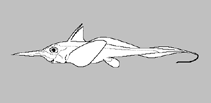 No image available for this species;
drawing shows typical species in Rhinochimaeridae.
Imagem do Google
drawing shows typical species in Rhinochimaeridae.
Classificação / Nomes Nomes comuns | Sinónimos | Catalog of Fishes(Género, Espécies) | ITIS | CoL | WoRMS | Cloffa
Holocephali (quimeras) (chimaeras) > Chimaeriformes (Chimaeras) > Rhinochimaeridae (Longnose chimaeras)
Etymology: Harriotta: [an]a- (L.), belonging to: per Goode & Bean (1896), in honor of Thomas Harriott (ca. 1560‒1621), English astronomer, mathematician, ethnographer and translator, who published the first English work on American natural history (1588) (See ETYFish); avia: Name from Latin noun 'avia' for grandmother, in memory of June Thomas who proudly supported her granddaughter’s (BF) science career.
Eponymy: Thomas Harriott (ca: 1560–1621) was an English astronomer, mathematician, ethnographer and translator, who published first English work on American natural history (1588). [...] (Ref. 128868), visit book page.
Etymology: Harriotta: [an]a- (L.), belonging to: per Goode & Bean (1896), in honor of Thomas Harriott (ca. 1560‒1621), English astronomer, mathematician, ethnographer and translator, who published the first English work on American natural history (1588) (See ETYFish); avia: Name from Latin noun 'avia' for grandmother, in memory of June Thomas who proudly supported her granddaughter’s (BF) science career.
Eponymy: Thomas Harriott (ca: 1560–1621) was an English astronomer, mathematician, ethnographer and translator, who published first English work on American natural history (1588). [...] (Ref. 128868), visit book page.
Ambiente: milieu / zona climática / intervalo de profundidade / gama de distribuição Ecologia
marinhas batidemersal; intervalo de profundidade 260 - 1278 m (Ref. 132499), usually 400 - 1000 m (Ref. 132499). Tropical
Distribuição Territórios | Áreas FAO | Ecossistemas | Ocorrências | Mapa dos pontos | Introduções | Faunafri
Southwest Pacific: New Zealand-Australia region.
Tamanho / Peso / Idade
Maturidade: Lm ? range ? - ? cm
Max length : 33.4 cm TL macho/indeterminado; (Ref. 132499); 44.5 cm TL (female)
Max length : 33.4 cm TL macho/indeterminado; (Ref. 132499); 44.5 cm TL (female)
Descrição breve Chaves de identificação | Morfologia | Morfometria
This species is distinguished from its congeners by the following set of characters: snout elongated, narrow and depressed up to 56% BDL; trunk long, slender; vomerine tooth plate beak-like; eye largelength 8-12% BDL and height 5-7% BDL; long dorsal spine reaching slightly beyond apex of the dorsal fin; pelvic claspers slender rod-likel; deciduous skin; uniform chocolate brown when skin intact (Ref. 132499).
Cross section: oval.
Cross section: oval.
Widespread on the continental slope and over seamounts and ridges. In terms of length measurements of specimens examined: largest female 44.5 cm BDL (107.5 cm TL), male 33.4 cm BDL (95.7 cm TL); smallest mature male 30.0 cm BDL (79.1 cm TL), largest adolescent male 24.9 cm BDL (67.2 cm TL); smallest mature female 36.2 cm BDL (85.9 cm TL), largest adolescent female 36.6 cm BDL (95.1 cm TL). Maturity was estimated at 28.6 cm BDL for males and 37.2 cm BDL for females (Ref. 132499).
Ciclo de vida e comportamento de acasalamento Maturidade | Reprodução | Desova | Ovos | Fecundidade | Larvas
Referência principal
Carregar as suas referências | Referências | Coordenador | Colaboradores
Finucci, B., D. Didier, D.A. Ebert, M.E. Green and J.M. Kemper, 2024. Harriotta avia sp. nov., a new rhinochimaerid (Chimaeriformes: Rhinochimaeridae) described from the Southwest Pacific. Environ Biol Fish (2024)107:841-865. (Ref. 132499)
Categoria na Lista Vermelha da IUCN (Ref. 130435: Version 2025-2 (Global))
Preocupação menor (LC) ; Date assessed: 25 August 2024
CITES
Not Evaluated
Ameaça para o homem
Harmless
Utilização humana
FAO - Publication: search | FishSource |
Mais informação
Ecologia Trófica
Produtos alimentares (presas)
Composição da dieta
Consumo alimentar
Rações alimentares
Predadores
Produtos alimentares (presas)
Composição da dieta
Consumo alimentar
Rações alimentares
Predadores
Ecologia
Ecologia
Ecologia
Dinâmica das populações
Parâmetros de crescimento
Idades / tamanhos máximos
Comprimento-peso rel.
Comprimento-comprimento rel.
Frequência de comprimento
Conversão de massa
Recrutamento
Abundância
Parâmetros de crescimento
Idades / tamanhos máximos
Comprimento-peso rel.
Comprimento-comprimento rel.
Frequência de comprimento
Conversão de massa
Recrutamento
Abundância
Ciclo de vida
Reprodução
Maturidade
Maturidade/Rel. das guelras
Fecundidade
Desova
Agregações de desova
Ovos
Desenvolvimento dos ovos
Larvas
Dinâmica larvar
Reprodução
Maturidade
Maturidade/Rel. das guelras
Fecundidade
Desova
Agregações de desova
Ovos
Desenvolvimento dos ovos
Larvas
Dinâmica larvar
Anatomia
Área branquial
Cérebro
Otólitos
Área branquial
Cérebro
Otólitos
Fisiologia
Composição corporal
Nutrientes
Consumo de oxigénio
Tipo de natação
Velocidade de natação
Pigmentos visuais
Som de peixe
Doenças e Parasitas
Toxicidade (LC50s)
Composição corporal
Nutrientes
Consumo de oxigénio
Tipo de natação
Velocidade de natação
Pigmentos visuais
Som de peixe
Doenças e Parasitas
Toxicidade (LC50s)
Genética
genoma
Genética
Heterozigotia
Hereditariedade
Diversidade genética
genoma
Genética
Heterozigotia
Hereditariedade
Diversidade genética
Relacionado com o ser humano
Sistemas de aquacultura
Perfis para aquacultura
Estirpes
Casos de Ciguatera
Selos, moedas, diversos.
Sistemas de aquacultura
Perfis para aquacultura
Estirpes
Casos de Ciguatera
Selos, moedas, diversos.
Ferramentas
E-book | Guia de campo | Ferramenta auxiliar de frequências de comprimento | Ferramenta sobre a história de vida | Mapa dos pontos |
Captura-MSY |
Relatórios especiais
Descarregue XML
Fontes da internet
AFORO (otoliths) | Aquatic Commons | BHL | Cloffa | Websites from users | Consultar FishWatcher | CISTI | Catalog of Fishes: Género, Espécies | DiscoverLife | ECOTOX | FAO - Publication: search | Faunafri | Fishipedia | Fishtrace | GloBI | Google Books | Google Scholar | Google | IGFA World Record | OneZoom | Open Tree of Life | Otolith Atlas of Taiwan Fishes | PubMed | Reef Life Survey | Socotra Atlas | TreeBase | Árvore da vida | Wikipedia: ir para, procurar | World Records Freshwater Fishing | Zoobank | Registo zoológico
Estimativas baseadas em modelos
Índice de diversidade filogenética (Ref. 82804): PD50 = 0.6270 [Uniqueness, from 0.5 = low to 2.0 = high].
Bayesian length-weight: a=0.00195 (0.00083 - 0.00455), b=3.14 (2.94 - 3.34), in cm total length, based on LWR estimates for this (Sub)family-body shape (Ref. 93245).
Nível Trófico (Ref. 69278): 3.6 ±0.4 se; based on size and trophs of closest relatives