This website uses cookies to enhance your browsing experience and ensure the functionality of our site. For more detailed information about the types of cookies we use and how we protect your privacy, please visit our Privacy Information page.
×
Cookie Settings
This website uses different types of cookies to enhance your experience. Please select your preferences below:
> Gobiiformes (Gobies) > Gobiidae (Gobies) > Gobiinae
Etymology: Bathygobius:Greek, bathys = deep + Latin, gobius = gudgeon (Ref. 45335); mero:Named after the MERO Foundation (Indonesian Marine Education and Research Organisation, Tulamben, Bali) for their generous sponsorship of this study; noun in apposition.
Umwelt: Milieu / Klimazone / Tiefenbereich / Verbreitungsgebiet Ökologie
seewasser demersal; tiefenbereich 9 - 30 m (Ref. 132436), usually ? - 15 m (Ref. 132436). Subtropical
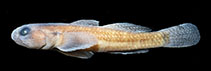
Rückenflossenstacheln (insgesamt) : 7; Rückenflossenweichstrahlen (insgesamt) : 9; Afterflossenstacheln: 1; Afterflossenweichstrahlen: 8; Wirbelzahl: 27. This species is distinguished by the following characters: D VI+I,9; A I,8; pectoral-fin rays 19–21 (usually 20); lateral scales 33 or 34; transverse scales backwards 11 or 12; median predorsal scales 2 or 3; absence of skin flaps on pores or anterior nasal tube; upper three rays of pectoral fin each with two free filamentous tips, upper branch of fourth ray with short, free tip; mental frenum possess a straight margin and short lateral lobes; cheek and operculum scales absent; pectoral-fin base, abdomen, and prepelvic region with embedded cycloid scales; cheek with a slight fold; pelvic interspinal membrane without a median lobe; tongue tip with a median notch. Colouration: when alive, overall pale greyish with a dense covering of reddish-brown freckles, with a brown spot about one-third of pupil size at uppermost part of gill opening, reddish-brown spotting on fins (Ref. 132436). Cross section: compressed.
This species has a commensal association with the large barrel sponge (Xestospongia testudinaria), unlike other members of the genus, which are typically free-living bottom dwellers. The type specimens were found living on a single sponge in 18 m depth. Numerous other individuals were also observed at this location, and all were associated with barrel sponges, with up to about 20 individuals on a single sponge, at depths ranging from 9-30 m. The goby inhabits the outer surface of the sponge and not the hollow central cavity, and occupies the deep, convoluted ravines between the longitudinal ridges and was not seen in the shallower ravines of the sponge. It also inhabits deeper water, but usually below about 15 m compared with most Bathygobius, which are mainly confined to shallow water less than 10 m deep (Ref. 132436).
Allen, G.R., M.V. Erdmann and N.K. Ichida, 2024. A new sponge-dwelling goby (Gobiidae: Bathygobius) from Indonesia, Philippines, and Australia. J. Ocean Sci. Found. 41:46-53. (Ref. 132436)
IUCN Rote Liste Status (Ref. 130435: Version 2025-2 (Global))