



Glyptothorax vatandousti Jouladeh-Roudbar, Ghanavi & Freyhof, 2023
Envoyez vos Photos et vidéos
Images Google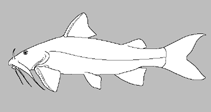 No image available for this species;
drawing shows typical species in Sisoridae.
Images Google
drawing shows typical species in Sisoridae.
Classification / Noms Noms communs | Synonymes | Catalog of Fishes(Genre, Espèce) | ITIS | CoL | WoRMS | Cloffa
> Siluriformes (Catfishes) > Sisoridae (Sisorid catfishes) > Sisorinae
Etymology: Glyptothorax: Greek, glyptes = carver + Greek, thorax = breast (Ref. 45335); vatandousti: Named for Saber Vatandoust (Qaemshahr), for his contributions to the taxonomy of fishes in Iran and an ichthyology professor of the first author, AJR, at the Azad Islamic University of Babol; noun in genitive, indeclinable.
Etymology: Glyptothorax: Greek, glyptes = carver + Greek, thorax = breast (Ref. 45335); vatandousti: Named for Saber Vatandoust (Qaemshahr), for his contributions to the taxonomy of fishes in Iran and an ichthyology professor of the first author, AJR, at the Azad Islamic University of Babol; noun in genitive, indeclinable.
Environnement : milieu / zone climatique / profondeur / gamme de distribution Écologie
; eau douce démersal. Subtropical
Distribution Territoires | Zones FAO | Écosystèmes | Occurrences | Carte par point | Introductions | Faunafri
Asia: Iran.
Taille / Poids / Âge
Description synthétique Clés d'identification | Morphologie | Morphométrie
This species is distinguished from its congeners in the Persian Gulf basin by the following characters: flank with a fine, pale-brown mottled pattern overlaid by small and large, blackish or dark-brown blotches; a deep caudal-peduncle, its depth 1.1-1.3 times in length; length of thoracic adhesive apparatus 0.8-1.1 in width; roundish anterior end of medial pit; none or with a pale-brown triangle-shaped blotch in front of dorsal-fin origin (Ref. 129017).
Cross section: oval.
Cross section: oval.
This species was only found in shallow and slow-moving streams. The Kangavar stream, where this species was found in abundance, has a relatively narrow width of around 1.5 meters, clear water with a rubble bed, and moderately fast current, and it is facing serious threats due to human activities. Water from the Kangavar and Gamasiab is used for irrigation in nearby agricultural farms, which can significantly alter the water flow and quality, leading to habitat degredation and the frequent passage of trucks and other vehicles near the Kangavar result in soil erosion and sedimentation, which can negatively impact the species’ survival and reproduction (Ref. 129017).
Cycle de vie et comportement reproducteur Maturité | Reproduction | Frai | Œufs | Fécondité | Larves
Référence principale
Téléchargez vos références | Références | Coordinateur | Collaborateurs
Jouladeh-Roudbar, A., H.R. Ghanavi and J. Freyhof, 2023. Glyptothorax vatandousti, a new species of torrent catfish from the upper Karkheh drainage in Iran (Teleostei: Sisoridae). Zootaxa 5315(1):037-058. (Ref. 129017)
CITES
Not Evaluated
Menace pour l'homme
Harmless
Utilisations par l'homme
FAO - Publication: search | FishSource |
Plus d'informations
Écologie trophique
Aliments (proies)
Composition du régime alimentaire
Consommation alimentaire
Rations alimentaires
Prédateurs
Aliments (proies)
Composition du régime alimentaire
Consommation alimentaire
Rations alimentaires
Prédateurs
Écologie
Écologie
Écologie
Dynamique des populations
Paramètres de croissance
Âges / tailles maximales
Longueur-poids rel.
Rel. longueur-longueur.
Fréquences de longueurs
Conversion de masse
Recrutement
Abondance
Paramètres de croissance
Âges / tailles maximales
Longueur-poids rel.
Rel. longueur-longueur.
Fréquences de longueurs
Conversion de masse
Recrutement
Abondance
Cycle de vie
Reproduction
Maturité
Maturité/épines rel.
Fécondité
Frai
Agrégats de frai
Œufs
Développement de l'œuf
Larves
Dynamique des populations larvaires
Reproduction
Maturité
Maturité/épines rel.
Fécondité
Frai
Agrégats de frai
Œufs
Développement de l'œuf
Larves
Dynamique des populations larvaires
Anatomie
Surface branchiale
Cerveau
Otolithe
Surface branchiale
Cerveau
Otolithe
Physiologie
Composition corporelle
Nutriments
Consommation d'oxygène
Type de natation
Vitesse de nage
Pigments visuels
Son de poisson
Maladies et parasites
Toxicité (CL50)
Composition corporelle
Nutriments
Consommation d'oxygène
Type de natation
Vitesse de nage
Pigments visuels
Son de poisson
Maladies et parasites
Toxicité (CL50)
Génétique
génôme
Génétique
Hétérozygotie
Héritabilité
Diversité génétique
génôme
Génétique
Hétérozygotie
Héritabilité
Diversité génétique
Liées à l'homme
Systèmes d'aquaculture
Profils d'aquaculture
Souches
Cas de ciguatera
Timbres, pièces de monnaie, divers
Systèmes d'aquaculture
Profils d'aquaculture
Souches
Cas de ciguatera
Timbres, pièces de monnaie, divers
Outils
E-book | Guide de terrain | Générateur de fréquences de longueur | Outil de dynamique de population | Carte par point |
Capture-MSY |
Articles particuliers
Télécharger en XML
Sources Internet
AFORO (otoliths) | Aquatic Commons | BHL | Cloffa | Websites from users | FishWatcher | CISTI | Catalog of Fishes: Genre, Espèce | DiscoverLife | ECOTOX | FAO - Publication: search | Faunafri | Fishipedia | Fishtrace | GloBI | Google Books | Google Scholar | Google | IGFA World Record | OneZoom | Open Tree of Life | Otolith Atlas of Taiwan Fishes | PubMed | Reef Life Survey | Socotra Atlas | TreeBase | Arbre de Vie | Wikipedia: aller à, chercher | World Records Freshwater Fishing | Zoobank | Zoological Record
Estimations basées sur des modèles
Indice de diversité phylogénétique (Réf. 82804): PD50 = 0.5000 [Uniqueness, from 0.5 = low to 2.0 = high].
Bayesian length-weight: a=0.00794 (0.00365 - 0.01726), b=3.02 (2.85 - 3.19), in cm total length, based on LWR estimates for this Genus-body shape (Ref. 93245).
Niveau trophique (Réf. 69278): 3.2 ±0.4 se; based on size and trophs of closest relatives
Résilience (Réf. 120179): Milieu, temps minimum de doublement de population : 1,4 à 4,4 années (Preliminary K or Fecundity.).