



Hochladen Photos und videos
Google Bild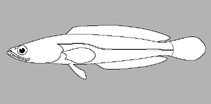 No image available for this species;
drawing shows typical species in Channidae.
Google Bild
drawing shows typical species in Channidae.
Klassifizierung / Names Namen | Synonyme | Catalog of Fishes(Gattung, Arten) | ITIS | CoL | WoRMS | Cloffa
> Anabantiformes (Gouramies, snakeheads) > Channidae (Snakeheads)
Etymology: Channa: Greek, channe, -es = an anchovy (Ref. 45335); aristonei: Named for Aristone M. Ryndongsngi from Meghalaya, for his discovery of this new species and assistance to the authors during the field work.
Eponymy: Aristone M ‘Bah’ Ryndongsngi (d: 1998) is Project Field Coordinator at FXB India, which supports marginalised communities. [...] (Ref. 128868), visit book page.
Etymology: Channa: Greek, channe, -es = an anchovy (Ref. 45335); aristonei: Named for Aristone M. Ryndongsngi from Meghalaya, for his discovery of this new species and assistance to the authors during the field work.
Eponymy: Aristone M ‘Bah’ Ryndongsngi (d: 1998) is Project Field Coordinator at FXB India, which supports marginalised communities. [...] (Ref. 128868), visit book page.
Umwelt: Milieu / Klimazone / Tiefenbereich / Verbreitungsgebiet Ökologie
; süßwasser benthopelagisch. Tropical
Verbreitung Territorien | FAO Gebiete | Ökosysteme | Vorkommen | Punkt Karte | Einführungen | Faunafri
Asia: India.
Größe / Gewicht / Alter
Kurzbeschreibung Bestimmungsschlüssel | Morphologie | Morphometrie
Rückenflossenweichstrahlen (insgesamt) : 36 - 39; Afterflossenweichstrahlen: 24 - 26; Wirbelzahl: 49. This species is distinguished from all its congeners by the following characters: body uniform bright blue to bluish-green, bright-blue dorsal, anal, and caudal fins, submarginally black with white distal margin, series of brown to maroon-red, rounded, oblong or clover-shaped blotches or spots on dorsolateral, postorbital, and ventrolateral region of head, continued on body forming oblique pattern or randomly distributed; similar to C. pardalis and C. bipuli in appearance, but differs from both in having brown to maroon-red, rounded, oblong or clover-shaped blotches or spots on head and sides of the body (vs. possession of well-defined, black to brown, rounded to oblong spots), fewer pre-dorsal scales 7 (vs. 8–9), more caudal-fin rays 15 (vs. 13), and more vertebrae 49 (vs. 45) (Ref. 131046).
Cross section: oval.
Cross section: oval.
Known from the streams at Puriang, East Khasi Hills, Meghalaya, where the habitat is a clear, slow-flowing hill stream, having rocky substrate, and Eriocaulon sp. as the only aquatic vegetation. Water temperature is18C at the time of survey. .Associated species in the habitat were C. lipor, Danio meghalayensis, and Tor sp. The species is shy in nature, hides in crevices among the submerged rocky boulders. It comes out only for feeding. Well-conditioned specimens when housed in water temperature less than 20C acquires a uniform bright blue body color with maroon-red blotches on the lateral body and immediately takes up golden-green to greenish-gray color when stressed or housed in warm temperature (Ref. 131046).
Lebenszyklus und Paarungsverhalten Geschlechtsreife | Fortpflanzung | Ablaichen | Eier | Fruchtbarkeit | Larven
Hauptreferenz
Laden Sie Ihre Referenzen hoch | Referenzen | Koordinator | Partner
Praveenraj, J., T. Thackeray, S.G. Singh, A. Uma, N. Moulitharan and B.K. Mukhim, 2020. A new species of snakehead (Teleostei: Channidae) from East Khasi Hills, Meghalaya, northeastern India. Copeia 108(4):938-947. (Ref. 131046)
CITES
Not Evaluated
Bedrohung für Menschen
Harmless
Nutzung durch Menschen
FAO - Publication: search | FishSource |
Mehr Information
Trophische Ökologie
Lebensmittel (Beutetiere)
Nahrungszusammensetzung
Nahrungsaufnahme
Lebensmittelrationen
Räuber
Lebensmittel (Beutetiere)
Nahrungszusammensetzung
Nahrungsaufnahme
Lebensmittelrationen
Räuber
Ökologie
Ökologie
Ökologie
Populationsdynamik
Wachstumsparameter
Max. Alter/Größen
Länge-Gewicht-Rel.
Länge-Länge-Verhältnis.
Längenhäufigkeiten
Massenkonvertierung
Rekrutierung
Dichte
Wachstumsparameter
Max. Alter/Größen
Länge-Gewicht-Rel.
Länge-Länge-Verhältnis.
Längenhäufigkeiten
Massenkonvertierung
Rekrutierung
Dichte
Lebenszyklus
Fortpflanzung
Geschlechtsreife
Reifung/Kiemen rel.
Fruchtbarkeit
Ablaichen
Laichaggregationen
Eier
Eientwicklung
Larven
Larven Pop.Dyn.
Fortpflanzung
Geschlechtsreife
Reifung/Kiemen rel.
Fruchtbarkeit
Ablaichen
Laichaggregationen
Eier
Eientwicklung
Larven
Larven Pop.Dyn.
Anatomie
Kiemenoberfläche
Gehirn
Otolith
Kiemenoberfläche
Gehirn
Otolith
Physiologie
Körperliche Zusammensetzung
Nährstoffe
Sauerstoffverbrauch
Schwimmart
Schwimmgeschwindigkeit
Visuelle Pigmente
Fischgeräusche
Krankheiten und Parasiten
Toxizität (LC50s)
Körperliche Zusammensetzung
Nährstoffe
Sauerstoffverbrauch
Schwimmart
Schwimmgeschwindigkeit
Visuelle Pigmente
Fischgeräusche
Krankheiten und Parasiten
Toxizität (LC50s)
Genetik
Genom
Genetik
Heterozygotie
Vererbbarkeit
Genetische Vielfalt
Genom
Genetik
Heterozygotie
Vererbbarkeit
Genetische Vielfalt
Menschenbezogen
Aquakultur-Systeme
Aquakultur Profile
Zuchtlinien
Ciguatera-Fälle
Briefmarken, Münzen, Verschiedenes.
Aquakultur-Systeme
Aquakultur Profile
Zuchtlinien
Ciguatera-Fälle
Briefmarken, Münzen, Verschiedenes.
Tools
Zusatzinformationen
Download XML
Zusammenfassung | Punktdaten | Namen | Photos
Internet Quellen
AFORO (otoliths) | Aquatic Commons | BHL | Cloffa | Websites from users | FishWatcher Einträge suchen | CISTI | Catalog of Fishes: Gattung, Arten | DiscoverLife | ECOTOX | FAO - Publication: search | Faunafri | Fishipedia | Fishtrace | GloBI | Google Books | Google Scholar | Google | IGFA World Record | OneZoom | Open Tree of Life | Otolith Atlas of Taiwan Fishes | PubMed | Reef Life Survey | Socotra Atlas | TreeBase | Tree of Life | Wikipedia: Gehe zu, Suchen | World Records Freshwater Fishing | Zoobank | Zoologischer Rekord
Schätzungen auf der Grundlage von Modellen
Phylogenetischer Diversitätsindex (Ref. 82804): PD50 = 0.5000 [Uniqueness, from 0.5 = low to 2.0 = high].
Bayesian length-weight: a=0.00813 (0.00372 - 0.01775), b=2.98 (2.81 - 3.15), in cm total length, based on LWR estimates for this Genus-body shape (Ref. 93245).
Trophische Ebene (Ref. 69278): 3.7 ±0.6 se; based on size and trophs of closest relatives
Widerstandsfähigkeit (Ref. 120179): hoch, Verdopplung der Population dauert weniger als 15 Monate. (Preliminary K or Fecundity.).