



Stolephorus eclipsis Hata, Lavoué & Motomura, 2022
Eclipse anchovy
Hochladen Photos und videos
Google Bild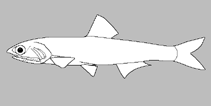 No image available for this species;
drawing shows typical species in Engraulidae.
Google Bild
drawing shows typical species in Engraulidae.
Klassifizierung / Names Namen | Synonyme | Catalog of Fishes(Gattung, Arten) | ITIS | CoL | WoRMS | Cloffa
> Clupeiformes (Herrings) > Engraulidae (Anchovies) > Engraulinae
Etymology: Stolephorus: Greek, stole, -es = garment + Greek, pherein = to carry (Ref. 45335); eclipsis: Name 'eclipsis refers to 'eclipse', referring to the concave pre-opercle of the new species.
Etymology: Stolephorus: Greek, stole, -es = garment + Greek, pherein = to carry (Ref. 45335); eclipsis: Name 'eclipsis refers to 'eclipse', referring to the concave pre-opercle of the new species.
Umwelt: Milieu / Klimazone / Tiefenbereich / Verbreitungsgebiet Ökologie
seewasser pelagic-neritic. Tropical
Verbreitung Territorien | FAO Gebiete | Ökosysteme | Vorkommen | Punkt Karte | Einführungen | Faunafri
Western Pacific: Indonesia.
Größe / Gewicht / Alter
Kurzbeschreibung Bestimmungsschlüssel | Morphologie | Morphometrie
This species is distinguished by the following characters: gill rakers on upper limb of 1st gill arch, 19-21 (modally 20), on lower limb 26-30 (28), total 47-51 (47); gill rakers on upper limb of 2nd gill arch 13-16 (14), on lower limb 24-27 (25), total 37-42 (39); gill rakers on upper limb of 3rd gill arch 10-13 (12), on lower limb 14-16 (15), total 25-28 (27); gill rakers on upper limb of 4th gill arch 8-11 (9), on lower limb 11-13 (12), total 19-24 (21); prepelvic scutes 5-7 (6); total vertebrae 38-39 (39); long maxilla, its posterior tip just reaching or slightly short of posterior margin of opercle; with predorsal scute; pelvic scute no spine; body scales are deciduous; posterior border of pre-opercle concave, indented; paired dark patch on parietal area with little following pigmentation; distinct double pigment lines along dorsum posterior to the dorsal fin; no black spots below eye and on lower-jaw tip; anal-fin base is short, 17.6-19.3% (mean 18.6%) of SL; third dorsal-fin ray 16.5-18.8% (17.6%) of SL; pelvic fin is short, 8.7-9.9% (9.4%) of SL, its posterior tip usually not reaching to vertical through dorsal-fin origin when depressed; distance between posterior ends of supramaxilla and maxilla 4.7-5.4% (5.1%) of SL; pre-dorsal-fin length 51.3-54.9% (53.4%) of SL; dorsal-fin base is short, 13.1-14.5% (13.8%) of SL (Ref. 130210).
Cross section: compressed.
Cross section: compressed.
Lebenszyklus und Paarungsverhalten Geschlechtsreife | Fortpflanzung | Ablaichen | Eier | Fruchtbarkeit | Larven
Hauptreferenz
Laden Sie Ihre Referenzen hoch | Referenzen | Koordinator | Partner
Hata, H., S. Lavoué and H. Motomura, 2022. Description of three new species previously identified as Stolephorus bengalensis (Dutt & Babu Rao, 1959) or Stolephorus insularis Hardenberg, 1933 and a re-description of S. bengalensis (Chordata, Osteichthyes, Clupeiformes, Engraulidae). ZooKeys 1121(0):145-173. (Ref. 130210)
CITES
Not Evaluated
Bedrohung für Menschen
Harmless
Nutzung durch Menschen
Fischereien: kommerziell
FAO - Publication: search | FishSource |
Mehr Information
Trophische Ökologie
Lebensmittel (Beutetiere)
Nahrungszusammensetzung
Nahrungsaufnahme
Lebensmittelrationen
Räuber
Lebensmittel (Beutetiere)
Nahrungszusammensetzung
Nahrungsaufnahme
Lebensmittelrationen
Räuber
Ökologie
Ökologie
Ökologie
Populationsdynamik
Wachstumsparameter
Max. Alter/Größen
Länge-Gewicht-Rel.
Länge-Länge-Verhältnis.
Längenhäufigkeiten
Massenkonvertierung
Rekrutierung
Dichte
Wachstumsparameter
Max. Alter/Größen
Länge-Gewicht-Rel.
Länge-Länge-Verhältnis.
Längenhäufigkeiten
Massenkonvertierung
Rekrutierung
Dichte
Lebenszyklus
Fortpflanzung
Geschlechtsreife
Reifung/Kiemen rel.
Fruchtbarkeit
Ablaichen
Laichaggregationen
Eier
Eientwicklung
Larven
Larven Pop.Dyn.
Fortpflanzung
Geschlechtsreife
Reifung/Kiemen rel.
Fruchtbarkeit
Ablaichen
Laichaggregationen
Eier
Eientwicklung
Larven
Larven Pop.Dyn.
Anatomie
Kiemenoberfläche
Gehirn
Otolith
Kiemenoberfläche
Gehirn
Otolith
Physiologie
Körperliche Zusammensetzung
Nährstoffe
Sauerstoffverbrauch
Schwimmart
Schwimmgeschwindigkeit
Visuelle Pigmente
Fischgeräusche
Krankheiten und Parasiten
Toxizität (LC50s)
Körperliche Zusammensetzung
Nährstoffe
Sauerstoffverbrauch
Schwimmart
Schwimmgeschwindigkeit
Visuelle Pigmente
Fischgeräusche
Krankheiten und Parasiten
Toxizität (LC50s)
Genetik
Genom
Genetik
Heterozygotie
Vererbbarkeit
Genetische Vielfalt
Genom
Genetik
Heterozygotie
Vererbbarkeit
Genetische Vielfalt
Menschenbezogen
Aquakultur-Systeme
Aquakultur Profile
Zuchtlinien
Ciguatera-Fälle
Briefmarken, Münzen, Verschiedenes.
Aquakultur-Systeme
Aquakultur Profile
Zuchtlinien
Ciguatera-Fälle
Briefmarken, Münzen, Verschiedenes.
Tools
Zusatzinformationen
Download XML
Zusammenfassung | Punktdaten | Namen | Photos
Internet Quellen
AFORO (otoliths) | Aquatic Commons | BHL | Cloffa | Websites from users | FishWatcher Einträge suchen | CISTI | Catalog of Fishes: Gattung, Arten | DiscoverLife | ECOTOX | FAO - Publication: search | Faunafri | Fishipedia | Fishtrace | GloBI | Google Books | Google Scholar | Google | IGFA World Record | OneZoom | Open Tree of Life | Otolith Atlas of Taiwan Fishes | PubMed | Reef Life Survey | Socotra Atlas | TreeBase | Tree of Life | Wikipedia: Gehe zu, Suchen | World Records Freshwater Fishing | Zoobank | Zoologischer Rekord
Schätzungen auf der Grundlage von Modellen
Phylogenetischer Diversitätsindex (Ref. 82804): PD50 = 0.5000 [Uniqueness, from 0.5 = low to 2.0 = high].
Bayesian length-weight: a=0.00501 (0.00217 - 0.01155), b=3.14 (2.97 - 3.31), in cm total length, based on LWR estimates for this Genus-body shape (Ref. 93245).
Trophische Ebene (Ref. 69278): 3.2 ±0.4 se; based on size and trophs of closest relatives
Widerstandsfähigkeit (Ref. 120179): hoch, Verdopplung der Population dauert weniger als 15 Monate. (Preliminary K or Fecundity.).