



Enneapterygius sericus Dewa, Harazaki & Motomura, 2024
Spotted-head triplefin
Carregue seu(sua) Fotos e vídeos
Imagem do Google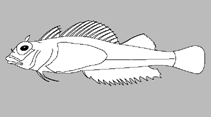 No image available for this species;
drawing shows typical species in Tripterygiidae.
Imagem do Google
drawing shows typical species in Tripterygiidae.
Classificação / Nomes Nomes comuns | Sinônimos | Catalog of Fishes(Gênero, Espécies) | ITIS | CoL | WoRMS | Cloffa
> Blenniiformes (Blennies) > Tripterygiidae (Triplefin blennies) > Tripterygiinae
Etymology: Enneapterygius: Greek, ennea = nine times + Greek, pterygion = little fin (Ref. 45335); sericus: Name from Latin 'sericus' meaning 'silk', referring to the shiny whitish body of this species; noun in apposition.
Etymology: Enneapterygius: Greek, ennea = nine times + Greek, pterygion = little fin (Ref. 45335); sericus: Name from Latin 'sericus' meaning 'silk', referring to the shiny whitish body of this species; noun in apposition.
Meio ambiente: milieu / Zona climática / intervalo de profundidade / faixa de distribuição Ecologia
marinhas associadas(os) a recifes; intervalo de profundidade 5 - 20 m (Ref. 130804), usually 0 - 5 m (Ref. 130804). Subtropical
Distribuição Territórios | Áreas da FAO | Ecossistemas | Ocorrências | Mapa de pontos | Introduções | Faunafri
Western Pacific: Ryukyu Is., Taiwan, Indonesia, Australia and Solomon Is.; probably in the Mariana Is. (Guam) and the Hall Islands.
Tamanho / Peso / Idade
Descrição suscinta Chaves de identificação | Morfologia | Morfometria
Espinhos dorsais (total) : 15 - 17; Raios dorsais (total) : 9 - 11; Espinhos anais: 1; Raios anais : 17 - 21. The new species is distinguished by the following set of characters: D1 III, D2 XII-XIV, D3 9-11, with first spine of D1 shorter than that of D2, its length 5.5-10.2% SL (mean 8.2%); pectoral-fin rays ii-v (iv) + 3-6 (4) + iv-viii (vii) = 13-16; A 17–21; scales below first notched lateral-line scale 3 or 3½; pored lateral line scales 15-18; scale rows in longitudinal series 32-37; circumpeduncular scales 8-12; single transverse scale row between posteriormost pored scale and anteriormost notched scale; mandibular-pore formula usually 3 + 1 + 3; orbital tentacle short, slender and pointed, its length shorter than nasal tentacle. Colouration: body generally semi-transparent white with reddish blotches and saddles; bright white blotches aligned along midlateral scale series; the dorsal surface of head with brownish blotches; head, snout and cheek, opercle, pectoral fin base, and base of 8 lowermost pectoral-fin rays black in nuptial males; undersurface of head, including pelvic-fin base, and anterior part of abdomen black, pigment sometimes extending to anus (Ref. 130804).
Cross section: oval.
Cross section: oval.
Occurs usually on exposed shallow rocky reefs in depths less than 5 m, haracteristically on the upper surface of rocks covered by patches of ca. 1-2 mm length algae, whereas other congeners tend to occur on vertical surfaces. Reproductive season at Yaku-shima Island extends from the end of February to April (ca. 18-21 °C), spawning usually taking place in the morning. During the spawning season, males display nuptial coloration, which can alter quickly depending on the situation for as a female approaches the male’s melanophores on head become more obvious, forming a blackish mask on the head and body. Also, the brownish blotches on the dorsal head surface become paler and almost completely fade. During spawning, brownish pigmentation on the nape continues to change, sometimes forming blotches or lines, and becoming dense or pale. When alive, brownish blotches on the dorsal head surface are more distinct in young individuals, but paler in nuptial males and relatively large females (Ref. 130804).
Ciclo de vida ou comportamento de acasalamento Maturidade | Reprodução | Desova | Ovos | Fecundidade | Larvas
Referência principal
Carregar suas referências | Referências | Coordenador : Fricke, Ronald | Colaboradores
Dewa, Y., S. Harazaki and H. Motomura, 2024. Enneapterygius sericus, a new species of triplefin (Perciformes: Tripterygiidae) from the western Pacific Ocean. Ichthyol. Res.: [1-13]. [First published online, pp. 1-13, 30 Jan. 2024.] (Ref. 130804)
CITES
Not Evaluated
Ameaça para os humanos
Harmless
Uso pelos humanos
Pescarias: sem interesse
FAO - Publication: search | FishSource |
Mais informação
Ecologia Trófica
Itens alimentares (presas)
Composição da dieta
Consumo alimentar
Rações alimentares
Predadores
Itens alimentares (presas)
Composição da dieta
Consumo alimentar
Rações alimentares
Predadores
Ecologia
Ecologia
Ecologia
Dinâmica populacional
Parâmetros de crescimento
Idade máxima / tamanhos
Relação comprimento-peso.
Relação comprimento-comprimento.
Frequências de comprimento
Conversão de massa
Recrutamento
Abundância
Parâmetros de crescimento
Idade máxima / tamanhos
Relação comprimento-peso.
Relação comprimento-comprimento.
Frequências de comprimento
Conversão de massa
Recrutamento
Abundância
Ciclo de vida
Reprodução
Maturidade
Maturidade/Rel. das guelras
Fecundidade
Desova
Agregações de desova
Ovos
Desenvolvimento dos ovos
Larvas
Dinâmica larval
Reprodução
Maturidade
Maturidade/Rel. das guelras
Fecundidade
Desova
Agregações de desova
Ovos
Desenvolvimento dos ovos
Larvas
Dinâmica larval
Anatomia
Área branquial
Cérebro
Otólito
Área branquial
Cérebro
Otólito
Fisiologia
Composição corporal
Nutrientes
Consumo de oxigênio
Tipo de natação
Velocidade de natação
Pigmentos visuais
Som de peixe
Doenças e Parasitas
Toxicidade (LC50s)
Composição corporal
Nutrientes
Consumo de oxigênio
Tipo de natação
Velocidade de natação
Pigmentos visuais
Som de peixe
Doenças e Parasitas
Toxicidade (LC50s)
Genética
genoma
Genética
Heterozigosidade
Hereditariedade
Diversidade genética
genoma
Genética
Heterozigosidade
Hereditariedade
Diversidade genética
Relacionado a humanos
Sistemas de aquicultura
Perfis para aquacultura
Estirpes
Casos de Ciguatera
Selos, moedas, diversos.
Sistemas de aquicultura
Perfis para aquacultura
Estirpes
Casos de Ciguatera
Selos, moedas, diversos.
Ferramentas
Livro eletrônico | Guia de campo | Ferramenta auxiliar de frequências de comprimento | Ferramenta sobre a história de vida | Mapa de pontos |
Catch-MSY |
Relatórios especiais
Checar Manutenção em Aquário | Checar Planilhas de Fatos sobre as Espécies | Checar Planilhas de Fatos sobre Aquicultura
Baixar XML
Fontes da internet
AFORO (otoliths) | Aquatic Commons | BHL | Cloffa | Websites from users | Checar Observador de Peixes (FishWatcher) | CISTI | Catalog of Fishes: Gênero, Espécies | DiscoverLife | ECOTOX | FAO - Publication: search | Faunafri | Fishipedia | Fishtrace | GloBI | Google Books | Google Scholar | Google | IGFA World Record | Bases de dados nacionais | OneZoom | Open Tree of Life | Otolith Atlas of Taiwan Fishes | PubMed | Reef Life Survey | Socotra Atlas | TreeBase | Árvore da vida | Wikipedia: Ir para, procura | World Records Freshwater Fishing | Zoobank | Registro zoológico
Estimativas baseadas em modelos
Índice de diversidade filogenética (Ref. 82804): PD50 = 0.5000 [Uniqueness, from 0.5 = low to 2.0 = high].
Bayesian length-weight: a=0.00617 (0.00290 - 0.01310), b=3.04 (2.86 - 3.22), in cm total length, based on LWR estimates for this (Sub)family-body shape (Ref. 93245).
Nível Trófico (Ref. 69278): 3.1 ±0.3 se; based on size and trophs of closest relatives
Resiliência (Ref. 120179): Elevada, tempo mínimo de duplicação da população menor que 15 meses (Preliminary K or Fecundity.).