



Amazonichthys lu Esguícero & Mendonça, 2023
Hochladen Photos und videos
Google Bild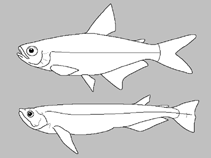 No image available for this species;
drawing shows typical species in Characidae.
Google Bild
drawing shows typical species in Characidae.
Klassifizierung / Names Namen | Synonyme | Catalog of Fishes(Gattung, Arten) | ITIS | CoL | WoRMS | Cloffa
> Characiformes (Characins) > Characidae (Characins; tetras) > Aphyocharacinae
Etymology: Amazonichthys: Name from the Greek 'Amazon' (a race of warrior women) and 'ichthys' for fishes; referring to the indigenous Icamiabas that battled against Spanish troops led by Francisco Orellana in 1542 (who led an aggressive expedition into the Amazon region). The Icamiabas resembled the Amazons from Greek mythology, fighting with bows and arrows and forbidding the presence of men inside their tribe (Medina, 1894); lu: Named after Luciana Leite, known by her friends as 'Lu'; noun in apposition.
Etymology: Amazonichthys: Name from the Greek 'Amazon' (a race of warrior women) and 'ichthys' for fishes; referring to the indigenous Icamiabas that battled against Spanish troops led by Francisco Orellana in 1542 (who led an aggressive expedition into the Amazon region). The Icamiabas resembled the Amazons from Greek mythology, fighting with bows and arrows and forbidding the presence of men inside their tribe (Medina, 1894); lu: Named after Luciana Leite, known by her friends as 'Lu'; noun in apposition.
Umwelt: Milieu / Klimazone / Tiefenbereich / Verbreitungsgebiet Ökologie
; süßwasser benthopelagisch. Tropical
Verbreitung Territorien | FAO Gebiete | Ökosysteme | Vorkommen | Punkt Karte | Einführungen | Faunafri
South America: Brazil.
Größe / Gewicht / Alter
Kurzbeschreibung Bestimmungsschlüssel | Morphologie | Morphometrie
Rückenflossenweichstrahlen (insgesamt) : 9; Afterflossenweichstrahlen: 21 - 25; Wirbelzahl: 35 - 37. This species is distinguished from its congeners by the following characters: dorsal and anal unbranched fin rays are poorly pigmented (vs. first unbranched dorsal and all unbranched anal-fin rays with dense concentration of dark brown chromatophores), absence of two symmetrical conspicuous small dark blotches at the base of the caudal-fin rays, but if present are diffuse (vs. presence); pectoral fin with i8 rays (vs. i9-11); differs from camelierae by having the anterior midlateral stripe reaching the dorsal-fin region (vs. stripe reaching the caudal peduncle blotch), triangular caudal peduncle blotch (vs. round), lateral line incomplete (vs. complete), lower number of longitudinal scales 33-36 (vs. 37-38), circumpeduncular scales 10-11 (vs. 12), ventral margin of the third infraorbital bone not reaching the anterodorsal margin of preopercle (vs. surpassing that point), precaudal vertebrae 12 (vs. 13); differs from lindeae by usually having smaller horizontal eye diameter 38.6-43.2% of HL (vs. 42.1-52.4%) (Ref. 130247).
Cross section: compressed.
Cross section: compressed.
Lebenszyklus und Paarungsverhalten Geschlechtsreife | Fortpflanzung | Ablaichen | Eier | Fruchtbarkeit | Larven
Hauptreferenz
Laden Sie Ihre Referenzen hoch | Referenzen | Koordinator | Partner
Esguícero, A.L.H. and M.B. Mendonça, 2023. A new genus and two new species of tetras (Characiformes: Characidae), with a redescription and generic reassignment of Axelrodia lindeae Géry. Ichthyology & Herpetology 111(3):426-447. (Ref. 130247)
CITES
Not Evaluated
Bedrohung für Menschen
Harmless
Nutzung durch Menschen
Fischereien: nicht kommerziell
FAO - Publication: search | FishSource |
Mehr Information
Trophische Ökologie
Lebensmittel (Beutetiere)
Nahrungszusammensetzung
Nahrungsaufnahme
Lebensmittelrationen
Räuber
Lebensmittel (Beutetiere)
Nahrungszusammensetzung
Nahrungsaufnahme
Lebensmittelrationen
Räuber
Ökologie
Ökologie
Ökologie
Populationsdynamik
Wachstumsparameter
Max. Alter/Größen
Länge-Gewicht-Rel.
Länge-Länge-Verhältnis.
Längenhäufigkeiten
Massenkonvertierung
Rekrutierung
Dichte
Wachstumsparameter
Max. Alter/Größen
Länge-Gewicht-Rel.
Länge-Länge-Verhältnis.
Längenhäufigkeiten
Massenkonvertierung
Rekrutierung
Dichte
Lebenszyklus
Fortpflanzung
Geschlechtsreife
Reifung/Kiemen rel.
Fruchtbarkeit
Ablaichen
Laichaggregationen
Eier
Eientwicklung
Larven
Larven Pop.Dyn.
Fortpflanzung
Geschlechtsreife
Reifung/Kiemen rel.
Fruchtbarkeit
Ablaichen
Laichaggregationen
Eier
Eientwicklung
Larven
Larven Pop.Dyn.
Anatomie
Kiemenoberfläche
Gehirn
Otolith
Kiemenoberfläche
Gehirn
Otolith
Physiologie
Körperliche Zusammensetzung
Nährstoffe
Sauerstoffverbrauch
Schwimmart
Schwimmgeschwindigkeit
Visuelle Pigmente
Fischgeräusche
Krankheiten und Parasiten
Toxizität (LC50s)
Körperliche Zusammensetzung
Nährstoffe
Sauerstoffverbrauch
Schwimmart
Schwimmgeschwindigkeit
Visuelle Pigmente
Fischgeräusche
Krankheiten und Parasiten
Toxizität (LC50s)
Genetik
Genom
Genetik
Heterozygotie
Vererbbarkeit
Genetische Vielfalt
Genom
Genetik
Heterozygotie
Vererbbarkeit
Genetische Vielfalt
Menschenbezogen
Aquakultur-Systeme
Aquakultur Profile
Zuchtlinien
Ciguatera-Fälle
Briefmarken, Münzen, Verschiedenes.
Aquakultur-Systeme
Aquakultur Profile
Zuchtlinien
Ciguatera-Fälle
Briefmarken, Münzen, Verschiedenes.
Tools
Zusatzinformationen
Download XML
Zusammenfassung | Punktdaten | Namen | Photos
Internet Quellen
AFORO (otoliths) | Aquatic Commons | BHL | Cloffa | Websites from users | FishWatcher Einträge suchen | CISTI | Catalog of Fishes: Gattung, Arten | DiscoverLife | ECOTOX | FAO - Publication: search | Faunafri | Fishipedia | Fishtrace | GloBI | Google Books | Google Scholar | Google | IGFA World Record | OneZoom | Open Tree of Life | Otolith Atlas of Taiwan Fishes | PubMed | Reef Life Survey | Socotra Atlas | TreeBase | Tree of Life | Wikipedia: Gehe zu, Suchen | World Records Freshwater Fishing | Zoobank | Zoologischer Rekord
Schätzungen auf der Grundlage von Modellen
Phylogenetischer Diversitätsindex (Ref. 82804): PD50 = 0.6250 [Uniqueness, from 0.5 = low to 2.0 = high].
Bayesian length-weight: a=0.00692 (0.00283 - 0.01691), b=3.09 (2.88 - 3.30), in cm total length, based on LWR estimates for this (Sub)family-body shape (Ref. 93245).
Trophische Ebene (Ref. 69278): 3.1 ±0.4 se; based on size and trophs of closest relatives