



Anablepsoides bibosi Valdesalici & Gil, 2019
Uploaden van uw Foto's en video's
Google afbeelding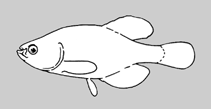 No image available for this species;
drawing shows typical species in Rivulidae.
Google afbeelding
drawing shows typical species in Rivulidae.
Classificatie / Namen Lokale namen | Synoniemen | Catalog of Fishes(Genus, Soort(en)) | ITIS | CoL | WoRMS | Cloffa
> Cyprinodontiformes (Rivulines, killifishes and live bearers) > Rivulidae (Rivulines) > Rivulinae
Etymology: bibosi: Named for its type-locality, the stream Bibosi, where the new species was collected; noun in apposition.
Etymology: bibosi: Named for its type-locality, the stream Bibosi, where the new species was collected; noun in apposition.
Milieu: milieu / Klimaatzone / Diepte / verspreidingsgebied Ecologie
; zoet water benthopelagisch; standvastig; diepte 0 - 1 m (Ref. 130459). Tropical
Verspreiding Gebieden | FAO regio's | Ecosystemen | Voorkomen | Verspreidingskaart | Introducties | Faunafri
South America: Bolivia.
Grootte / Gewicht / Leeftijd
Maturiteit: Lm ? range ? - ? cm
Max length : 3.7 cm SL mannelijk / geslacht onbekend; (Ref. 130459); 3.4 cm SL (female)
Max length : 3.7 cm SL mannelijk / geslacht onbekend; (Ref. 130459); 3.4 cm SL (female)
Korte beschrijving Determinatiesleutels | Morfologie | Morfometrie
Dorsale zachte stralen (totaal) : 9; Anale zachte stralen: 13 - 15. This males of this species is distinguished from all other species of the A. limoncochae species group by having the anal fin pattern consisting of a sub-basal row of red, closely-set dots forming stripes and a black fin margin (vs. absence, or if present, in reduced number and well separated). Further distinguished from the members of A. limoncochae species group occurring in the rio Madeira basin as follows: differs from A. chapare by the number of scales on longitudinal series 47-49 (vs. 43-44), with dorsal fin origin above base of the 10th or 11th anal-fin ray (vs.12th-13th anal fin ray), and males with pelvic fin yellow on distal portion (vs. light blue); differs from A. christinae by the number of scales on longitudinal series 47-49 (vs. 38-41), scales around caudal peduncle 18-20 (vs. 17-18) and males with black margins on unpaired fin (vs. dark margin hardly visible); differs from A. luitalimae by the number of scales on longitudinal series 47-49 (vs. 43-44), dorsal-fin rays 9 (vs. 7), caudal and pectoral-fin rays 29 and 15, respectively (vs. 26-28 and 12, respectively), with reduced number of pelvic-fin rays 6 (vs. 7) and by a distinct dorsal fin proximal portion coloration in males whitish (vs. pale yellow); differs from A. parlettei by the number of scales on longitudinal series 47-49 (vs. 37-40) and the caudal-fin rays 26-28 (vs. 24) and males with red stripes on sides (vs. irregularly striped to dotted pattern); differs from A. lineasoppilatae by the number of scales on longitudinal series 47-49 (vs. 36-39), dorsal fin origin above base of the 10th or 11th anal-fin ray (vs. 7th-8th anal-fin ray) and males with red stripes running from humeral region to caudal peduncle (vs. starting from the area posterior to pectoral fin); differs from A. hoetmeri by the number of pectoral-fin rays 15 (vs. 14), the number of scales on longitudinal series 47-49 (vs. 42-44), with scales around caudal peduncle 18-20 (vs. 16) and males with seven thin longitudinal stripes on caudal peduncle (vs. six lines, three of which interrupted at the level of anal fin origin), dorsal fin with white coloration at the proximal portion (vs. white with golden patch); differs from A. taeniatus by by the number of scales on longitudinal series 47-49 (vs. 38-40), and with less pelvic-fin rays 6 (vs. 7). The females can be distinguished from females of the other species of the A. limoncochae species group by the reduced black spot on the upper portion of the caudal-fin base (vs. broad black spot) (Ref. 130459).
Cross section: oval.
Cross section: oval.
Facultative air-breathing; Specimens were collected in a forest stream, about 4 meters wide and 0.1-0.2 meters deep with substrate composed by sand and stone, without aquatic vegetation. The water was fast, clear and transparent, with the following abiotic parameters (during the middle morning): temperature 22°C, pH 8.9, conductivity 213 µS.cm-2. Other fish present were unidentified cichlids and characids (Ref. 130459).
Levenscyclus en paargedrag Maturiteit | Voortplanting | Paaien | Eieren | Fecunditeit | Larven
Hoofdreferentie
Upload uw referenties | Referenties | Coördinator : Costa, Wilson J.E.M. | Medewerkers
Valdesalici, S. and J.R. Gil, 2019. A new killifish from central Bolivia: Anablepsoides bibosi (Cyprinodontiformes: Rivulidae). aqua, International Journal of Ichthyology v. 25 (no. 4): 149-154. (Ref. 130459)
CITES
Not Evaluated
Gevaar voor de mens
Harmless
Gebruik door de mens
FAO - Publication: search | FishSource |
Meer informatie
Trofische ecologie
Voedsel (prooien)
Dieetsamenstelling
Voedselconsumptie
Voedselrantsoenen
Predatoren
Voedsel (prooien)
Dieetsamenstelling
Voedselconsumptie
Voedselrantsoenen
Predatoren
Ecologie
Ecologie
Ecologie
Populatiedynamica
Groeiparameters
Max. leeftijden / maten
Lengte-gewicht rel.
Lengte-lengte rel.
Lengtefrequenties
Massaconversie
Rekrutering
Abundantie
Groeiparameters
Max. leeftijden / maten
Lengte-gewicht rel.
Lengte-lengte rel.
Lengtefrequenties
Massaconversie
Rekrutering
Abundantie
Levenscyclus
Voortplanting
Maturiteit
Rijpheid/kieuwen rel.
Fecunditeit
Paaien
Paaibestanden
Eieren
Ontwikkeling van de eieren
Larven
Larvale populatiedynamiek
Voortplanting
Maturiteit
Rijpheid/kieuwen rel.
Fecunditeit
Paaien
Paaibestanden
Eieren
Ontwikkeling van de eieren
Larven
Larvale populatiedynamiek
Anatomie
Kieuwoppervlak
Hersenen
Otoliet
Kieuwoppervlak
Hersenen
Otoliet
Fysiologie
Lichaamssamenstelling
Voedingsstoffen
Zuurstofverbruik
Type zwemmen
Zwemsnelheid
Visuele pigmenten
Vis geluid
Ziekten en parasieten
Toxiciteit (LC50)
Lichaamssamenstelling
Voedingsstoffen
Zuurstofverbruik
Type zwemmen
Zwemsnelheid
Visuele pigmenten
Vis geluid
Ziekten en parasieten
Toxiciteit (LC50)
Genetica
genoom
Genetica
Heterozygositeit
Erfelijkheid
Genetische diversiteit
genoom
Genetica
Heterozygositeit
Erfelijkheid
Genetische diversiteit
Menselijk gerelateerd
Aquacultuursystemen
Aquacultuurprofielen
Kweeklijnen
Ciguatera gevallen
Postzegels, munten, diversen.
Aquacultuursystemen
Aquacultuurprofielen
Kweeklijnen
Ciguatera gevallen
Postzegels, munten, diversen.
Tools
Speciale rapporten
Bekijk gegevens voor het houden in een aquarium | Bekijk Fact Sheets voor de soort | Bekijk Aquacultuur Fact Sheets
Download XML
Internetbronnen
AFORO (otoliths) | Aquatic Commons | BHL | Cloffa | Websites from users | Bekijk FishWatcher | CISTI | Catalog of Fishes: Genus, Soort(en) | DiscoverLife | ECOTOX | FAO - Publication: search | Faunafri | Fishipedia | Fishtrace | GloBI | Google Books | Google Scholar | Google | IGFA World Record | OneZoom | Open Tree of Life | Otolith Atlas of Taiwan Fishes | PubMed | Reef Life Survey | Socotra Atlas | TreeBase | Tree of Life | Wikipedia: ga naar, zoek | World Records Freshwater Fishing | Zoobank | Zoological Record
Schattingen op basis van modellen
Fylogenetische diversiteitsindex (Ref. 82804): PD50 = 0.5000 [Uniqueness, from 0.5 = low to 2.0 = high].
Bayesian length-weight: a=0.00912 (0.00375 - 0.02219), b=3.11 (2.93 - 3.29), in cm total length, based on LWR estimates for this Genus-body shape (Ref. 93245).
Trofisch niveau (Ref. 69278): 3.2 ±0.4 se; based on size and trophs of closest relatives
Weerstandsvermogen (Ref. 120179): Hoog, minimale populatieverdubbelingstijd minder dan 15 maanden (Preliminary K or Fecundity.).