



Didogobius lanceolatus Schliewen, Knorrn & Böhmer, 2023
Hochladen Photos und videos
Google Bild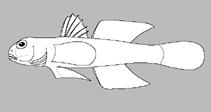 No image available for this species;
drawing shows typical species in Gobiidae.
Google Bild
drawing shows typical species in Gobiidae.
Klassifizierung / Names Namen | Synonyme | Catalog of Fishes(Gattung, Arten) | ITIS | CoL | WoRMS | Cloffa
> Gobiiformes (Gobies) > Gobiidae (Gobies) > Gobiinae
Etymology: Didogobius: From Dido, queen of Carthage who killed herself when abandoned by Aeneas; Greek, mithology; lanceolatus: Name from Latin 'lanceola', a diminutive term of lancea, meaning 'lancet', i.e. a small lancet. referring to the lancet-shaped caudal fin of the new species, a character shared in the iChromogobius-Didogobius species complex only shared with the type species of the genusD. bentuvii.
Eponymy: Dido was a princess of Tyre (in modern-day Lebanon), who sailed the eastern Mediterranean (where D. bentuvii occurs) to found the city of Carthage and become its first queen. She is particularly noted for her role in Virgil’s Aeneid. (Ref. 128868), visit book page.
Etymology: Didogobius: From Dido, queen of Carthage who killed herself when abandoned by Aeneas; Greek, mithology; lanceolatus: Name from Latin 'lanceola', a diminutive term of lancea, meaning 'lancet', i.e. a small lancet. referring to the lancet-shaped caudal fin of the new species, a character shared in the iChromogobius-Didogobius species complex only shared with the type species of the genusD. bentuvii.
Eponymy: Dido was a princess of Tyre (in modern-day Lebanon), who sailed the eastern Mediterranean (where D. bentuvii occurs) to found the city of Carthage and become its first queen. She is particularly noted for her role in Virgil’s Aeneid. (Ref. 128868), visit book page.
Umwelt: Milieu / Klimazone / Tiefenbereich / Verbreitungsgebiet Ökologie
seewasser benthopelagisch; tiefenbereich ? - 30 m (Ref. 130223). Tropical
Verbreitung Territorien | FAO Gebiete | Ökosysteme | Vorkommen | Punkt Karte | Einführungen | Faunafri
Eastern Central Atlantic: Mauritania.
Größe / Gewicht / Alter
Kurzbeschreibung Bestimmungsschlüssel | Morphologie | Morphometrie
Rückenflossenstacheln (insgesamt) : 7; Rückenflossenweichstrahlen (insgesamt) : 13; Afterflossenstacheln: 1; Afterflossenweichstrahlen: 11; Wirbelzahl: 27. This species is distinguished from all currently described members of the genera Didogobius, Chromogobius, Marcelogobius and Peter, by the following set of characters: caudal fin lanceolate; eyes small or reduced (vs. large eyes); vertebrae 27; D2 I,13, A I,11; predorsal region is in front of D1 naked; body squamation reduced, with only a few cycloid scales anteriorly and in tail region; with anterior oculoscapular canal with only pores ?,??,??,??; posterior oculascapular and preopercular head canal are absent; suborbital row 7 with more than five papillae; suborbital rows 2 and 4 close to orbit (Ref. 130223).
Cross section: oval.
Cross section: oval.
Like other members of the subfamily Gobiinae, this species has a cryptobenthic lifestyle, living at least temporarily sheltered in soft sediment burrows. Its discovery was accidental after being collected with (silty) mud The sediment sample contained agglutinated worm tubes and shells of Atrina chautardi. Live associated fauna comprised a second unidentified fish species and beyond abundant polychaetes, gastropods, bivalves, amphipods and shrimps. A potential burrow-dwelling lifestyle might provide shelter against predators on this relatively flat seafloor lacking any hard substrates (Ref. 130223).
Lebenszyklus und Paarungsverhalten Geschlechtsreife | Fortpflanzung | Ablaichen | Eier | Fruchtbarkeit | Larven
Hauptreferenz
Laden Sie Ihre Referenzen hoch | Referenzen | Koordinator | Partner
Schliewen, U.K., A.H. Knorrn, R. Böhmer, L. Beuck, M. Sonnewald and A. Freiwald, 2023. Didogobius lanceolatus sp. nov., a new goby species from Mauritania, with diagnoses for two new gobiine genera. Spixiana (München) 46(1):119-133. (Ref. 130223)
IUCN Rote Liste Status (Ref. 130435: Version 2025-2 (Global))
Daten mangelhaft (DD) ; Date assessed: 16 February 2024
CITES
Not Evaluated
Bedrohung für Menschen
Harmless
Nutzung durch Menschen
FAO - Publication: search | FishSource |
Mehr Information
Trophische Ökologie
Lebensmittel (Beutetiere)
Nahrungszusammensetzung
Nahrungsaufnahme
Lebensmittelrationen
Räuber
Lebensmittel (Beutetiere)
Nahrungszusammensetzung
Nahrungsaufnahme
Lebensmittelrationen
Räuber
Ökologie
Ökologie
Ökologie
Populationsdynamik
Wachstumsparameter
Max. Alter/Größen
Länge-Gewicht-Rel.
Länge-Länge-Verhältnis.
Längenhäufigkeiten
Massenkonvertierung
Rekrutierung
Dichte
Wachstumsparameter
Max. Alter/Größen
Länge-Gewicht-Rel.
Länge-Länge-Verhältnis.
Längenhäufigkeiten
Massenkonvertierung
Rekrutierung
Dichte
Lebenszyklus
Fortpflanzung
Geschlechtsreife
Reifung/Kiemen rel.
Fruchtbarkeit
Ablaichen
Laichaggregationen
Eier
Eientwicklung
Larven
Larven Pop.Dyn.
Fortpflanzung
Geschlechtsreife
Reifung/Kiemen rel.
Fruchtbarkeit
Ablaichen
Laichaggregationen
Eier
Eientwicklung
Larven
Larven Pop.Dyn.
Anatomie
Kiemenoberfläche
Gehirn
Otolith
Kiemenoberfläche
Gehirn
Otolith
Physiologie
Körperliche Zusammensetzung
Nährstoffe
Sauerstoffverbrauch
Schwimmart
Schwimmgeschwindigkeit
Visuelle Pigmente
Fischgeräusche
Krankheiten und Parasiten
Toxizität (LC50s)
Körperliche Zusammensetzung
Nährstoffe
Sauerstoffverbrauch
Schwimmart
Schwimmgeschwindigkeit
Visuelle Pigmente
Fischgeräusche
Krankheiten und Parasiten
Toxizität (LC50s)
Genetik
Genom
Genetik
Heterozygotie
Vererbbarkeit
Genetische Vielfalt
Genom
Genetik
Heterozygotie
Vererbbarkeit
Genetische Vielfalt
Menschenbezogen
Aquakultur-Systeme
Aquakultur Profile
Zuchtlinien
Ciguatera-Fälle
Briefmarken, Münzen, Verschiedenes.
Aquakultur-Systeme
Aquakultur Profile
Zuchtlinien
Ciguatera-Fälle
Briefmarken, Münzen, Verschiedenes.
Tools
Zusatzinformationen
Download XML
Zusammenfassung | Punktdaten | Namen | Photos
Internet Quellen
AFORO (otoliths) | Aquatic Commons | BHL | Cloffa | Websites from users | FishWatcher Einträge suchen | CISTI | Catalog of Fishes: Gattung, Arten | DiscoverLife | ECOTOX | FAO - Publication: search | Faunafri | Fishipedia | Fishtrace | GloBI | Google Books | Google Scholar | Google | IGFA World Record | OneZoom | Open Tree of Life | Otolith Atlas of Taiwan Fishes | PubMed | Reef Life Survey | Socotra Atlas | TreeBase | Tree of Life | Wikipedia: Gehe zu, Suchen | World Records Freshwater Fishing | Zoobank | Zoologischer Rekord
Schätzungen auf der Grundlage von Modellen
Phylogenetischer Diversitätsindex (Ref. 82804): PD50 = 0.5625 [Uniqueness, from 0.5 = low to 2.0 = high].
Bayesian length-weight: a=0.01023 (0.00477 - 0.02194), b=3.01 (2.83 - 3.19), in cm total length, based on LWR estimates for this (Sub)family-body shape (Ref. 93245).
Trophische Ebene (Ref. 69278): 3.3 ±0.3 se; based on size and trophs of closest relatives
Widerstandsfähigkeit (Ref. 120179): hoch, Verdopplung der Population dauert weniger als 15 Monate. (Preliminary K or Fecundity.).