



Chiloglanis msirii Kashindye, Katemo Manda, Friel, Chakona & Vreven, 2021
Envoyez vos Photos et vidéos
Images Google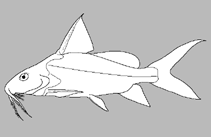 No image available for this species;
drawing shows typical species in Mochokidae.
Images Google
drawing shows typical species in Mochokidae.
Classification / Noms Noms communs | Synonymes | Catalog of Fishes(Genre, Espèce) | ITIS | CoL | WoRMS | Cloffa
> Siluriformes (Catfishes) > Mochokidae (Squeakers or upside-down catfishes) > Chiloglanidinae
Etymology: Chiloglanis: Greek, cheilos = lip + Greek, glanis = a fish that can eat the bait without touching the hook; a cat fish (Ref. 45335); msirii: The species name is dedicated to King Mwenda Msiri Ngelengwa (1830-1891); he founded and ruled the Yeke Kingdom of south-east Katanga, now DRC, from about 1856 to 1891 and was murdered for resisting Belgian colonial rule in his area; it is dedicated to the King Msiri in acknowledgement and in honour of his service and defence of the integrity of his people (Ref. 128503).
Etymology: Chiloglanis: Greek, cheilos = lip + Greek, glanis = a fish that can eat the bait without touching the hook; a cat fish (Ref. 45335); msirii: The species name is dedicated to King Mwenda Msiri Ngelengwa (1830-1891); he founded and ruled the Yeke Kingdom of south-east Katanga, now DRC, from about 1856 to 1891 and was murdered for resisting Belgian colonial rule in his area; it is dedicated to the King Msiri in acknowledgement and in honour of his service and defence of the integrity of his people (Ref. 128503).
Environnement : milieu / zone climatique / profondeur / gamme de distribution Écologie
; eau douce benthopélagique; pH range: 7.3 - 8.2; profondeur 0 - 1 m (Ref. 128503). Tropical; 24°C - 27°C (Ref. 128503)
Distribution Territoires | Zones FAO | Écosystèmes | Occurrences | Carte par point | Introductions | Faunafri
Africa: Democratic Republic of the Congo.
Taille / Poids / Âge
Description synthétique Clés d'identification | Morphologie | Morphométrie
Épines dorsales (Total) : 2; Rayons mous dorsaux (Total) : 5; Épines anales: 0; Rayons mous anaux: 10 - 12; Vertèbres: 33 - 36. Diagnosis: Chiloglanis msirii can be distinguished from its congeners in the Congo basin by the following unique combination of characters: an oral disc without a mid-ventral cleft, vs. an oral disc with a well-developed mid-ventral cleft in C. asymetricaudalis, C. angolensis, C. carnosus, C. congicus, C. igamba, C. kalambo, C. kazumbei, C. lufirae, C. lukugae, C. macropterus, C. marlieri, C. micropogon, C. microps, C. orthodontus, C. pojeri, C. productus, C. reticulatus, C. ruziziensis, and shallow mid-ventral cleft in C. elisabethianus (Ref. 128503). Outside the Congo basin, C. msirii can be distinguished from all its congeners from southern Africa, except for C. swierstrai, by the following unique combination of characters: an oral disc without a mid-ventral cleft, vs. an oral disc with a well-developed mid-ventral cleft in C. anoterus, C. bifurcus, C. fasciatus, C. neumanni and C. paratus; and a forked caudal fin without apparent sexual dimorphism, vs. emarginate in both sexes in C. emarginatus and C. pretoriae (Ref. 128503). Finally, C. msirii can be distinguished from the most similar species, C. swierstrai, by a relatively robust body with few total number of vertebrae, 33-36, vs. a more slender body with a higher number of total vertebrae, 37-40; its relatively large body width at the pectoral-fin insertion, 22.0-27.2% of standard length vs. more slender, 17.3-20.3% of standard length; its deep caudal peduncle, 10.2-12.9% of standard length, vs. shallower, 8.3-9.8% of standard length; its long predorsal length, 34.4-41.8% of standard length, vs. shorter, 30.6-34.7% of standard length; and its long prepelvic length, 51.8-59.8% of standard length, vs. shorter, 46.1-51.9% of standard length (Ref. 128503).
Cycle de vie et comportement reproducteur Maturité | Reproduction | Frai | Œufs | Fécondité | Larves
Référence principale
Téléchargez vos références | Références | Coordinateur | Collaborateurs
Kashindye, B.B., B. Katemo Manda, J.P. Friel, A. Chakona and E. Vreven, 2021. Chiloglanis msirii, a new species of African suckermouth catfish (Teleostei: Mochokidae), from the Upper Congo basin. Ichthyol. Explor. Freshwaters 31(1):33-46. (Ref. 128503)
CITES
Not Evaluated
Menace pour l'homme
Harmless
Utilisations par l'homme
Pêcheries: sans intérêt
FAO - Publication: search | FishSource |
Plus d'informations
Écologie trophique
Aliments (proies)
Composition du régime alimentaire
Consommation alimentaire
Rations alimentaires
Prédateurs
Aliments (proies)
Composition du régime alimentaire
Consommation alimentaire
Rations alimentaires
Prédateurs
Dynamique des populations
Paramètres de croissance
Âges / tailles maximales
Longueur-poids rel.
Rel. longueur-longueur.
Fréquences de longueurs
Conversion de masse
Recrutement
Abondance
Paramètres de croissance
Âges / tailles maximales
Longueur-poids rel.
Rel. longueur-longueur.
Fréquences de longueurs
Conversion de masse
Recrutement
Abondance
Cycle de vie
Reproduction
Maturité
Maturité/épines rel.
Fécondité
Frai
Agrégats de frai
Œufs
Développement de l'œuf
Larves
Dynamique des populations larvaires
Reproduction
Maturité
Maturité/épines rel.
Fécondité
Frai
Agrégats de frai
Œufs
Développement de l'œuf
Larves
Dynamique des populations larvaires
Anatomie
Surface branchiale
Cerveau
Otolithe
Surface branchiale
Cerveau
Otolithe
Physiologie
Composition corporelle
Nutriments
Consommation d'oxygène
Type de natation
Vitesse de nage
Pigments visuels
Son de poisson
Maladies et parasites
Toxicité (CL50)
Composition corporelle
Nutriments
Consommation d'oxygène
Type de natation
Vitesse de nage
Pigments visuels
Son de poisson
Maladies et parasites
Toxicité (CL50)
Génétique
génôme
Génétique
Hétérozygotie
Héritabilité
Diversité génétique
génôme
Génétique
Hétérozygotie
Héritabilité
Diversité génétique
Liées à l'homme
Systèmes d'aquaculture
Profils d'aquaculture
Souches
Cas de ciguatera
Timbres, pièces de monnaie, divers
Systèmes d'aquaculture
Profils d'aquaculture
Souches
Cas de ciguatera
Timbres, pièces de monnaie, divers
Outils
E-book | Guide de terrain | Générateur de fréquences de longueur | Outil de dynamique de population | Carte par point |
Capture-MSY |
Articles particuliers
Télécharger en XML
Sources Internet
AFORO (otoliths) | Aquatic Commons | BHL | Cloffa | Websites from users | FishWatcher | CISTI | Catalog of Fishes: Genre, Espèce | DiscoverLife | ECOTOX | FAO - Publication: search | Faunafri | Fishipedia | Fishtrace | GloBI | Google Books | Google Scholar | Google | IGFA World Record | OneZoom | Open Tree of Life | Otolith Atlas of Taiwan Fishes | PubMed | Reef Life Survey | Socotra Atlas | TreeBase | Arbre de Vie | Wikipedia: aller à, chercher | | Zoobank | Zoological Record
Estimations basées sur des modèles
|
Indice de diversité phylogénétique (Réf. 82804) |
PD50 = 0.5000 [Uniqueness, from 0.5 = low to 2.0 = high]. |
| Bayesian length-weight | a=0.00389 (0.00180 - 0.00842), b=3.12 (2.94 - 3.30), in cm total length, based on all LWR estimates for this body shape (Ref. 93245). |
|
Niveau trophique (Réf. 69278) |
3.2 ±0.4 se; based on size and trophs of closest relatives |
|
Résilience (Réf. 120179) |
Haut, temps minimum de doublement de population inférieur à 15 mois (Preliminary K or Fecundity.). |
|
Vulnérabilité de la pêche (Ref. 59153) |
Low vulnerability (10 of 100). 🛈 |