



Hochladen Photos und videos
Google Bild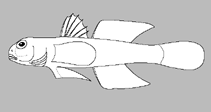 No image available for this species;
drawing shows typical species in Gobiidae.
Google Bild
drawing shows typical species in Gobiidae.
Klassifizierung / Names Namen | Synonyme | Catalog of Fishes(Gattung, Arten) | ITIS | CoL | WoRMS | Cloffa
> Gobiiformes (Gobies) > Gobiidae (Gobies) > Gobiinae
Etymology: Psilotris: Greek, psilos = hairless + Greek, thrix = hair (Ref. 45335); laetarii: Named for Heath Jens Laetari (Ref. 113825).
Eponymy: Heath Jens Laetari (1978–2006) was Vice President of Dive Operations, Partner & Acquisition Manager for Dynasty Marine (a supplier of live Caribbean marine life), who was lost at sea during a free dive in the Florida Keys. [...] (Ref. 128868), visit book page.
Etymology: Psilotris: Greek, psilos = hairless + Greek, thrix = hair (Ref. 45335); laetarii: Named for Heath Jens Laetari (Ref. 113825).
Eponymy: Heath Jens Laetari (1978–2006) was Vice President of Dive Operations, Partner & Acquisition Manager for Dynasty Marine (a supplier of live Caribbean marine life), who was lost at sea during a free dive in the Florida Keys. [...] (Ref. 128868), visit book page.
Umwelt: Milieu / Klimazone / Tiefenbereich / Verbreitungsgebiet Ökologie
seewasser demersal; tiefenbereich 8 - ? m (Ref. 113825). Tropical
Verbreitung Territorien | FAO Gebiete | Ökosysteme | Vorkommen | Punkt Karte | Einführungen | Faunafri
Western Central Atlantic: Florida, USA.
Größe / Gewicht / Alter
Geschlechtsreife: Lm ? range ? - ? cm
Max length : 2.3 cm SL Männchen/unbestimmt; (Ref. 113825); 2.4 cm SL (female)
Max length : 2.3 cm SL Männchen/unbestimmt; (Ref. 113825); 2.4 cm SL (female)
Kurzbeschreibung Bestimmungsschlüssel | Morphologie | Morphometrie
Rückenflossenstacheln (insgesamt) : 8; Rückenflossenweichstrahlen (insgesamt) : 9 - 10; Afterflossenweichstrahlen: 7 - 8. This species can be distinguished by the following set of characters: D1 VII, without elongate spines; D2 I, 9-10; A I, 7-8; pelvic fins well separated, no anterior frenum, membrane connecting 5th pelvic-fin rays absent or very low; 5th pelvic ray unbranched and 1/2 length of fourth; no without fleshy tips in pelvic-fin; side of body and head without scales; no modified basicaudal scales present; papillae row 5s and 5i connected forming a single row, interorbital papillae row pc’ present; head and preopercle canals and pores absent; two anal-fin pterygiophores inserted anterior to haemal arch. Colouration: reticulating yellowish orange pattern on the body (Ref. 113825).
Cross section: oval.
Cross section: oval.
Found in back-reef rubble habitat. Collected from a sand and rubble (ca. 0.5-10.0 cm in diameter) substrate, 45-90 m from the gradual reef drop-off. Found in or near yellowhead jawfish (Opistognathus aurifrons) burrows. Although not a common species, this species is regularly seen from April to November, which is when jawfish are abundant (Ref. 113825).
Lebenszyklus und Paarungsverhalten Geschlechtsreife | Fortpflanzung | Ablaichen | Eier | Fruchtbarkeit | Larven
Hauptreferenz
Laden Sie Ihre Referenzen hoch | Referenzen | Koordinator | Partner
Tornabene, L., J.L. Van Tassel, D.R. Robertson and C.C. Baldwin, 2016. Molecular phylogeny, analysis of discrete character evolution, and submersible collections facilitate a new classification for a diverse group of gobies (Teleostei: Gobiidae: Gobiosomatini: Nes subgroup), with descriptions of nine new species. Zoological Journal of the Linnean Society 177(4):764-812. (Ref. 113825)
IUCN Rote Liste Status (Ref. 130435: Version 2025-2 (Global))
Daten mangelhaft (DD) ; Date assessed: 09 October 2018
CITES
Not Evaluated
Bedrohung für Menschen
Harmless
Nutzung durch Menschen
FAO - Publication: search | FishSource |
Mehr Information
Trophische Ökologie
Lebensmittel (Beutetiere)
Nahrungszusammensetzung
Nahrungsaufnahme
Lebensmittelrationen
Räuber
Lebensmittel (Beutetiere)
Nahrungszusammensetzung
Nahrungsaufnahme
Lebensmittelrationen
Räuber
Populationsdynamik
Wachstumsparameter
Max. Alter/Größen
Länge-Gewicht-Rel.
Länge-Länge-Verhältnis.
Längenhäufigkeiten
Massenkonvertierung
Rekrutierung
Dichte
Wachstumsparameter
Max. Alter/Größen
Länge-Gewicht-Rel.
Länge-Länge-Verhältnis.
Längenhäufigkeiten
Massenkonvertierung
Rekrutierung
Dichte
Lebenszyklus
Fortpflanzung
Geschlechtsreife
Reifung/Kiemen rel.
Fruchtbarkeit
Ablaichen
Laichaggregationen
Eier
Eientwicklung
Larven
Larven Pop.Dyn.
Fortpflanzung
Geschlechtsreife
Reifung/Kiemen rel.
Fruchtbarkeit
Ablaichen
Laichaggregationen
Eier
Eientwicklung
Larven
Larven Pop.Dyn.
Anatomie
Kiemenoberfläche
Gehirn
Otolith
Kiemenoberfläche
Gehirn
Otolith
Physiologie
Körperliche Zusammensetzung
Nährstoffe
Sauerstoffverbrauch
Schwimmart
Schwimmgeschwindigkeit
Visuelle Pigmente
Fischgeräusche
Krankheiten und Parasiten
Toxizität (LC50s)
Körperliche Zusammensetzung
Nährstoffe
Sauerstoffverbrauch
Schwimmart
Schwimmgeschwindigkeit
Visuelle Pigmente
Fischgeräusche
Krankheiten und Parasiten
Toxizität (LC50s)
Genetik
Genom
Genetik
Heterozygotie
Vererbbarkeit
Genetische Vielfalt
Genom
Genetik
Heterozygotie
Vererbbarkeit
Genetische Vielfalt
Menschenbezogen
Aquakultur-Systeme
Aquakultur Profile
Zuchtlinien
Ciguatera-Fälle
Briefmarken, Münzen, Verschiedenes.
Aquakultur-Systeme
Aquakultur Profile
Zuchtlinien
Ciguatera-Fälle
Briefmarken, Münzen, Verschiedenes.
Tools
Zusatzinformationen
Download XML
Zusammenfassung | Punktdaten | Namen | Photos
Internet Quellen
AFORO (otoliths) | Aquatic Commons | BHL | Cloffa | Websites from users | FishWatcher Einträge suchen | CISTI | Catalog of Fishes: Gattung, Arten | DiscoverLife | ECOTOX | FAO - Publication: search | Faunafri | Fishipedia | Fishtrace | GloBI | Google Books | Google Scholar | Google | IGFA World Record | OneZoom | Open Tree of Life | Otolith Atlas of Taiwan Fishes | PubMed | Reef Life Survey | Socotra Atlas | TreeBase | Tree of Life | Wikipedia: Gehe zu, Suchen | World Records Freshwater Fishing | Zoobank | Zoologischer Rekord
Schätzungen auf der Grundlage von Modellen
Phylogenetischer Diversitätsindex (Ref. 82804): PD50 = 0.5156 [Uniqueness, from 0.5 = low to 2.0 = high].
Bayesian length-weight: a=0.00741 (0.00347 - 0.01582), b=3.09 (2.91 - 3.27), in cm total length, based on LWR estimates for this (Sub)family-body shape (Ref. 93245).
Trophische Ebene (Ref. 69278): 3.1 ±0.3 se; based on size and trophs of closest relatives
Widerstandsfähigkeit (Ref. 120179): hoch, Verdopplung der Population dauert weniger als 15 Monate. (Preliminary K or Fecundity.).